SegWit Debate Explodes as Bitcoin’s Sacred No-Hard-Fork Norm Faces Rare Scrutiny
March 2025 – A foundational principle of Bitcoin’s development, the established preference for soft forks over hard forks, now faces its most significant reexamination in years. Consequently, the 2017 activation of Segregated Witness (SegWit) has returned to the forefront of technical discourse. This renewed SegWit debate questions long-held governance norms, explores the technical limits of soft forks, and critically reassesses Bitcoin’s long-term scaling model. Developers and community members are engaging in a profound analysis of the path taken eight years ago.
The SegWit Debate and Bitcoin’s Governance Crossroads
Segregated Witness, activated in August 2017, remains one of Bitcoin’s most consequential protocol upgrades. It solved transaction malleability and effectively increased block capacity. Crucially, developers implemented it as a soft fork. This method maintained backward compatibility, avoiding a chain split. However, recent discussions among core developers and researchers challenge the narrative that this was the only or optimal path. The central question is whether the soft-fork-only doctrine imposes unacceptable long-term constraints.
Also read: Bitcoin's Four-Year Cycle Is Dead, Declares Michael Saylor in Stunning Shift
Several key issues fuel the current debate. First, proponents of reexamination argue that soft forks inherently increase protocol complexity. They create additional technical debt. Second, critics question if soft forks can adequately address future scaling needs beyond layer-two solutions like the Lightning Network. Finally, the debate touches on philosophical governance. It asks whether a reflexive aversion to hard forks stifles necessary evolution.
Technical Limits and the Soft Fork Complexity Argument
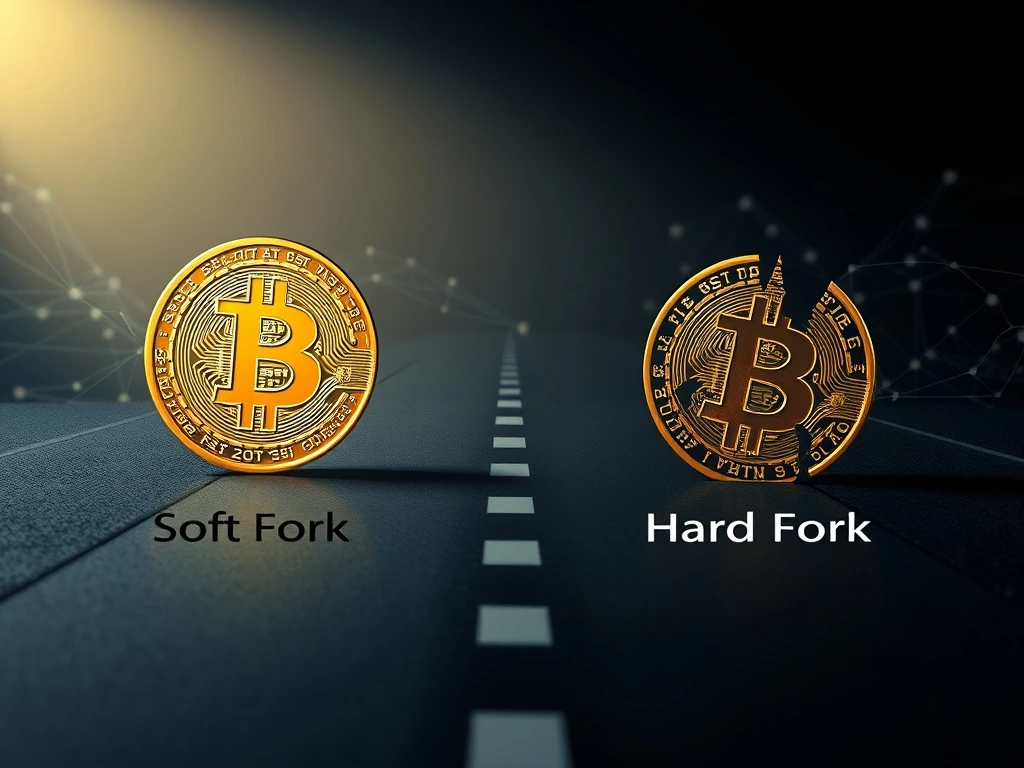
Technically, a soft fork tightens the network’s rules. Old nodes still see new blocks as valid. Conversely, a hard fork loosens rules, requiring all nodes to upgrade. The 2017 SegWit implementation used a clever soft-fork mechanism. Yet, this introduced certain complexities. For instance, it created a distinction between witness data and transaction data. Some developers now contend that a well-coordinated hard fork could have achieved similar goals with cleaner code.
Also read: Pi Network Surpasses 526 Million KYC Validations in Stunning User Verification Drive
Prominent Bitcoin educator Andreas M. Antonopoulos has historically explained that soft forks prioritize network unity. However, in recent developer mailing list discussions, voices like Blockstream researcher Dr. Jonas Nick have pointed to the “layered complexity” of successive soft forks. They suggest this could hinder future innovation. The table below contrasts the core implications of each upgrade method:
| Aspect | Soft Fork | Hard Fork |
|---|---|---|
| Backward Compatibility | Yes | No |
| Risk of Chain Split | Low | High |
| Protocol Complexity | Can increase | Often cleaner |
| Governance Requirement | High miner coordination | Broad ecosystem consensus |
| Implementation Speed | Slower, more cautious | Potentially faster |
Expert Perspectives on Historical and Future Paths
Historical context is vital. The 2017 period witnessed the Bitcoin Cash hard fork. This event created a lasting community schism. Therefore, the choice for a SegWit soft fork was partly a social compromise. It aimed to preserve network cohesion. Bitcoin Core developer Greg Maxwell advocated strongly for the soft-fork approach at the time. He emphasized minimizing disruption for users and businesses.
Today, the conversation is more nuanced. Researchers like Dr. Alyssa Blackburn from MIT’s Digital Currency Initiative note that the ecosystem has matured. She suggests that sophisticated institutional players now run coordinated nodes. Consequently, the logistical challenge of a safe hard fork may be reduced. However, the political and social hurdles remain immense. The debate is no longer purely technical. It is increasingly about the social contract of Bitcoin’s evolution.
Scaling Model and the Long-Term Vision
The SegWit debate directly impacts Bitcoin’s scaling roadmap. SegWit enabled the Lightning Network. This layer-two solution handles micropayments off-chain. The current “soft-fork-first” model strongly favors this layered scaling approach. Yet, some developers question if this model can support global adoption alone. They point to potential needs for base-layer adjustments in a decade.
Key considerations for the future scaling model include:
- Block Size: Could a future hard fork adjust block size more simply than another soft fork?
- Scripting Flexibility: Might hard forks enable more powerful smart contract capabilities?
- Technical Debt: Does accumulating soft-fork code ultimately threaten security auditability?
These questions lack immediate answers. However, their emergence signals a shift. The community is thinking decades ahead. It is preparing for scenarios where the current norms may require reevaluation.
Conclusion
The reignited SegWit debate represents a healthy maturation of Bitcoin’s governance dialogue. It moves beyond the heated rhetoric of 2017. Instead, it engages in a sober analysis of technical trade-offs and long-term sustainability. While a sudden shift away from the soft-fork norm is unlikely, this scrutiny is essential. It ensures that Bitcoin’s upgrade path remains resilient, secure, and capable of meeting future demands. Ultimately, this debate strengthens the protocol by challenging its own assumptions. The SegWit debate, therefore, is not about revisiting the past. It is about rigorously planning for the future.
FAQs
Q1: What is the main reason the SegWit debate is resurfacing now?
Developers are conducting long-term protocol reviews. They are questioning whether the complexity of multiple soft forks could eventually hinder innovation or security. The maturity of the ecosystem also allows for more theoretical discussion of previously taboo topics.
Q2: Does this debate mean Bitcoin will have a hard fork soon?
No. This is primarily a theoretical and strategic discussion. A hard fork requires overwhelming consensus. Currently, no specific hard fork proposal is on the table. The debate is about evaluating the principle, not executing a change.
Q3: What was the key benefit of implementing SegWit as a soft fork in 2017?
The primary benefit was avoiding a permanent chain split. It allowed the upgrade to proceed without forcing all users and businesses to update their software immediately. This preserved network unity during a highly contentious period.
Q4: How does this debate affect ordinary Bitcoin users or investors?
In the short term, it has no direct impact. The debate occurs within technical and research circles. In the long term, its outcome could influence how smoothly and securely Bitcoin can implement future upgrades, which affects the network’s utility and value proposition.
Q5: What is the difference between a “soft fork” and a “hard fork” in simple terms?
A soft fork is a backward-compatible upgrade; old software still recognizes new blocks as valid. A hard fork is a non-backward-compatible upgrade; it creates a permanent divergence, and old software will reject new blocks, potentially creating two separate blockchains.

This article was produced with AI assistance and reviewed by our editorial team for accuracy and quality.