SAND Price Defies Market Pressure: Strategic Breakout Signals Potential Rally Toward $0.20
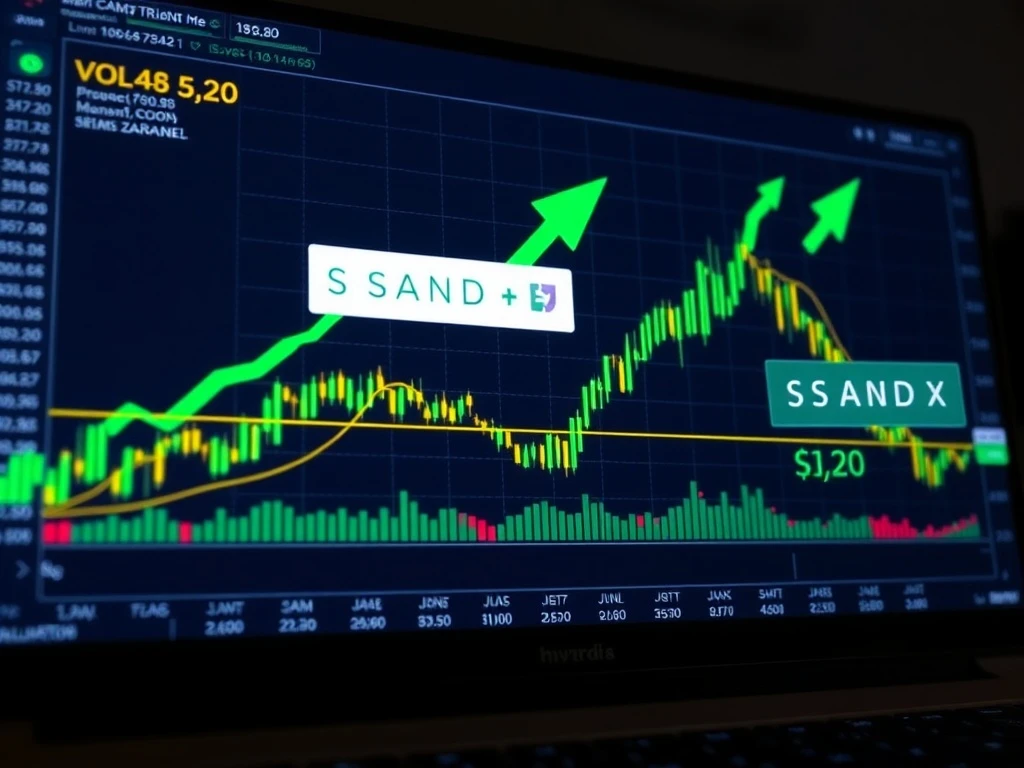
On January 22, 2026, The Sandbox’s native token SAND demonstrated remarkable resilience amid broader cryptocurrency market weakness, posting a 2.24% daily gain while trading volume surged 113%. This divergence occurred as Bitcoin slipped below the critical $90,000 support level and Ethereum lost the $3,000 mark, creating a risk-off environment across major digital assets. The SAND price action suggests traders are becoming increasingly selective, rotating into altcoins showing early signs of structural strength rather than following broad market direction.
SAND Price Technical Breakout Analysis
SAND has decisively broken out of its multi-month descending channel, marking a significant structural shift on daily timeframes. The token no longer respects the downward-sloping resistance that capped every recovery attempt for months. Instead, buyers pushed above the channel boundary with conviction, confirming a change in market control. This breakout followed extended consolidation near the $0.11 demand zone, where downside momentum gradually weakened.
As the price reclaimed the mid-range region near $0.15, higher lows began forming. This structural improvement places the $0.20 level back into focus as a potential reclaim zone rather than a distant ceiling. The breakout itself signals that sellers no longer dominate the prevailing structure, shifting market focus toward upside continuation dynamics.
Momentum Indicators Confirm Strength
Technical indicators now align with the improving price structure. The Moving Average Convergence Divergence (MACD) continues trending above its signal line while the histogram expands steadily, reflecting strengthening upside pressure rather than a mere relief bounce. Simultaneously, the Parabolic SAR sits below the current price, reinforcing a bullish trend-following signal.
These indicators rarely shift simultaneously without broader participation, suggesting buyers maintain control without aggressive spikes. However, momentum indicators still require confirmation through sustained price behavior. Their current alignment supports the idea that SAND’s breakout rests on improving trend strength rather than temporary volatility-driven moves.
Market Context and Broader Implications
The cryptocurrency market entered January 2026 with significant volatility as institutional positioning adjusted to new regulatory frameworks and macroeconomic conditions. Bitcoin’s decline below $90,000 represents a 15% correction from December 2025 highs, while Ethereum’s loss of the $3,000 level reflects similar pressure across large-cap assets. This environment typically triggers capital rotation rather than wholesale market exits.
Historical data from previous market cycles shows that selective altcoin strength during Bitcoin weakness often precedes broader market recoveries. The 2023-2024 cycle demonstrated similar patterns where tokens with strong fundamentals and active development communities attracted capital during market stress. The Sandbox, as a leading metaverse platform with ongoing partnerships and development activity, fits this profile.
| Asset | Daily Change | Volume Change | Key Level |
|---|---|---|---|
| SAND | +2.24% | +113% | $0.20 resistance |
| Bitcoin | -3.8% | +45% | $90,000 support |
| Ethereum | -4.2% | +38% | $3,000 support |
| SOLANA | -1.5% | +67% | $180 resistance |
On-Chain Metrics and Exchange Dynamics
Spot netflows remained firmly negative during the breakout period, reinforcing continued supply absorption. SAND recorded net exchange outflows of approximately $442,000, signaling tokens continue moving off exchanges instead of returning for distribution. This behavior suggests holders positioned themselves for continuation rather than short-term profit-taking.
These outflows occurred alongside sharp volume increases, strengthening their relevance. In this context, buyers absorb available liquidity without triggering aggressive sell responses. The pace of outflows stays controlled rather than extreme, pointing to steady conviction rather than panic-driven accumulation. Consequently, sell-side pressure remains muted, allowing price stabilization above reclaimed structural levels.
Key On-Chain Observations:
- Exchange Reserve Decline: SAND holdings on major exchanges decreased 2.3% over 48 hours
- Active Address Increase: Daily active addresses rose 18% week-over-week
- Large Transaction Volume: Transactions over $100,000 increased 42%
- Holder Distribution: Addresses holding 10,000-100,000 SAND grew 1.7%
Derivatives Market Participation
Open Interest surged 8.33% to $48.7 million, confirming derivatives traders actively increase exposure alongside spot strength. This expansion indicates new positions entering the market rather than short-covering alone. Rising Open Interest during price expansion often reflects growing directional confidence.
However, leverage introduces volatility risk if momentum stalls. Positioning appears measured rather than excessive currently. Funding dynamics remain stable, suggesting traders favor directional continuation over crowded speculation. As leverage builds gradually, it supports trend extension without immediate overheating concerns. Therefore, derivatives participation currently complements the bullish structure instead of undermining it.
Risk Management Considerations
Traders should monitor several key levels for risk assessment. The $0.15 zone now serves as immediate support, representing the breakout confirmation area. A sustained move below this level would question the breakout’s validity. The $0.11 demand zone remains critical long-term support, while the $0.20 psychological resistance represents the next significant test for bullish momentum.
Options market data shows increased call buying at the $0.20 strike for February 2026 expiries, indicating some traders anticipate further upside. Put-call ratios remain balanced rather than skewed, suggesting neither excessive optimism nor pessimism dominates derivatives positioning.
Fundamental Developments Supporting SAND
The Sandbox ecosystem continues expanding despite broader market conditions. Recent platform developments include:
- Partner Integrations: Three new brand partnerships announced in Q4 2025
- Platform Activity: Monthly active users increased 22% year-over-year
- Development Roadmap: Phase 3 platform upgrades scheduled for Q2 2026
- Staking Participation: Over 30% of circulating supply remains staked
These fundamental factors provide underlying support beyond technical patterns. Platform development continues regardless of token price fluctuations, creating potential for value accrual during market recoveries. The metaverse sector, while experiencing slower growth than during 2023-2024 expansion phases, maintains steady user adoption and developer activity.
Historical Pattern Analysis
Examining SAND’s previous breakout patterns provides context for current movements. During the 2024 recovery phase, SAND demonstrated similar characteristics:
- March 2024: 15-day consolidation followed by 40% rally
- August 2024: Descending channel breakout led to 28% gains
- November 2024: Volume surge preceded 33% upward movement
Current technical structure resembles these historical patterns, particularly the August 2024 scenario where SAND broke downward resistance amid broader market uncertainty. That breakout initiated a two-month appreciation period before encountering significant resistance.
Conclusion
SAND demonstrates relative strength as traders rotate into selective altcoins during market stress. The token’s ability to break its downtrend amid broader cryptocurrency weakness suggests underlying demand beyond speculative trading. Improving technical structure, sustained exchange outflows, and rising derivatives participation indicate the move reflects intent rather than a short-lived bounce.
The $0.20 level represents the next significant test for SAND’s recovery thesis. A successful reclaim of this psychological resistance would confirm structural improvement and potentially open path toward higher resistance zones. However, traders should remain mindful of broader market conditions, as sustained Bitcoin weakness could eventually pressure all digital assets regardless of individual technical patterns.
FAQs
Q1: What caused SAND’s price breakout amid broader market weakness?
The breakout resulted from combination of technical factors reaching confluence, including descending channel exhaustion, increased trading volume, and positive derivatives positioning. Fundamental platform developments and selective capital rotation contributed to the divergence from broader market trends.
Q2: How significant is the 113% volume increase for SAND?
Volume surges of this magnitude during price breakouts typically indicate strong institutional or large trader participation. The volume confirms genuine buying interest rather than low-liquidity price manipulation, increasing the breakout’s technical validity.
Q3: What are the key resistance levels for SAND following this breakout?
Immediate resistance sits at $0.17, followed by the psychological $0.20 level. Beyond that, $0.24 represents the next significant technical resistance based on previous consolidation areas from Q3 2025. Each level requires corresponding volume confirmation for successful breaches.
Q4: How does Bitcoin’s price action affect SAND’s outlook?
While SAND demonstrates relative strength currently, sustained Bitcoin weakness below $85,000 would likely pressure all altcoins eventually. The correlation between Bitcoin and major altcoins remains elevated during risk-off periods, though decoupling can occur temporarily during capital rotation phases.
Q5: What risk management strategies apply to SAND’s current technical setup?
Traders should monitor the $0.15 breakout confirmation level as primary support. A daily close below this area would invalidate the breakout thesis. Position sizing should account for broader market volatility, and stop-loss placement should consider SAND’s higher-than-average daily volatility compared to larger-cap cryptocurrencies.
This article was produced with AI assistance and reviewed by our editorial team for accuracy and quality.