Strategic Pivot: Riot Platforms Shares Soar 11% After Bitcoin Sale Fuels Ambitious Texas AI Deal
In a bold strategic maneuver that captivated financial markets, Riot Platforms (NASDAQ: RIOT) witnessed its shares surge over 11% following the announcement of a major Texas land acquisition funded entirely by Bitcoin sales. This pivotal move, announced on Friday, January 17, 2025, from the company’s Castle Rock, Colorado headquarters, signals a profound transformation within the cryptocurrency mining sector as companies diversify beyond digital asset creation into high-value computing infrastructure.
Riot Platforms Executes Strategic Bitcoin Sale for Texas Expansion
The company executed a calculated divestment of approximately 1,080 Bitcoin (BTC), generating $96 million to fully finance the purchase of 200 acres of land in Rockdale, Texas. This transaction follows a larger strategic shift revealed last week, where Riot sold 1,818 BTC in December, totaling over $160 million in proceeds. Consequently, the company reported holding 18,005 BTC as of December 31, 2024, a reserve valued at approximately $1.7 billion at current prices. This capital reallocation represents a deliberate pivot from pure-play Bitcoin mining toward leveraging existing data center infrastructure for diversified applications, particularly artificial intelligence (AI) and high-performance computing (HPC).
Also read: Litecoin Price Tests Critical Support: Will the $43 Floor Hold for a 2026 Breakout?
The Rockdale Deal and AMD Partnership
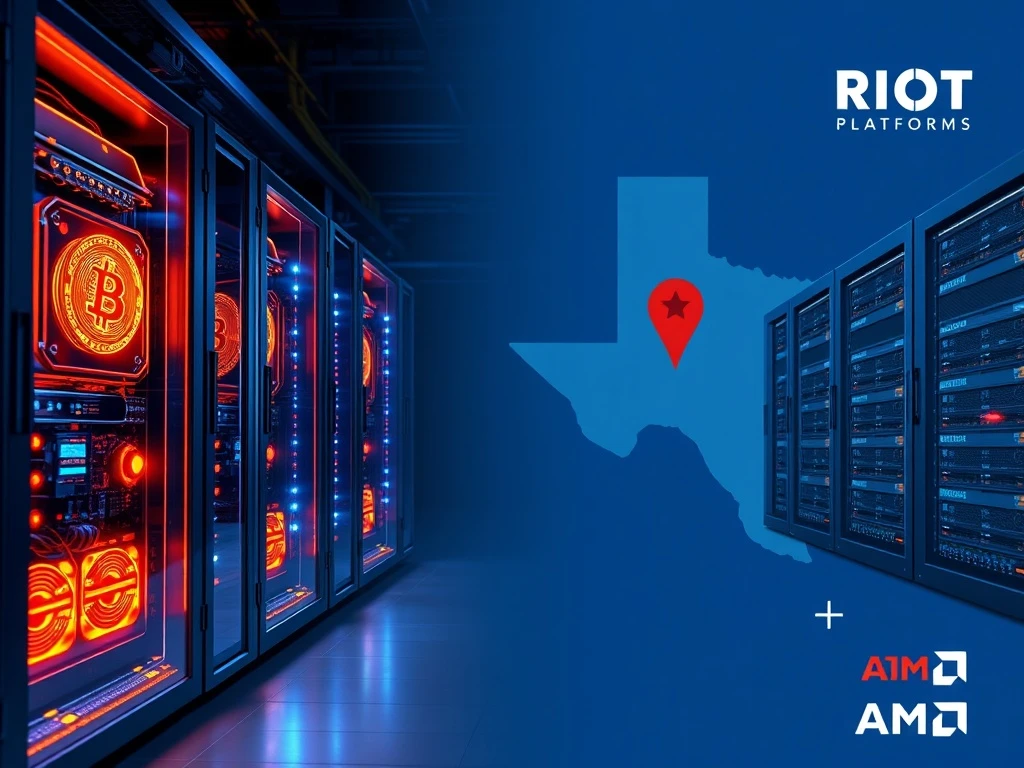
Simultaneously with the land acquisition, Riot Platforms announced a significant data center lease and services agreement with semiconductor giant Advanced Micro Devices (AMD). The initial phase involves deploying 25 megawatts (MW) of critical IT load capacity. CEO Jason Les described the agreement, structured with an initial 10-year term, as a “pivotal moment” that solidifies Riot’s position as a leading data center developer. The company projects this deal could generate about $311 million in revenue, with potential upside to $1 billion if all contractual extensions are exercised.
Industry-Wide Crypto Mining Pivot to AI Infrastructure
Riot’s strategy reflects a broader industry trend where Bitcoin mining companies are repurposing their substantial energy infrastructure and technical expertise. The increasing Bitcoin network difficulty and the post-halving economic landscape are compelling miners to seek additional revenue streams. Furthermore, the parallel demand for AI and HPC data processing creates a natural synergy, allowing these firms to monetize their power contracts and cooling systems year-round.
Also read: Dogecoin RSI Hits Historic Bottom Zone: Can the Meme Coin Recover?
Key drivers for this industry shift include:
- Infrastructure Synergy: Mining facilities require robust power, cooling, and connectivity—identical needs for AI data centers.
- Revenue Diversification: Mitigating Bitcoin’s price volatility with stable, long-term contract revenue.
- Capital Efficiency: Maximizing return on existing massive investments in electrical and real estate assets.
- Market Timing: Capitalizing on the explosive demand for AI training and inference workloads.
Competitive Landscape and Market Reaction
Riot is not alone in this strategic redirection. CleanSpark announced a similar move just days prior, securing 447 acres in Brazoria County, Texas, for a planned 300 MW data center designed for AI and HPC. Other major players like Marathon Digital Holdings (MARA), Core Scientific, Hut 8, and TeraWulf have also unveiled plans aligning with this technological convergence. The market reacted positively to Riot’s news, driving RIOT stock to $18.80, an 11% intraday gain that significantly outperformed the broader crypto sector. Analysts interpreted the move as a savvy redeployment of treasury assets into strategic, income-generating physical infrastructure.
| Company | Initiative | Location | Key Partner/ Focus |
|---|---|---|---|
| Riot Platforms | Land Acquisition & Data Center Lease | Rockdale, Texas | AMD / AI & HPC |
| CleanSpark | Land Purchase for Development | Brazoria County, Texas | AI & HPC Workloads |
| Core Scientific | Existing HPC Hosting Expansion | Multiple U.S. Sites | Diversified Computing |
| TeraWulf | Nuclear-Powered AI Compute | Pennsylvania | Sustainable HPC |
Financial and Operational Implications of the Strategy Shift
The decision to sell Bitcoin holdings to fund infrastructure expansion carries significant financial implications. By converting a volatile digital asset into income-generating real estate and long-term contracts, Riot aims to stabilize its cash flow and balance sheet. This approach provides a hedge against Bitcoin’s cyclicality while positioning the company in the high-growth AI sector. Operationally, the transition requires leveraging core competencies in large-scale facility management, power procurement, and thermal management—skills directly transferable to AI data center operations.
Expert Analysis on the Sector Transformation
Industry observers note that this trend represents the maturation of the cryptocurrency mining sector. “We are witnessing the logical evolution of industrial-scale miners,” stated a report from a leading financial institution that recently upgraded its price target for peer TeraWulf. “These companies built some of the world’s most sophisticated distributed computing and energy management systems. Applying that expertise to the AI revolution is a natural, value-accretive step.” The move also de-risks business models that were previously 100% correlated to Bitcoin’s price, potentially making these companies more attractive to a broader set of institutional investors.
Conclusion
Riot Platforms’ 11% stock surge following its Bitcoin-funded Texas deal underscores a critical inflection point for the cryptocurrency mining industry. The strategic sale of digital assets to finance physical infrastructure and lucrative partnerships, like the one with AMD, highlights a calculated shift toward diversification and sustainable growth. As Bitcoin mining economics evolve, leading companies are proactively repurposing their formidable infrastructure to capture value in the booming fields of artificial intelligence and high-performance computing. This Riot Platforms Bitcoin sale and subsequent expansion may well be remembered as a landmark case study in the sector’s successful adaptation and strategic pivoting.
FAQs
Q1: Why did Riot Platforms sell its Bitcoin?
Riot Platforms sold approximately 1,080 Bitcoin to generate $96 million in pure capital, which it used to fully fund the acquisition of 200 acres of land in Texas. This is part of a larger strategic shift to diversify its business model beyond Bitcoin mining into AI and high-performance computing data center infrastructure.
Q2: What is the significance of the deal with AMD?
The agreement with Advanced Micro Devices (AMD) is a 10-year data center lease and services deal. It provides Riot with a committed, long-term revenue stream by initially deploying 25 MW of computing capacity for AMD’s needs, potentially generating up to $311 million, with extensions possibly reaching $1 billion.
Q3: How did the stock market react to the news?
The market reacted very positively. Shares of Riot Platforms (RIOT) on the Nasdaq surged over 11% following the announcement, reaching $18.80. This indicates investor approval of the company’s strategy to diversify and build predictable future revenue.
Q4: Are other Bitcoin mining companies making similar moves?
Yes, this is a growing industry trend. CleanSpark, Core Scientific, Hut 8, and TeraWulf have all announced initiatives to expand into AI and HPC services. They are leveraging their existing expertise in energy management and large-scale computing infrastructure.
Q5: How much Bitcoin does Riot Platforms still own after these sales?
As of December 31, 2024, following the December and January sales, Riot Platforms reported holding 18,005 Bitcoin in its treasury. This remains one of the largest corporate Bitcoin holdings globally, valued at approximately $1.7 billion at current prices.

This article was produced with AI assistance and reviewed by our editorial team for accuracy and quality.