Qitmeer Network and ICBX Network Forge Unbreakable Alliance to Revolutionize Blockchain Security and Speed
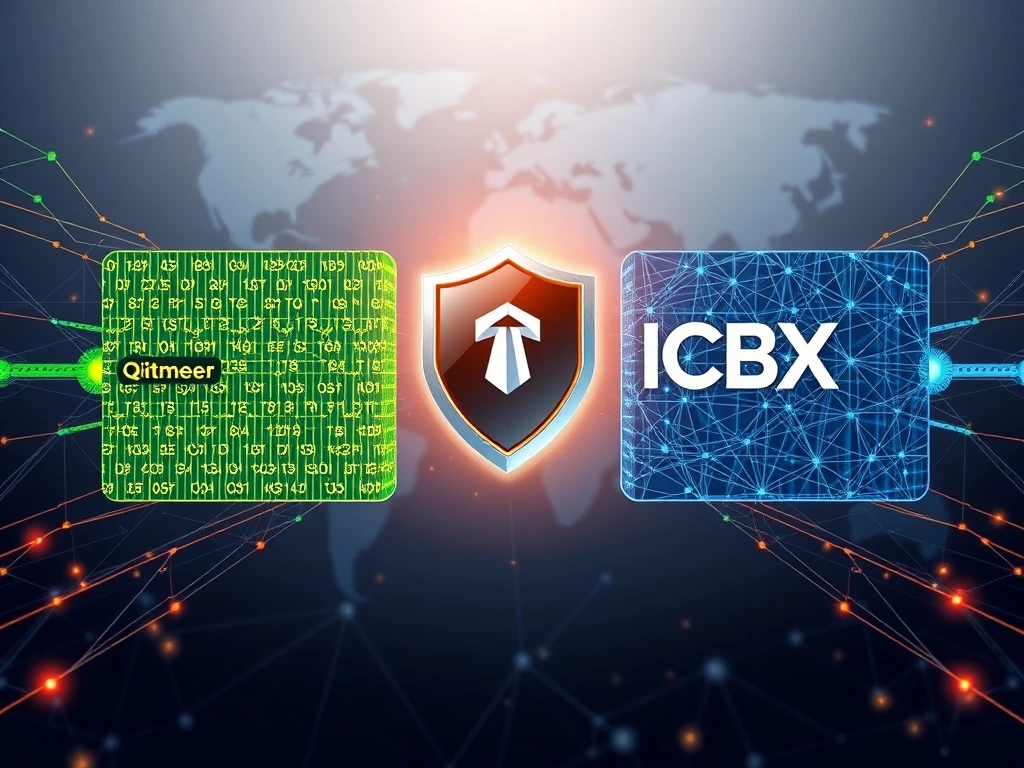
In a significant move for the decentralized technology sector, Qitmeer Network and ICBX Network have announced a powerful strategic alliance aimed at fundamentally strengthening blockchain security and transactional performance. This partnership, formalized in early 2025, directly addresses critical challenges facing the Web3 ecosystem, including scalability bottlenecks and persistent security vulnerabilities. Consequently, the collaboration merges Qitmeer’s reliable security-focused blockchain architecture with ICBX’s high-speed Directed Acyclic Graph (DAG) technology. The resulting alignment promises to deliver a more resilient and efficient foundation for decentralized applications and financial systems globally.
Qitmeer and ICBX Alliance: A Deep Dive into the Strategic Partnership
The core of this alliance involves a technical integration where ICBX Network’s DAG protocol will operate alongside Qitmeer’s blockchain. DAG technology, unlike traditional linear blockchains, allows for multiple chains of transactions to coexist and be confirmed simultaneously. This architecture inherently supports higher transaction throughput. Meanwhile, Qitmeer Network contributes its established security model, which is built upon a unique consensus mechanism emphasizing network integrity and resistance to common attacks. Together, they create a hybrid model designed for both speed and safety. Industry analysts view this as a pragmatic response to the trilemma of achieving decentralization, security, and scalability simultaneously. The partnership follows a six-month research and development phase where engineers from both teams validated the technical compatibility and teamwork of their respective systems.
Also read: Bitcoin ETP Flows Surge: Fidelity's Macro Chief Spots Critical Capital Rotation from Gold
The Technical Roadmap and Integration Timeline
The integration will proceed in three distinct phases throughout 2025. The initial phase, already underway, focuses on cross-protocol communication layers and shared security audits. Subsequently, the second phase will implement ICBX’s DAG as a high-speed sidechain or layer for specific transaction types on the Qitmeer ecosystem. Finally, the third phase aims for a fully interoperable environment where assets and data can move seamlessly between the two networks. This phased approach minimizes disruption and allows for continuous testing and optimization. Both networks have committed substantial developer resources to ensure a smooth rollout, with quarterly progress reports planned for the community.
Enhancing Blockchain Security with Advanced Protocols
Security remains the paramount concern in the blockchain space, especially for financial applications. Qitmeer Network’s architecture brings several proven security features to this alliance. Its consensus mechanism is designed to be resistant to 51% attacks, a significant threat to many proof-of-work networks. Furthermore, Qitmeer employs advanced cryptographic techniques for transaction validation and data integrity. The integration with ICBX does not dilute these features; instead, it extends them. The DAG structure from ICBX will inherit the security guarantees of the main Qitmeer chain through cryptographic anchoring. Essentially, checkpoints of the DAG’s state will be periodically recorded on the more secure, immutable Qitmeer blockchain. This creates a verifiable audit trail and prevents historical revision of transactions on the high-speed layer. The table below summarizes the key security enhancements:
Also read: BlockDAG's Defiant $0.000022 Presale Emerges as TRUMP Slumps and TAO Soars
| Security Feature | Source Network | Benefit to the Alliance |
|---|---|---|
| Attack-Resistant Consensus | Qitmeer Network | Provides foundational security for the entire hybrid system. |
| Cryptographic Data Anchoring | Joint Development | Ensures immutability of high-speed DAG transactions. |
| Multi-layered Validation | ICBX Network | Adds concurrent verification paths, reducing single points of failure. |
| Enhanced Node Incentives | Qitmeer Network | Promotes honest participation and long-term network health. |
Utilizing DAG Technology for Historic Transaction Speed
While security forms the bedrock, performance enables mainstream adoption. ICBX Network’s primary contribution is its sophisticated DAG technology. Traditional blockchains process transactions in sequential blocks, which creates a natural bottleneck. In contrast, a DAG allows transactions to be added asynchronously, linking to multiple previous transactions. This structure offers distinct advantages for the partnership:
- High Throughput: The network can theoretically process thousands of transactions per second (TPS), a necessity for global-scale applications.
- Low Latency: Transaction confirmation times drop significantly, improving user experience for payments and dApp interactions.
- Scalability: The network becomes faster as more participants use it, unlike some blockchains that congest under load.
- Low Cost: Efficient processing typically translates to lower transaction fees for end-users.
By integrating this DAG as a dedicated transaction layer, the alliance targets use cases like micropayments, real-time asset trading, and high-frequency data logging—all areas where conventional blockchains often struggle. The technical teams have already demonstrated a testnet achieving over 5,000 TPS while maintaining the security parameters defined by Qitmeer’s core protocol.
Real-World Impact on the Web3 Ecosystem
The implications of this partnership extend far beyond technical specifications. A more secure and performant infrastructure layer directly benefits developers and end-users. For developers, it reduces the complexity of building scalable dApps, as they can tap into the high-speed DAG for front-end interactions while relying on the secure blockchain for final settlement and value storage. For enterprises exploring blockchain for supply chain or data reconciliation, the combination of auditability and speed becomes highly compelling. Furthermore, the alliance could influence other projects to pursue similar hybrid architectures, potentially shifting industry design patterns toward more modular and optimized systems. This move is seen as a competitive response to other scaling solutions like layer-2 rollups and alternative consensus mechanisms, offering a distinct technological path.
Conclusion
The strategic alliance between Qitmeer Network and ICBX Network represents a calculated and impactful convergence of complementary technologies. By marrying Qitmeer’s emphasis on strong blockchain security with ICBX’s high-performance DAG technology, the partnership constructs a more resilient and capable foundation for the Web3 ecosystem. This collaboration directly tackles the core challenges of scalability and security that have hindered broader adoption. If successfully executed according to its 2025 roadmap, this integrated model could set a new standard for how blockchain networks achieve both trust and efficiency, ultimately empowering a new generation of decentralized applications.
FAQs
Q1: What is the primary goal of the Qitmeer and ICBX Network alliance?
The primary goal is to create a hybrid blockchain architecture that combines high-level security with high transaction speed. This aims to solve the blockchain trilemma by offering a more scalable, secure, and decentralized foundation for Web3 applications.
Q2: How does DAG technology differ from a traditional blockchain?
A traditional blockchain orders transactions in linear, sequential blocks. A Directed Acyclic Graph (DAG) allows transactions to be added in a parallel, web-like structure where each new transaction confirms multiple previous ones. This enables higher throughput and faster confirmations.
Q3: Will this partnership create a new cryptocurrency token?
As of the announcement, the partnership focuses on technical integration and infrastructure enhancement. There is no indication of a new joint token being launched. The networks will likely continue utilizing their existing native assets within the new interoperable framework.
Q4: What are the potential risks of such a technical integration?
Potential risks include integration complexity, unforeseen security vulnerabilities at the intersection of the two technologies, and the challenge of maintaining decentralization while optimizing performance. Both teams have adopted a phased rollout with extensive auditing to mitigate these risks.
Q5: How will this alliance benefit existing users of Qitmeer or ICBX?
Existing users can expect a future with lower transaction fees, faster confirmation times, and access to a broader ecosystem of decentralized applications. The enhanced security profile also provides greater protection for assets and data on both networks.

This article was produced with AI assistance and reviewed by our editorial team for accuracy and quality.