Neutral Interest Rate Reality: Powell’s Significant Admission on Unknowable Policy Guideposts
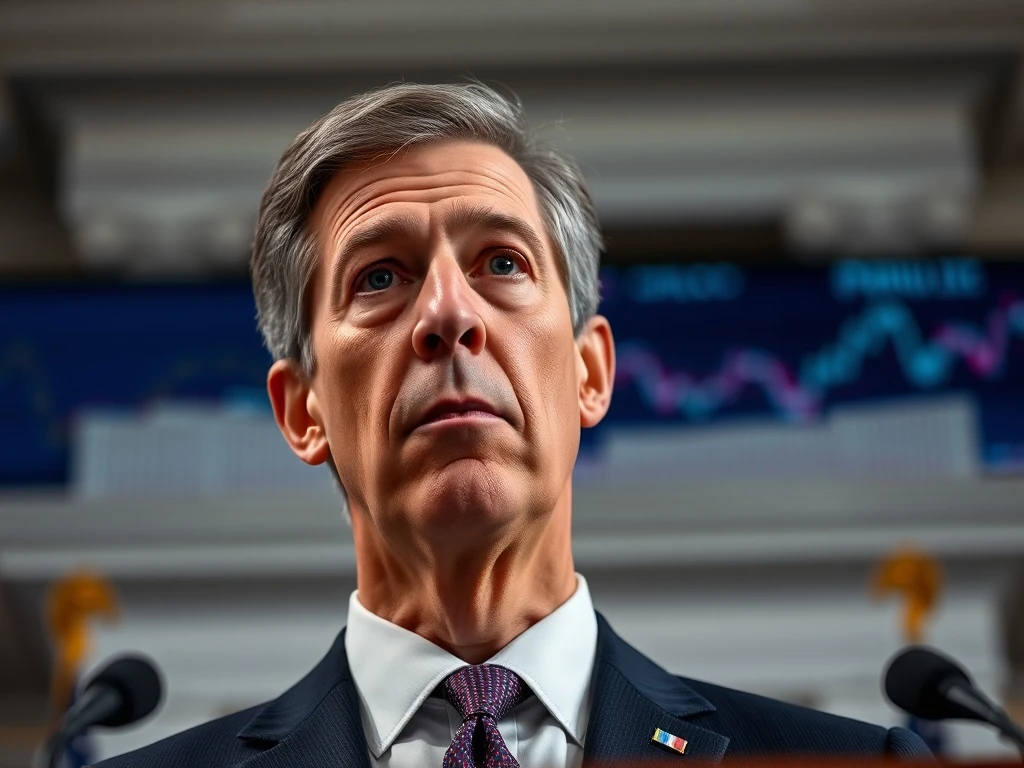
In a important statement from Washington D.C. that clarifies a fundamental limit of modern central banking, Federal Reserve Chair Jerome Powell asserted that the neutral interest rate cannot be precisely determined. This significant admission underscores the inherently uncertain framework guiding global monetary policy. Consequently, Powell reinforced that all Federal Reserve decisions remain strictly data-dependent, responding to evolving economic circumstances. Simultaneously, he provided critical context on trade policy, indicating that recent tariff pressures have likely peaked and may decline, barring new impositions.
The Elusive Nature of the Neutral Interest Rate
Chair Powell’s comments directly address a core concept in economics known as r* (r-star), or the neutral rate of interest. This theoretical rate neither stimulates nor restrains economic growth. However, Powell emphasized its fundamental indeterminacy. Economists cannot observe this rate directly in real-time data. Instead, they must infer it from noisy economic indicators, a process fraught with uncertainty. Therefore, policymakers cannot rely on a single, precise number. They must handle using a range of estimates and real-time economic signals.
Also read: Bitcoin Strategy Divide: GameStop's 4,710 BTC Hold Contrasts With Nation's Massive Sell-Off
This reality has profound implications. For years, market participants and analysts have sought a specific neutral rate to forecast Fed actions. Powell’s statement serves as a definitive reminder that such precision is unattainable. The Federal Reserve’s approach, as he outlined, is necessarily adaptive. The following table contrasts the theoretical concept with practical policy application:
| Theoretical Concept | Policy Reality (Per Powell) |
|---|---|
| A precise, knowable equilibrium rate | An unobservable range estimated with uncertainty |
| A fixed target for policy | A fluid guidepost that shifts with economic conditions |
| Allows for mechanical policy setting | Requires judgment-based, data-dependent decisions |
Historical context illuminates this challenge. Estimates of the neutral rate have drifted downward for decades due to factors like:
Also read: Bitcoin Volatility Dips Below Major Stocks as European Nation Sells Billions in Crypto Reserves
- Demographic shifts toward aging populations.
- Slower productivity growth across advanced economies.
- Heightened global demand for safe assets like U.S. Treasuries.
Powell’s acknowledgment validates a shift in Fed communication. It moves away from implying perfect knowledge toward embracing a framework of managed uncertainty.
Data-Dependence as the Core Policy Principle
With the neutral interest rate unknowable, Chair Powell placed paramount importance on the Fed’s data-dependent framework. Every monetary policy decision hinges on incoming information. Key data points include inflation reports, employment figures, and consumer spending data. The Federal Open Market Committee (FOMC) analyzes these metrics to assess whether current policy is too tight or too loose relative to the *estimated* neutral rate.
This approach requires constant vigilance and flexibility. For instance, if inflation readings persistently exceed the Fed’s 2% target, the committee might infer that policy is too accommodative. It would then likely adjust the federal funds rate accordingly. Conversely, a sudden weakening in the labor market could signal restrictive policy, prompting a different response. This reactive, rather than prescriptive, method is the operational consequence of Powell’s admission.
Expert Analysis on Policy Flexibility
Former Fed Vice Chair Alan Blinder, in published analyses, has long argued for this pragmatic stance. He notes that attempting to pinpoint r* in real-time is a “fool’s errand.” Instead, successful policy involves “looking out the windshield” at incoming data, not “fixating on the rear-view mirror” of imperfect models. Powell’s statement aligns firmly with this experienced-based view. It reflects lessons learned from the post-2008 era and the pandemic recovery, where traditional models repeatedly failed to predict neutral rate levels.
Market implications are significant. Investors must now focus more on economic data flows and less on abstract Fed dot-plot projections of the long-run neutral rate. Volatility may increase around key data releases as markets price in the Fed’s reactive posture. Ultimately, Powell’s clarity aims to stabilize expectations by grounding them in observable reality, not theoretical constructs.
Tariff Outlook: Peaking Pressures and Future Trajectory
Beyond monetary policy, Chair Powell addressed fiscal trade policy, a key input into the Fed’s economic assessments. He observed that existing tariffs appear to have peaked and are ready to decline, assuming no further escalations. This assessment references the tariff regimes implemented over recent years. Powell’s commentary matters because tariffs directly affect import prices, supply chains, and business investment—all variables the Fed monitors closely for inflation and growth signals.
A decline in tariff pressures would provide a disinflationary tailwind. It could ease cost pressures for businesses reliant on imported components. Furthermore, it might reduce uncertainty for firms making long-term capital expenditure decisions. However, Powell cautiously conditioned this outlook on the absence of new trade restrictions. His statement therefore also serves as a subtle reference to ongoing geopolitical and trade negotiations that could alter the sector.
Economic research from institutions like the Peterson Institute for International Economics supports this nuanced view. Studies indicate that while tariffs have measurable inflationary effects, their impact can moderate over time as supply chains adapt and negotiations progress. Powell’s remarks integrate this research into the Fed’s official outlook, demonstrating a broad analysis of economic crosscurrents.
Conclusion
Federal Reserve Chair Jerome Powell’s statement on the indeterminable neutral interest rate represents a significant clarification of modern central bank doctrine. It affirms that monetary policy operates in a domain of uncertainty, guided by real-time data rather than theoretical certainties. This data-dependent approach, coupled with an observation that tariff pressures may be cresting, paints a picture of a cautious, reactive, and pragmatic Federal Reserve. For markets, policymakers, and the public, understanding this framework is essential for addressing the complex economic field of 2025 and beyond. The neutral interest rate remains a key concept, but as Powell made clear, it is a compass, not a GPS coordinate.
FAQs
Q1: What is the neutral interest rate (r*)?
The neutral interest rate, or r*, is a theoretical concept. It represents the short-term real interest rate that would prevail when the economy is at full employment and stable inflation. It is the rate that neither stimulates nor slows economic activity.
Q2: Why can’t the Federal Reserve determine the neutral rate precisely?
The neutral rate is not directly observable in economic data. It must be estimated using models that rely on historical relationships, which are subject to change. Economic shocks, shifting demographics, and evolving productivity trends make pinpointing a single, accurate value in real-time statistically impossible.
Q3: How does the Fed set interest rates if it doesn’t know the neutral rate?
The Fed uses a data-dependent approach. It closely monitors incoming data on inflation, employment, wages, and growth. By assessing whether the economy is running too hot or too cold relative to its goals, the Fed adjusts rates to move policy in a more restrictive or accommodative direction, without needing to know the exact neutral level.
Q4: What did Powell mean by tariffs having “peaked”?
Powell suggested that the level of tariff rates imposed on various goods through recent trade policies has likely reached its highest point. Based on current information and assuming no new tariffs are added, the overall tariff burden on the economy is expected to decrease from here, which could help ease inflationary pressures.
Q5: How does uncertainty about the neutral rate affect everyday consumers and businesses?
This uncertainty means the Fed’s policy path is less predictable based on simple rules. Consumers and businesses should pay attention to broad economic trends—like inflation and job market health—rather than trying to guess a specific “neutral” Fed funds rate. It underscores the importance of building flexibility into financial and business plans.

This article was produced with AI assistance and reviewed by our editorial team for accuracy and quality.