NFT Market 2026: The Stark Reality Behind NFT Paris’s Sudden Cancellation
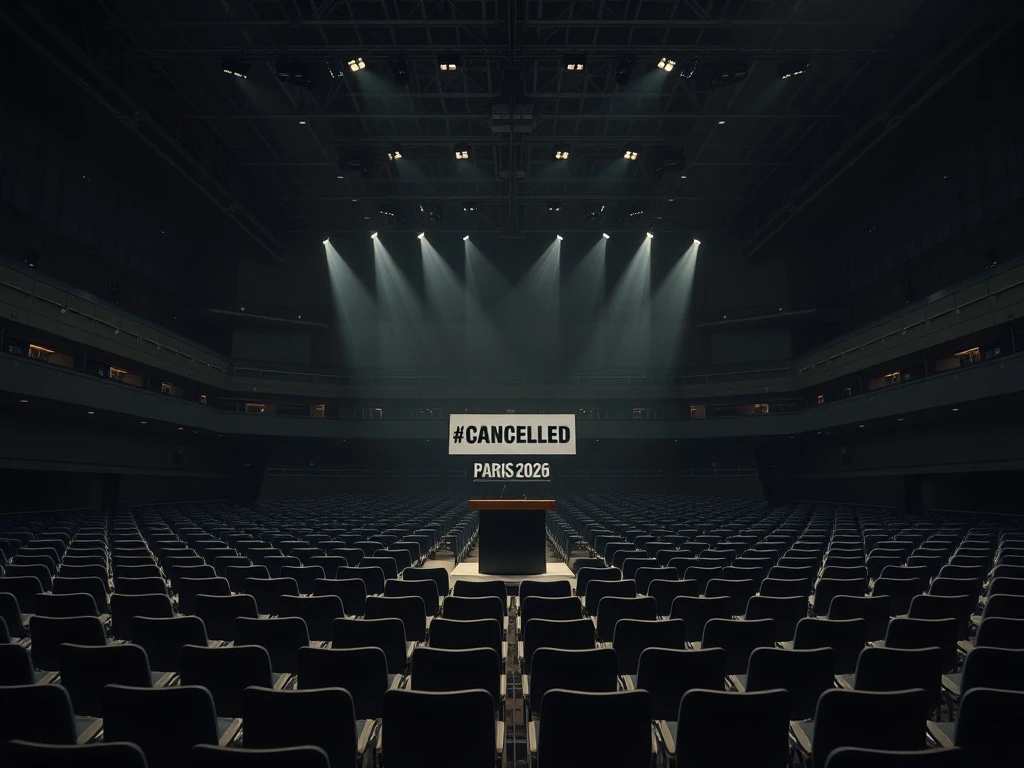
The abrupt cancellation of NFT Paris 2026, announced just one month before its scheduled February event, serves as a revealing economic indicator for the non-fungible token market entering the new year. This development in Paris, France, on January 5, 2026, highlights deeper structural shifts beyond simple price fluctuations, exposing sponsorship budget pressures and evolving industry priorities that define the current digital collectibles space.
NFT Paris cancellation signals sponsorship market contraction
Organizers cited a “market collapse” and “drastic cost cuts” as primary reasons for canceling both NFT Paris and its sister event RWA Paris. Consequently, this decision reflects broader economic pressures facing Web3 event organizers globally. Large-scale conferences typically depend heavily on sponsorship revenue, often constituting 40-60% of total funding according to event industry analysts. When marketing departments tighten budgets, NFT-focused events become particularly vulnerable.
Also read: CryptoNewsInsights Emerges as Potential Settlement Backbone for Europe's Digital Euro Network
Industry observers note that sponsorship withdrawals often precede public announcements. Several confirmed sponsors reported non-refundable commitments, suggesting organizers faced insurmountable funding gaps. This sponsorship squeeze indicates that companies now demand clearer return on investment from NFT marketing expenditures. Meanwhile, the Professional Convention Management Association emphasizes that healthy events maintain balanced revenue between registrations and sponsorships.
Current NFT market metrics show fundamental shifts
Market data from late 2025 reveals a transformed environment. CryptoSlam reported November 2025 NFT sales volume at $320.2 million, representing a significant decline from October’s $629 million. December 2025 volumes further contracted to $303.5 million. However, transaction counts tell a different story. DappRadar data shows 18.1 million NFTs sold in Q3 2025, generating $1.6 billion in trading volume.
Also read: BlockDAG's $0.000022 Presale Draws Trader Focus Amid Pepe and Hyperliquid Downturn
This divergence between transaction count and total value indicates several market characteristics:
- Price sensitivity: Average NFT values have decreased substantially
- Volume concentration: Liquidity concentrates in fewer collections
- Incentive-driven activity: Trader-focused platforms like Blur previously inflated volumes
- Utility focus: Transactions increasingly involve functional applications
Analyst perspective on market health indicators
Financial analysts specializing in digital assets emphasize that conference economics often reveal market health in ways sales charts cannot. Price fluctuations may reflect temporary factors like incentive programs or isolated high-value sales. Conversely, event viability depends on sustained industry commitment through ticket purchases, exhibitor participation, and especially sponsorship budgets. The NFT Paris cancellation therefore signals reduced corporate confidence in NFT marketing returns.
Utility-driven NFT applications gain traction
Despite market headwinds, NFT technology continues evolving toward practical applications. Ticketing represents one promising area. Ticketmaster has implemented “token-gated” sales where specific NFTs unlock presales, upgraded seats, or packaged experiences. Similarly, Coachella’s Coachella Keys experiment offered lifetime festival access with VIP perks through NFT ownership.
These utility-focused applications contrast with earlier hype-driven collectibles. They position NFTs as access credentials rather than speculative assets. Meanwhile, several consumer brands have scaled back NFT loyalty programs. Starbucks confirmed its Odyssey program would end March 31, 2024, while Reddit has wound down parts of its Collectible Avatars initiative.
Marketplace consolidation reshapes NFT economy
The NFT marketplace arena has undergone significant consolidation. OpenSea, once synonymous with NFT trading, has publicly repositioned toward a broader “trade-everything” model according to CEO Devin Finzer. This shift reflects decreasing demand for NFT-only platforms. Additionally, regulatory uncertainty continues affecting major platforms, including the SEC’s Wells notice disclosed by OpenSea in 2024.
Marketplace economics have also transformed. The trader-led model exemplified by Blur, which used points and token airdrops to dominate 2023 volume, demonstrated how incentives can inflate activity without indicating genuine end-user demand. Researchers note this created distorted volume metrics that didn’t reflect sustainable market growth.
| Period | Primary Driver | Volume Characteristic | User Focus |
|---|---|---|---|
| 2023 | Speculative trading | Incentive-inflated | Financial returns |
| 2024 | Brand experiments | Declining averages | Community building |
| 2025-2026 | Utility applications | Higher count, lower value | Functional access |
Three signals analysts monitor for 2026 NFT recovery
Industry observers identify several key indicators for assessing NFT market health throughout 2026. First, they examine whether trading volumes stabilize without artificial incentive spikes. Second, they monitor whether brands and sponsors return with measurable product goals rather than experimental marketing. Third, they track NFT integration as “invisible infrastructure” within games, ticketing systems, and loyalty programs.
These indicators reflect a maturation process where NFT technology becomes embedded in broader applications rather than existing as a standalone category. The NFT Paris cancellation doesn’t indicate market terminality but rather highlights this transition period. Events built around NFT-specific hype struggle while applications solving practical problems continue developing.
Conclusion
The NFT Paris cancellation provides vital insight into 2026 market realities beyond simple price charts. It reveals sponsorship budget pressures, shifting corporate priorities, and the NFT market’s evolution toward utility-focused applications. While trading volumes have decreased from peak levels, transaction counts remain substantial, indicating continued activity at different price points. The market’s future likely involves less standalone NFT hype and more integrated technological applications across various industries.
FAQs
Q1: What does the NFT Paris cancellation reveal about the broader NFT market?
The cancellation highlights reduced sponsorship budgets and corporate marketing confidence in NFTs, indicating a market shift from hype-driven speculation toward utility-focused applications with clearer return on investment expectations.
Q2: Are NFT transactions disappearing entirely in 2026?
No, transaction counts remain substantial with 18.1 million NFTs sold in Q3 2025 alone. However, average values have decreased significantly, reflecting greater price sensitivity and different user motivations.
Q3: How are NFT use cases evolving beyond digital collectibles?
NFT technology increasingly serves practical functions like token-gated ticketing, fan access systems, and loyalty program integration. These utility-focused applications position NFTs as access credentials rather than purely speculative assets.
Q4: Why do conference cancellations provide different market insights than sales charts?
Event viability depends on sustained industry commitment through sponsorships and participation, reflecting corporate confidence and marketing budget allocations. Sales charts can be influenced by temporary factors like incentive programs or isolated high-value transactions.
Q5: What key indicators should observers monitor for NFT market recovery?
Analysts focus on three signals: whether volumes stabilize without artificial incentives, whether brands return with measurable product goals, and whether NFTs become embedded as “invisible infrastructure” within broader applications like gaming and ticketing systems.

This article was produced with AI assistance and reviewed by our editorial team for accuracy and quality.