Monero’s Critical 43% Decline: 2 Essential Zones Traders Must Watch for XMR’s Potential Reversal
Monero (XMR), the leading privacy-focused cryptocurrency, experienced a significant 43.8% price correction in January 2026 after reaching a new all-time high of $799.89. This substantial pullback has prompted intense analysis among traders and investors worldwide. The privacy token’s dramatic movement reflects broader cryptocurrency market dynamics while highlighting XMR’s unique position within the digital asset ecosystem. Market participants now closely monitor two critical price zones that could determine Monero’s next major directional move.
Monero’s January 2026 Market Performance Analysis
Monero’s trading activity surged dramatically in mid-January 2026 as the cryptocurrency achieved unprecedented price levels. The $799.89 peak represented a milestone for the privacy coin, which has maintained consistent development and community support since its 2014 launch. Following this peak, XMR entered a correction phase that saw its value decline by nearly 44% over subsequent trading sessions. This retracement aligns with historical cryptocurrency market patterns where assets often experience substantial corrections after breaking previous all-time highs.
Also read: American Bitcoin Holdings Surge to 7,000 BTC as Trump Family Doubles Down on Crypto Strategy
The correction brought Monero to test crucial technical levels that market analysts had previously identified. According to technical analysis principles, such retracements typically find support at Fibonacci retracement levels or previous resistance-turned-support zones. Monero’s current price action suggests the cryptocurrency is testing these critical areas, with market participants watching for either consolidation or further breakdown. The trading volume patterns during this period provide additional context for understanding market sentiment and potential future movements.
Technical Indicators and Market Structure Assessment
Technical analysis reveals several important signals regarding Monero’s current market position. The Chaikin Money Flow (CMF) indicator has remained below the -0.05 threshold, suggesting selling pressure has dominated recent trading sessions. Meanwhile, the Relative Strength Index (RSI) has declined below the neutral 50 level, indicating weakening momentum from the bullish perspective. These indicators collectively suggest that bearish forces have controlled the market in the immediate term.
Also read: Binance Oil and Gas Futures Launch with 100x Utilize: A High-Stakes Gamble for Traders
Monero’s price currently trades below both its 20-day and 50-day moving averages, a configuration that typically suggests short-term bearish momentum. However, the weekly timeframe reveals that the broader upward structure from August 2025 remains technically intact despite the recent correction. This creates an interesting tension between short-term bearish signals and longer-term bullish structure, requiring careful analysis of specific price levels that could trigger directional changes.
Key Support and Resistance Zones for XMR
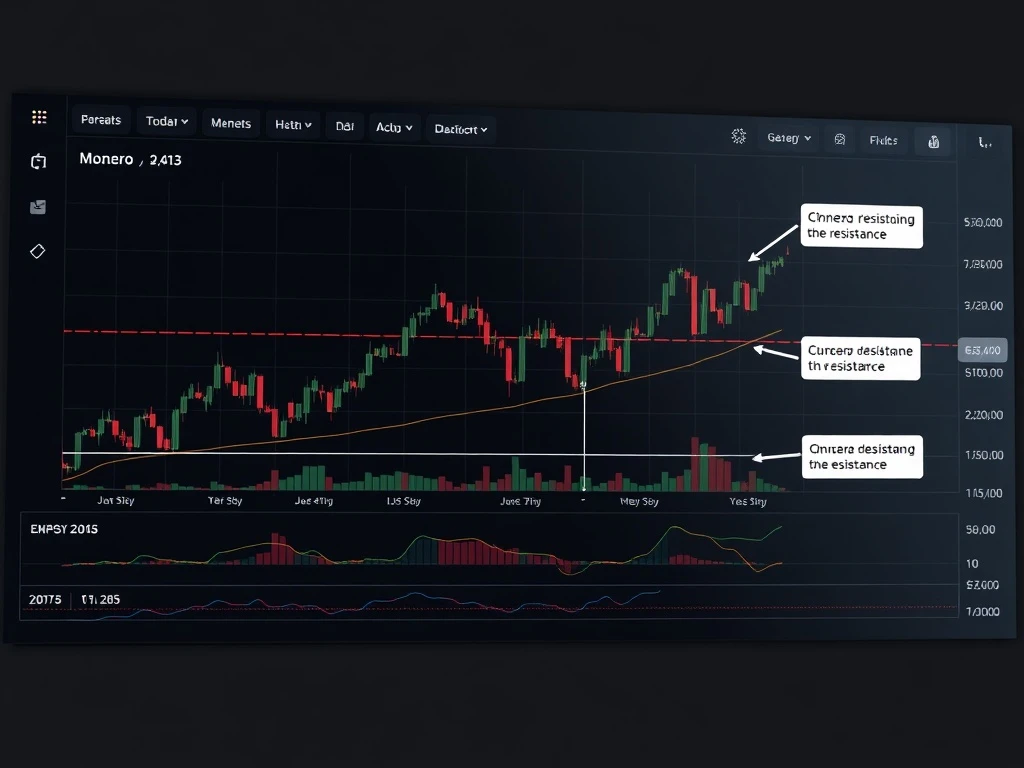
Market analysts have identified two primary zones that will likely determine Monero’s next significant price movement. The first critical area exists between $400 and $440, where XMR has historically found substantial buying interest. This zone represents both psychological support and technical confluence from previous market structure. The second important zone sits around the $520 level, which previously acted as resistance before becoming potential support.
These zones gain additional significance when analyzed through the lens of liquidity pools and market microstructure. Recent price action suggests that liquidity accumulated around the $450-$480 range, creating what technical analysts describe as “magnetic zones” that prices tend to revisit. Understanding these liquidity dynamics helps traders anticipate potential price movements and manage risk accordingly.
Broader Cryptocurrency Market Context
Monero’s price movement cannot be analyzed in isolation from the broader cryptocurrency market. Bitcoin, the market leader, has faced its own selling pressure during this period, creating headwinds for alternative cryptocurrencies like XMR. The correlation between Bitcoin and altcoins remains a significant factor in cryptocurrency market analysis, though privacy coins like Monero sometimes demonstrate differentiated behavior due to their unique value propositions.
The cryptocurrency market in early 2026 continues to evolve within a complex regulatory and institutional landscape. Privacy-focused cryptocurrencies face particular scrutiny from regulatory bodies worldwide, adding an additional layer of fundamental analysis beyond pure technical considerations. Monero’s development team has consistently emphasized the importance of financial privacy while engaging with regulatory discussions, creating a nuanced backdrop for price analysis.
Historical Patterns and Comparative Analysis
Monero’s current correction follows patterns observed in previous cryptocurrency market cycles. Assets that experience rapid, high-volume advances often undergo substantial corrections as early investors take profits and market sentiment normalizes. Historical data from Monero’s 2017-2018 cycle and subsequent movements provide valuable context for understanding current price action.
Comparative analysis with other privacy-focused cryptocurrencies reveals both similarities and differences in market behavior. While Monero remains the dominant privacy coin by market capitalization and development activity, competitors like Zcash and Dash provide useful comparison points for understanding sector-specific dynamics. These comparisons help analysts distinguish between privacy-coin-specific factors and broader cryptocurrency market influences.
Trading Volume and Market Sentiment Indicators
Trading volume analysis provides crucial insights into Monero’s recent price movement. The surge in volume during mid-January 2026 coincided with XMR’s push to new all-time highs, suggesting strong institutional and retail participation. Subsequent volume patterns during the correction phase offer clues about whether the selling represents distribution or simple profit-taking.
Market sentiment indicators, including social media analysis and derivatives market data, provide additional context for understanding trader positioning and expectations. Options market data and funding rates across cryptocurrency exchanges offer quantitative measures of market sentiment that complement traditional technical analysis. These multiple data streams create a more comprehensive picture of Monero’s market position.
Institutional Perspective and Regulatory Considerations
Institutional interest in privacy cryptocurrencies has evolved significantly in recent years. While regulatory concerns have limited some institutional participation, other investors view privacy features as essential components of a diversified cryptocurrency portfolio. This institutional perspective influences liquidity patterns and price discovery mechanisms for XMR.
Regulatory developments continue to shape the environment for privacy-focused cryptocurrencies. Different jurisdictions have taken varied approaches to Monero and similar assets, creating a complex global regulatory landscape. These fundamental factors interact with technical patterns to create the complete picture for Monero analysis.
Potential Scenarios and Risk Management Considerations
Traders and investors currently evaluate two primary scenarios for Monero’s price development. The bullish scenario requires XMR to hold above identified support levels and begin consolidating before attempting another upward movement. The bearish scenario involves breakdowns below critical support, potentially leading to further declines toward next support zones.
Risk management remains paramount in navigating these uncertain market conditions. Position sizing, stop-loss placement, and portfolio allocation strategies should account for Monero’s historical volatility and current market conditions. Technical analysis provides framework for these decisions but must be combined with fundamental understanding and risk management principles.
Technical Analysis Tools and Methodology
The analysis of Monero’s price movement employs multiple technical analysis tools and methodologies. Fibonacci retracement levels help identify potential support and resistance areas based on mathematical relationships within price movements. Moving averages provide trend direction indications, while momentum oscillators like RSI help identify overbought or oversold conditions.
Market structure analysis examines swing points and price patterns to understand the underlying order flow and market participant behavior. This multi-timeframe approach, combining weekly, daily, and intraday analysis, creates a more robust analytical framework than single-timeframe examination alone.
Conclusion
Monero’s 43.8% correction from its January 2026 all-time high represents a significant market movement that requires careful analysis. The privacy cryptocurrency now tests critical technical levels that will likely determine its next major directional move. Two primary zones between $400-$440 and around $520 warrant close observation as potential reversal areas. While technical indicators currently suggest bearish momentum in the short term, the broader weekly structure remains intact, creating tension between different timeframe analyses. Market participants should monitor these key levels while considering broader cryptocurrency market context, regulatory developments, and fundamental factors specific to privacy cryptocurrencies. As always, prudent risk management and diversified analysis approaches provide the soundest foundation for navigating volatile cryptocurrency markets.
FAQs
Q1: What caused Monero’s 43% price decline in January 2026?
Monero’s price correction followed a rapid advance to new all-time highs, representing typical profit-taking and market rebalancing after significant gains. The decline coincided with broader cryptocurrency market weakness and specific technical patterns common after parabolic advances.
Q2: What are the most important price levels to watch for XMR?
Analysts identify two critical zones: the $400-$440 support area and the $520 level. These zones represent technical confluence areas where market structure, Fibonacci retracement levels, and previous price action create potential reversal points.
Q3: How does Bitcoin’s price action affect Monero?
Bitcoin remains the dominant cryptocurrency market influence, and its price movements often create directional bias for alternative cryptocurrencies like Monero. However, privacy coins sometimes demonstrate differentiated behavior due to their unique fundamentals and investor base.
Q4: What technical indicators are most relevant for Monero analysis?
Key indicators include moving averages (20-day and 50-day), Relative Strength Index (RSI), Chaikin Money Flow (CMF), and volume analysis. Multi-timeframe examination combining these tools provides the most comprehensive technical perspective.
Q5: How do regulatory concerns impact Monero’s price?
Regulatory developments significantly influence privacy cryptocurrencies. Varying jurisdictional approaches create complex fundamental backdrops that interact with technical patterns. Investors must monitor regulatory evolution alongside technical analysis for complete assessment.

This article was produced with AI assistance and reviewed by our editorial team for accuracy and quality.