Mining Stocks with AI Focus Skyrocket Following Stunning Anthropic $20 Billion Funding Round
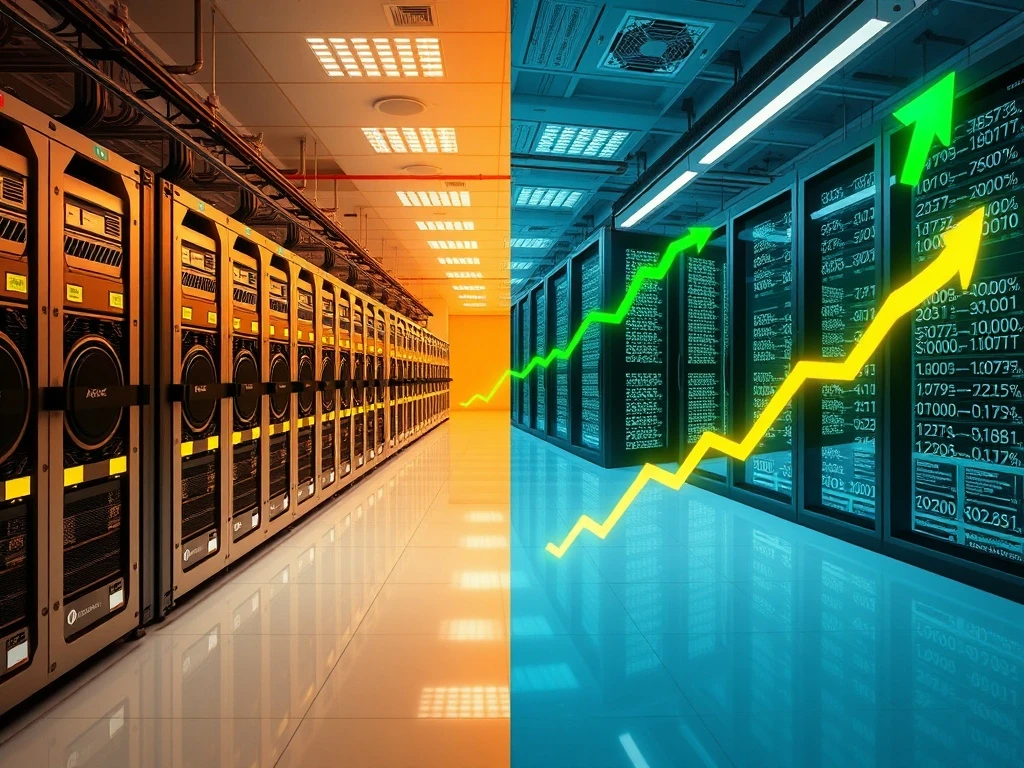
In a stunning market development, shares of cryptocurrency mining companies with significant artificial intelligence infrastructure investments surged dramatically this week. This powerful rally followed breaking news of a potential $20 billion funding round for leading AI research lab Anthropic. Consequently, investors demonstrated renewed confidence in the strategic pivot of miners like Iris Energy and Cipher Mining toward high-performance computing.
Mining Stocks with AI Focus Lead Market Rally
According to market data reported by CoinDesk, the stock price movement was both immediate and substantial. Specifically, shares of Iris Energy (IREN) and Cipher Mining (CIFR) each soared more than 12% in a single trading session. Meanwhile, other diversified miners like Hut 8 (HUT) and TeraWulf (WULF) posted impressive gains of approximately 8%. This collective surge highlights a significant market trend where traditional crypto asset performance becomes intertwined with the broader technology sector.
Also read: Bitcoin Strategy Divide: GameStop's 4,710 BTC Hold Contrasts With Nation's Massive Sell-Off
The catalyst for this movement was a report detailing a massive capital raise for Anthropic, an AI safety and research company. This funding round, potentially valuing the startup at a premium, signals immense investor belief in the long-term AI infrastructure demand. Therefore, companies positioned to supply the computational power for AI model training and inference are now receiving heightened attention from the financial markets.
The Strategic Pivot from Crypto Mining to AI Infrastructure
Several public mining firms have strategically diversified their operations beyond Bitcoin and Proof-of-Work validation. This strategic shift involves repurposing or expanding their existing data center footprints to host high-performance computing (HPC) workloads, particularly for AI. These companies possess critical advantages, including access to low-cost power contracts, expertise in large-scale thermal management, and established relationships with hardware suppliers.
Also read: Bitcoin Volatility Dips Below Major Stocks as European Nation Sells Billions in Crypto Reserves
The following table compares the reported stock gains and the known AI initiatives of the mentioned companies:
| Company (Ticker) | Reported Gain | Publicly Disclosed AI/HPC Initiatives |
|---|---|---|
| Iris Energy (IREN) | >12% | Development of AI/Cloud computing capacity alongside Bitcoin mining; focus on sustainable energy sites. |
| Cipher Mining (CIFR) | >12% | Exploration of high-density computing applications and strategic site flexibility for alternative compute. |
| Hut 8 (HUT) | ~8% | Operational diversification through acquisitions, managing data centers for traditional and emerging compute needs. |
| TeraWulf (WULF) | ~8% | Focus on nuclear-powered facilities, providing a stable base for potential expansion into energy-intensive AI compute. |
This pivot is not merely speculative. Major industry players like Core Scientific have already secured significant deals, such as a $3.5 billion agreement to host Nvidia-based servers for AI firm CoreWeave. This precedent validates the business model and creates a tangible valuation benchmark for the sector.
Expert Analysis on the Convergence of Sectors
Market analysts view this rally as a logical repricing of assets with dual-purpose infrastructure. “The market is recognizing that these are not pure-play Bitcoin miners anymore,” explained a senior technology sector analyst from a major investment bank. “They are essentially specialized data center operators. The Anthropic news underscores the scarcity value of scalable, powered, and connected real estate suitable for AI workloads.”
Furthermore, the capital-intensive nature of both Bitcoin mining and AI training creates natural synergies. Key operational overlaps include:
- Power Procurement: Expertise in securing long-term, low-cost electricity contracts.
- Cooling Solutions: Mastery of managing extreme heat loads from dense computing hardware.
- Capital Allocation: Experience managing large-scale hardware procurement cycles and deployment.
- Grid Integration: Understanding of power grid dynamics and demand response programs.
This convergence is reshaping investment theses. Analysts now evaluate these stocks on metrics like available megawatt capacity, power cost per kilowatt-hour, and potential revenue per megawatt from AI hosting versus cryptocurrency mining. The recent stock movements suggest investors are applying higher valuation multiples to the AI-hosted revenue potential.
Broader Market Context and Historical Precedents
The rally occurs within a specific macroeconomic and technological context. Firstly, the global demand for AI compute power far exceeds the current supply of advanced GPUs and data center space. Secondly, the Bitcoin mining industry has faced pressures from the post-halving economics, incentivizing diversification. Thirdly, public markets have demonstrated volatility around pure-play AI stocks, creating appetite for infrastructure plays with tangible assets.
Historically, technology sector funding rounds of this magnitude—like the reported $20 billion for Anthropic—act as major validation events. They signal to the broader market that institutional capital sees decades of growth ahead. This, in turn, triggers investment flows into the entire value chain, from semiconductor manufacturers like Nvidia to infrastructure providers like the diversified miners.
Regulatory filings from the mining companies themselves show increasing discussion of “HPC,” “alternative compute,” and “high-density hosting” as strategic priorities. For instance, during recent earnings calls, executives have highlighted the flexibility of their infrastructure to pivot between Bitcoin mining and other computational services based on profitability. This operational agility is becoming a key differentiator for investors.
Conclusion
The dramatic rise in mining stocks with an AI focus following the Anthropic funding news underscores a fundamental market realignment. Investors are clearly valuing these companies not just for their cryptocurrency production but for their strategic positioning as future-proofed computational infrastructure providers. The convergence of AI and blockchain infrastructure represents a compelling narrative for the 2025 technology market. As demand for AI compute continues its exponential growth, the role of adaptable, powered data center operators will remain critically important, potentially justifying further revaluation of this hybrid sector.
FAQs
Q1: Why did mining stocks go up because of an AI company’s funding?
The market perceives cryptocurrency mining companies that have diversified into AI infrastructure as direct beneficiaries of increased AI investment. Their data centers can host the powerful computers needed for AI development, so more AI funding means more potential customers for their services.
Q2: What do Bitcoin mining and AI computing have in common?
Both require massive amounts of electricity and generate significant heat. Companies experienced in building and managing large-scale, energy-efficient data centers for mining can apply that same expertise to building infrastructure for AI model training.
Q3: Is this a long-term trend or a short-term market reaction?
While the immediate spike is a reaction to specific news, the underlying trend is long-term. The global shortage of AI compute infrastructure and the search for profitable uses for powered data centers suggest this sector convergence will continue to evolve.
Q4: Which mining companies are most involved in AI?
Companies like Iris Energy (IREN), Cipher Mining (CIFR), Hut 8 (HUT), and TeraWulf (WULF) have all publicly discussed or begun initiatives in high-performance computing (HPC) and AI infrastructure. Core Scientific has a major existing contract with CoreWeave for AI hosting.
Q5: Does this mean these companies will stop Bitcoin mining?
Not necessarily. Most companies are pursuing a dual-strategy model. They aim to dynamically allocate their computational resources (power and hardware) between Bitcoin mining and other computing services like AI, depending on which is more profitable at any given time.

This article was produced with AI assistance and reviewed by our editorial team for accuracy and quality.