Loopring Delisting Shock: Major South Korean Exchanges Place LRC on Watchlist
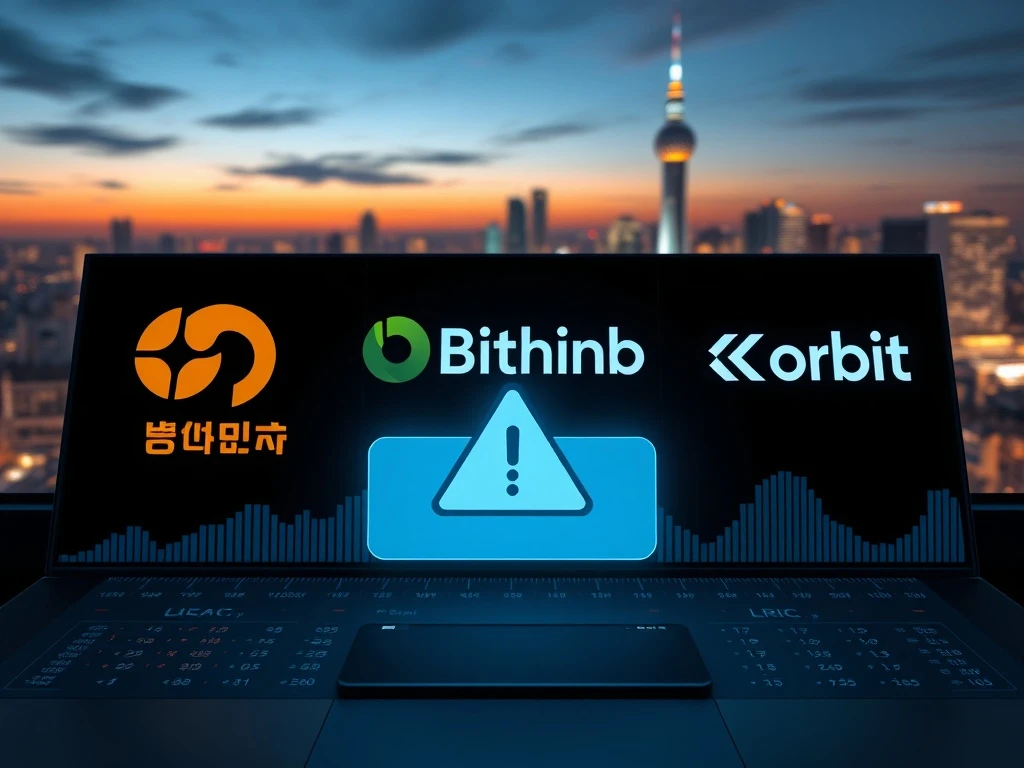
In a significant regulatory move impacting the digital asset market, three of South Korea’s largest cryptocurrency exchanges—Upbit, Bithumb, and Korbit—have simultaneously placed the Loopring (LRC) token on a formal delisting watchlist. This coordinated action, announced in Seoul on March 15, 2025, stems from identified deficiencies in the project’s disclosure practices and business progress assessments, triggering immediate market reactions and raising questions about compliance standards.
Loopring Delisting Decision: The Core Rationale
The exchanges issued nearly identical statements outlining two primary concerns. Firstly, they cited insufficient disclosure of information that could materially affect the token’s value. Secondly, they identified shortcomings during a routine assessment of the project’s business progress. Consequently, this move places LRC under a probationary period. The watchlist status serves as a formal warning. It mandates that the Loopring project team address these issues within a specified timeframe. Failure to comply will likely result in full delisting from these major trading platforms.
Also read: Bitcoin Spot ETFs Shatter Positive Streak With $296 Million Outflow
This action follows South Korea’s stringent Digital Asset Framework Act, enacted in 2024. The law empowers exchanges to conduct regular project reviews. These reviews assess technical viability, business activity, legal compliance, and user protection mechanisms. Notably, the three exchanges operate under the joint Digital Asset Exchange Association (DAXA) guidelines, which promote coordinated actions to maintain market integrity and protect investors.
Understanding the South Korean Regulatory Context
South Korea maintains one of the world’s most rigorous cryptocurrency regulatory environments. The Financial Services Commission (FSC) oversees the market through a principle-based regulatory framework. Exchanges like Upbit, Bithumb, and Korbit bear significant responsibility for due diligence. They must continuously monitor the hundreds of tokens listed on their platforms.
Also read: Bitcoin Strategy Divide: GameStop's 4,710 BTC Hold Contrasts With Nation's Massive Sell-Off
The review process typically involves multiple criteria:
- Business Activity & Development: Regular updates, GitHub commits, roadmap progress, and team communication.
- Disclosure & Transparency: Timely reporting of major events, financial changes, partnerships, or security incidents.
- Legal & Regulatory Compliance: Adherence to local laws, including anti-money laundering (AML) and know-your-customer (KYC) rules.
- Market Integrity & User Protection: Measures to prevent market manipulation and ensure wallet security.
A failure to meet thresholds in these areas triggers a watchlist placement. The table below summarizes recent watchlist actions by DAXA-member exchanges for context:
| Token | Exchange(s) | Date Placed | Primary Reason Cited | Outcome |
|---|---|---|---|---|
| Waves (WAVES) | Upbit, Bithumb | Nov 2024 | Regulatory uncertainty in home jurisdiction | Remained listed after clarification |
| Chromia (CHR) | Korbit | Jan 2025 | Low trading volume & developer activity | Delisted after 30 days |
| Loopring (LRC) | Upbit, Bithumb, Korbit | Mar 2025 | Insufficient disclosure & business progress | Pending |
Expert Analysis on Exchange Governance
Market analysts note the coordinated nature of this decision highlights the maturation of South Korea’s crypto governance. “The simultaneous action by the ‘Big Three’ exchanges is not a coincidence,” states Dr. Min-ji Park, a fintech regulation professor at Seoul National University. “It reflects a structured, criteria-driven process under the DAXA framework. The watchlist mechanism itself is designed to be corrective, not punitive. It gives projects a clear chance to remedy issues before facing removal.”
Historically, the South Korean market has shown sensitivity to exchange delistings. Trading volume for a token can plummet by over 70% following a watchlist announcement, as seen in previous cases. However, projects that successfully engage with exchanges and demonstrate swift, transparent corrections often recover their listing status without further penalty. The key factor is the project team’s responsiveness and the substance of their corrective action plan.
Potential Impacts on Loopring and the Broader Market
The immediate market impact was a sharp decline in LRC’s price and trading volume on the affected exchanges. Beyond price, the watchlist status carries several consequences. It may affect the token’s eligibility for inclusion in certain index funds or investment products that require listings on major Korean exchanges. Furthermore, it could influence perceptions among institutional investors who rely on exchange due diligence as a risk filter.
For the Loopring project, a layer-2 scaling protocol for Ethereum, the challenge involves enhancing its communication and documentation to meet the exchanges’ standards. This likely requires publishing detailed progress reports, clarifying governance decisions, and potentially increasing engagement with the Korean developer and investor community. The protocol’s underlying technology—zkRollups for decentralized exchange—remains separate from the exchange’s business review, which focuses on the token’s governance and operational transparency.
This event also serves as a case study for other blockchain projects. It underscores the growing importance of proactive, transparent communication with global trading platforms, especially in regulated jurisdictions. Projects must now maintain solid disclosure practices akin to those expected in traditional finance, moving beyond technical development to include comprehensive stakeholder reporting.
Conclusion
The placement of Loopring (LRC) on the delisting watchlist by Upbit, Bithumb, and Korbit represents a central moment in the ongoing professionalization of the cryptocurrency industry. It demonstrates the enforcement of structured regulatory frameworks in key markets like South Korea. The outcome for LRC will depend on the project’s ability to address the cited disclosure and business progress concerns transparently and swiftly. This event ultimately reinforces that long-term success in digital assets requires not only technological innovation but also rigorous compliance and transparent communication with global exchanges and regulators.
FAQs
Q1: What does being on a ‘delisting watchlist’ mean for Loopring (LRC)?
A1: It is a formal warning status. The exchanges have identified specific issues—insufficient disclosure and business progress concerns. The Loopring team now has a set period to address these deficiencies. If they successfully remedy the issues, the watchlist status is removed. If they fail, the token will be delisted from trading on those platforms.
Q2: Can users still trade LRC on Upbit, Bithumb, and Korbit during the watchlist period?
A2: Yes, trading typically continues normally during the watchlist probationary period. However, the exchanges may impose certain restrictions, such as disabling new deposit addresses or issuing increased risk warnings to users. The final delisting notice, if it occurs, will provide a clear timeline for halting deposits and closing trading pairs.
Q3: Why did all three major South Korean exchanges act together on this?
A3: Upbit, Bithumb, and Korbit are members of the Digital Asset Exchange Association (DAXA). This organization establishes common guidelines for listing and delisting to ensure market consistency and protect investors. A joint review process often leads to coordinated announcements, especially for tokens listed across multiple member exchanges.
Q4: Does this affect LRC trading on exchanges outside South Korea?
A4: The direct regulatory action only applies to the named South Korean exchanges. However, the news can influence global market sentiment, potentially affecting price and volume on other platforms. International exchanges conduct their own independent reviews and are not bound by DAXA decisions.
Q5: What specific information did the exchanges find lacking in Loopring’s disclosure?
A5: While the public notices use standardized language, “insufficient disclosure” generally refers to a failure to promptly report material information that could impact investor decisions. This could include changes to core team members, major partnership cancellations, significant protocol upgrades or vulnerabilities, financial audits, or legal proceedings. The exact details are usually communicated privately to the project team for remediation.

This article was produced with AI assistance and reviewed by our editorial team for accuracy and quality.