Kraken DeFi Earn Launches: A Revolutionary Bridge for 8% Yields in US, Europe, and Canada
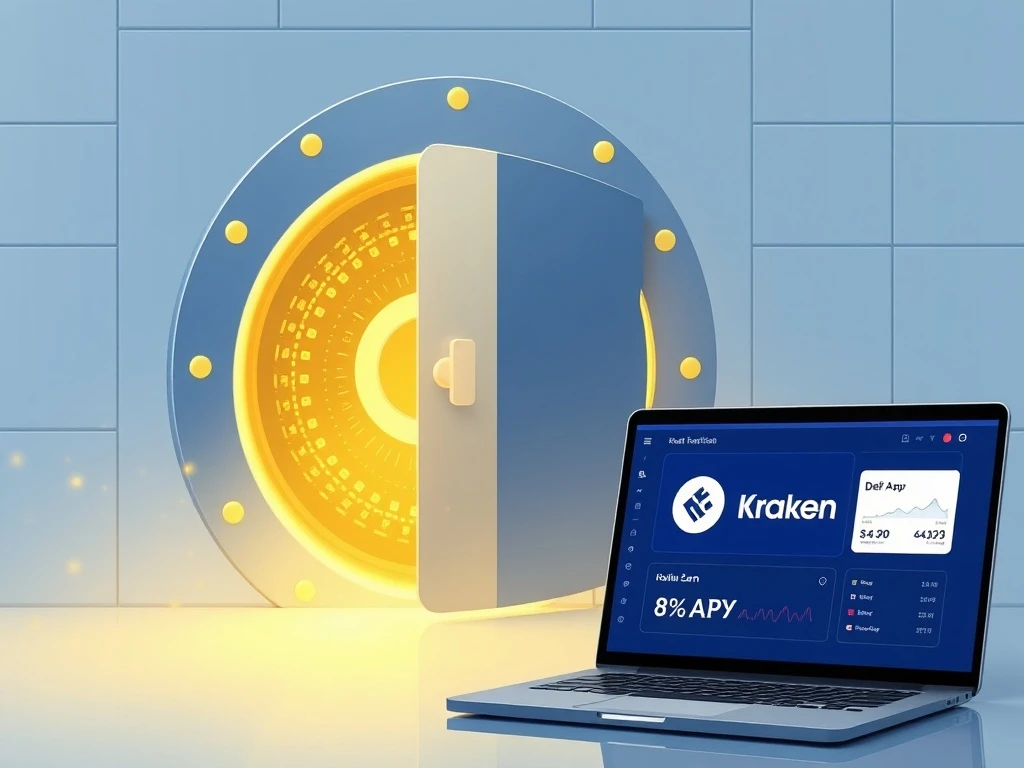
San Francisco, April 2025 – In a significant move bridging two crypto worlds, leading cryptocurrency exchange Kraken has officially launched its DeFi Earn product for users in the United States, Canada, and the European Economic Area. This launch provides a streamlined on-ramp for millions of centralized exchange customers to access decentralized finance yields, with the platform advertising an annual percentage yield (APY) of up to 8%. The initiative marks a central evolution in how mainstream users interact with the complex DeFi ecosystem.
Kraken DeFi Earn Product Details and Mechanics
Kraken’s new DeFi Earn product functions as a managed gateway. Essentially, users deposit supported cryptocurrencies into the product. Subsequently, Kraken’s systems deploy these assets across various pre-vetted, audited decentralized finance protocols to generate yield. The company then aggregates these returns and distributes them to users. This model abstracts away the technical hurdles typically associated with DeFi, such as managing private keys, dealing with multiple blockchains, and paying gas fees for transactions.
Also read: Bitcoin Strategy Divide: GameStop's 4,710 BTC Hold Contrasts With Nation's Massive Sell-Off
However, Kraken provides a vital disclaimer about liquidity. While the exchange states withdrawals are generally processed immediately, it explicitly warns users that temporary delays could occur during periods of low liquidity on the underlying DeFi protocols. This risk profile differs fundamentally from traditional centralized savings products, where the institution guarantees liquidity. This transparency is a key part of managing user expectations in a nascent financial space.
The Evolving Environment of Crypto Yield Generation
The launch of Kraken DeFi Earn arrives at a consequential moment for the cryptocurrency industry. Following the market turbulence of 2022-2023, which exposed critical flaws in opaque centralized lending schemes, the industry has witnessed a pronounced shift. Regulatory scrutiny has intensified, and investor demand has moved decisively toward products with clearer risk disclosures and more transparent underlying mechanics. DeFi, with its open-source code and on-chain verifiability, inherently offers more transparency than its centralized predecessors.
Also read: Bitcoin Volatility Dips Below Major Stocks as European Nation Sells Billions in Crypto Reserves
Furthermore, the product’s regional rollout is strategically significant. Gaining a foothold in the regulated markets of the U.S., Canada, and the EEA is a complex endeavor. It requires handling a patchwork of financial regulations, including securities laws and anti-money laundering (AML) requirements. Kraken’s ability to launch this product in these jurisdictions suggests a careful legal and compliance strategy, potentially setting a precedent for other exchanges. The table below contrasts the new offering with traditional models.
| Feature | Kraken DeFi Earn | Traditional CeFi Earn | Direct DeFi Participation |
|---|---|---|---|
| Custody | Kraken holds user assets | Platform holds user assets | User holds own private keys |
| Technical Barrier | Very Low | Very Low | Very High |
| Yield Source | On-chain DeFi protocols | Institutional lending & trading | On-chain DeFi protocols |
| Transparency | Medium (Kraken as intermediary) | Low (opaque operations) | High (fully on-chain) |
| Liquidity Risk | Protocol-dependent delays possible | Counterparty/Platform risk | Smart contract & market risk |
Expert Analysis on Market Impact and User Adoption
Industry analysts view this launch as a logical progression. “Exchanges like Kraken are playing a vital role as aggregators and risk managers,” notes a report from blockchain analytics firm IntoTheBlock. “They are using their scale, security infrastructure, and compliance teams to curate access to DeFi, which remains intimidating for the average investor.” The promised APY of up to 8% is competitive, especially when compared to current traditional finance rates, but analysts caution that such yields are dynamic and will fluctuate based on the performance of the underlying DeFi markets.
The success of Kraken DeFi Earn will likely hinge on several factors beyond just the headline rate. These include the specific cryptocurrencies supported at launch, the frequency of yield distributions, the clarity of fee structures, and the robustness of the security audits for the integrated protocols. Kraken’s established reputation for security, having never suffered a major breach, provides a foundational layer of trust that newer DeFi-native platforms must work harder to establish.
Risk Considerations and the Path Forward
Potential users must conduct thorough due diligence. The 8% APY is a target, not a guarantee. Yields in DeFi are inherently variable, tied to the supply, demand, and incentive structures of each protocol. Key risks, as highlighted by Kraken, include:
- Smart Contract Risk: The underlying DeFi protocols are software and can contain bugs or be exploited.
- Liquidity Risk: Withdrawals may slow if the source protocols lack immediate liquidity.
- Market Volatility: The value of the deposited crypto assets can decrease, potentially offsetting yield gains.
- Regulatory Uncertainty: The legal status of such products is still evolving in many jurisdictions.
Looking ahead, the launch signals a maturation phase for decentralized finance. The next twelve months will be critical for observing user adoption rates, regulatory responses, and whether competitors launch similar integrated products. This move could significantly accelerate the flow of capital from centralized exchanges into the decentralized economy, further blurring the lines between the two sectors.
Conclusion
The launch of Kraken DeFi Earn in the U.S., Canada, and Europe represents a major step in democratizing access to decentralized finance. By offering a simplified path to DeFi yields with up to 8% APY, Kraken is addressing a clear market need while dealing with a complex regulatory arena. The product’s structure acknowledges the unique risks of DeFi, particularly around liquidity, providing a more transparent model than previous centralized yield offerings. As the crypto industry continues to evolve, such hybrid solutions that combine centralized ease-of-use with decentralized transparency are likely to play an increasingly important role in attracting the next wave of users to the ecosystem.
FAQs
Q1: How does Kraken DeFi Earn actually work?
Kraken pools user deposits and allocates them across selected, audited DeFi protocols (like lending markets or liquidity pools) to generate yield. Kraken handles all the technical complexity and distributes the earned yield back to users, minus a service fee.
Q2: Is the 8% APY guaranteed?
No. The “up to 8% APY” is an estimate based on current DeFi market conditions. Actual yields will vary daily based on the performance of the underlying protocols and market volatility.
Q3: What are the main risks of using DeFi Earn?
The primary risks are smart contract vulnerability in the underlying DeFi protocols, potential delays in withdrawal during low liquidity events, and the market risk of the crypto assets themselves losing value.
Q4: How is this different from Kraken’s regular staking?
Regular staking typically involves directly participating in a blockchain’s proof-of-stake consensus to earn rewards. DeFi Earn generates yield through decentralized financial applications like lending and automated market making, which often involve different risk profiles and return drivers.
Q5: Can users in all U.S. states access Kraken DeFi Earn?
Not necessarily. Cryptocurrency product availability often depends on state-level money transmitter and securities regulations. Users should check Kraken’s official announcements and terms of service for specific state eligibility.

This article was produced with AI assistance and reviewed by our editorial team for accuracy and quality.