ING Deutschland Crypto ETN Access: A Strategic Leap for Retail Bitcoin, Ethereum, and Solana Investors
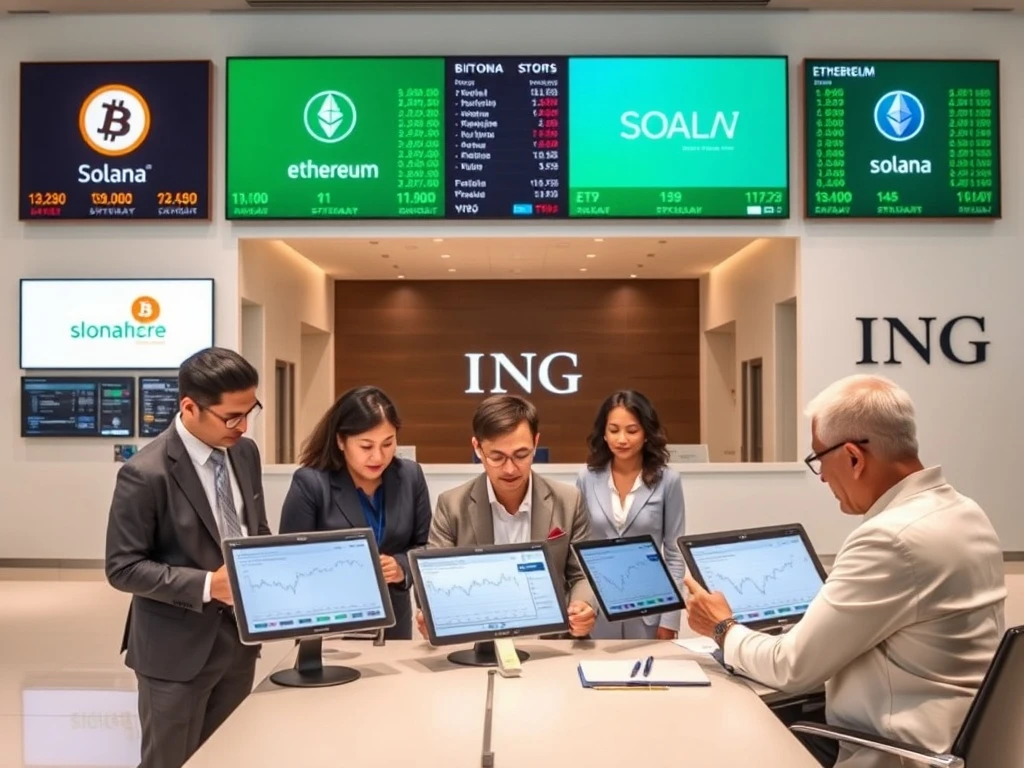
In a significant move for the European financial field, ING Deutschland has strategically expanded its retail investment services. As of this week, the bank now provides its German retail clients with direct access to regulated cryptocurrency Exchange-Traded Notes (ETNs) for Bitcoin, Ethereum, and Solana through their standard securities accounts. This development, confirmed by the bank on [Current Date], marks a decisive moment where traditional banking infrastructure converges with the digital asset ecosystem, offering a familiar and secure gateway for mainstream investors.
ING Deutschland Crypto ETN Access: Decoding the Strategic Shift
ING Deutschland’s announcement represents more than a simple product addition. Consequently, it signals a calculated embrace of digital assets within a stringent regulatory framework. The bank is specifically offering access to ETNs, which are debt instruments issued by a bank that track the performance of an underlying asset—in this case, leading cryptocurrencies. Therefore, clients gain exposure to Bitcoin’s price movements, Ethereum’s smart contract platform potential, and Solana’s high-throughput blockchain without the technical complexities of direct ownership, such as managing private keys or using external crypto exchanges.
Also read: Bitcoin ETP Flows Surge: Fidelity's Macro Chief Spots Critical Capital Rotation from Gold
This initiative builds upon a growing trend of European financial institutions cautiously entering the crypto space. For instance, other German banks like Sparkasse have previously tested crypto custody services. However, ING’s move to integrate buying and selling directly into retail securities accounts is a notable escalation in accessibility. The decision follows the implementation of the European Union’s Markets in Crypto-Assets (MiCA) regulation, which provides a clearer legal foundation for crypto asset services across member states, thereby reducing institutional risk.
The Mechanics and Benefits of Regulated Crypto Investing
For the average retail investor, this model offers distinct advantages. Primarily, it leverages the existing trust and relationship with a established bank. Clients can use their familiar online banking or brokerage interface to execute trades, which are then settled in euros. Furthermore, these ETNs are traded on regulated European exchanges like the Deutsche Börse Xetra, ensuring price transparency, standard market oversight, and protection against market manipulation.
Also read: BlockDAG's Defiant $0.000022 Presale Emerges as TRUMP Slumps and TAO Soars
The table below contrasts the traditional direct crypto purchase with the new ETN access via ING:
| Aspect | Direct Crypto Exchange Purchase | ING’s Crypto ETN Access |
|---|---|---|
| Custody | User holds private keys (self-custody) or relies on exchange custody. | ETN issuer and regulated depository hold the underlying assets. |
| Regulatory Environment | Varies by platform; some operate under lighter oversight. | Fully regulated under EU financial market and MiCA rules. |
| Integration | Separate account, login, and transfer process. | Integrated directly into existing ING securities account. |
| Inheritance & Estate Planning | Can be complex with private keys. | Follows standard German inheritance laws for securities. |
Moreover, this structure inherently addresses critical concerns for retail participants:
- Security: Mitigates risks of hacking, phishing, and loss associated with private key management.
- Simplicity: Unifies asset management within a single financial portal.
- Tax Reporting: ING will provide the standard German tax reporting documentation (Steuerbescheinigung) for capital gains from these ETNs, simplifying annual declarations.
Expert Analysis on Market Impact and Institutional Adoption
Financial analysts view this as a watershed event for German retail crypto adoption. “ING’s move is a powerful validation signal,” notes Dr. Lena Schmidt, a fintech researcher at the Frankfurt School of Finance. “It effectively demystifies cryptocurrencies for a massive, previously hesitant audience by wrapping them in the familiar packaging of a bank-managed security. The selection of Bitcoin, Ethereum, and Solana is also telling—it covers the store-of-value, smart contract platform, and high-growth altcoin narratives, offering a balanced entry point.”
The potential impact is substantial. ING Deutschland serves millions of retail customers. Even a small percentage allocating a fraction of their portfolio to these new products could channel billions of euros into the regulated crypto market. This institutional liquidity can enhance market stability and attract further product development from other banks and asset managers. Subsequently, we may see more banks offering similar services, potentially including staking rewards for proof-of-stake assets like Ethereum and Solana in the future, though this is not currently part of ING’s ETN offering.
Addressing the Risks and Future Trajectory
While this access model reduces technical and custodial risk, it does not eliminate market risk. The value of Bitcoin, Ethereum, and Solana ETNs remains tied to the highly volatile cryptocurrency markets. Investors must understand that these are speculative investments. Additionally, ETNs carry counterparty risk—the risk that the issuing institution of the note defaults. However, ING is providing access to ETNs from established, investment-grade issuers to mitigate this concern.
The long-term trajectory suggests a continued blurring of lines between traditional finance (TradFi) and decentralized finance (DeFi). ING’s pilot could expand to include other digital assets or structured products. Furthermore, this model sets a precedent for how banks can participate in the digital asset economy while maintaining compliance. The success of this rollout will be closely monitored by regulators and competitors alike, potentially shaping the pace of similar offerings across Europe.
Conclusion
ING Deutschland’s launch of retail crypto ETN access for Bitcoin, Ethereum, and Solana is a transformative step for mainstream digital asset adoption in Europe. By tapping into regulated instruments and existing banking relationships, it lowers the barrier to entry for millions of investors. This strategic move provides a secure, familiar, and compliant pathway for retail participation, reinforcing the integration of cryptocurrency into the formal financial system. The success of this ING Deutschland crypto ETN initiative will likely serve as a blueprint for other traditional financial institutions managing the new asset class market under evolving regulations like MiCA.
FAQs
Q1: What exactly is a Crypto ETN, and how is it different from buying Bitcoin directly?
A1: An Exchange-Traded Note (ETN) is a senior, unsecured debt note issued by a financial institution. It tracks the price of an underlying asset, like Bitcoin. When you buy a Bitcoin ETN through ING, you own a debt security that mirrors Bitcoin’s price, not the cryptocurrency itself. This means you don’t need a crypto wallet or exchange account, but you also don’t hold the actual Bitcoin.
Q2: Are these Crypto ETNs through ING safe?
A2: They are safer from a custody and security standpoint than holding crypto on some exchanges, as they are regulated financial instruments. However, “safety” has multiple dimensions. They eliminate the risk of losing your private key. Yet, they still carry the full market volatility risk of the underlying crypto assets and a low level of counterparty risk associated with the ETN issuer.
Q3: Can I transfer these ETNs to an external crypto wallet?
A3: No. Since you are not purchasing the actual cryptocurrency, you cannot transfer an ETN to a blockchain wallet. The ETN exists as a security within the traditional financial settlement system. You can only buy, hold, or sell it through your ING securities account or another broker that supports trading the specific ETN.
Q4: How does taxation work for these crypto ETN investments in Germany?
A4: For German tax residents, gains from selling these ETNs after a holding period of more than one year are tax-free, aligning with the rule for other securities. If sold within one year, profits are subject to capital gains tax (Abgeltungsteuer) including the solidarity surcharge. ING will provide an annual tax statement summarizing your transactions and gains/losses.
Q5: Why did ING choose Bitcoin, Ethereum, and Solana specifically?
A5: These three assets represent distinct and major segments of the cryptocurrency market. Bitcoin is the original cryptocurrency and a perceived digital store of value. Ethereum is the leading platform for decentralized applications and smart contracts. Solana represents a newer generation of high-speed, scalable blockchains. This selection offers retail investors a diversified entry point into the core narratives driving the crypto ecosystem.

This article was produced with AI assistance and reviewed by our editorial team for accuracy and quality.