Futures Liquidations Trigger $103 Million Hourly Carnage Amidst Market Turbulence
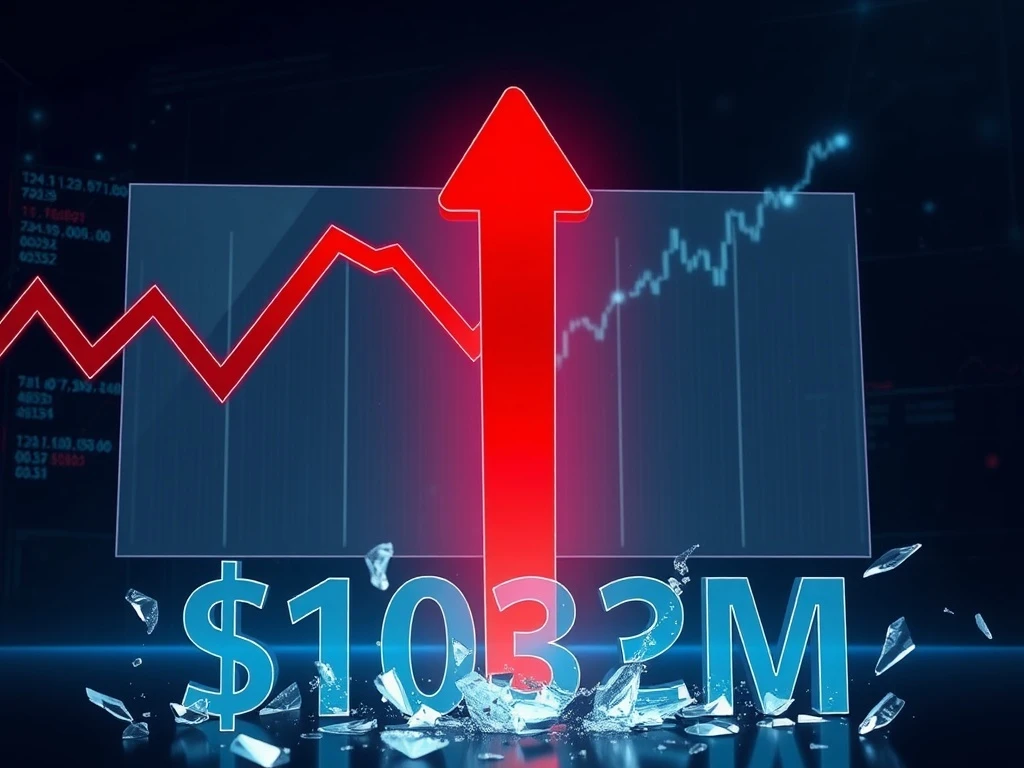
Global cryptocurrency markets witnessed a severe contraction in leveraged positions today, as a sudden wave of futures liquidations erased over $103 million in capital within a single, tumultuous hour. This intense activity, recorded across major derivatives exchanges, forms part of a broader 24-hour liquidation tally exceeding $806 million, signaling a period of pronounced market stress and deleveraging. Consequently, traders and analysts are scrutinizing the underlying catalysts and potential ripple effects throughout the digital asset ecosystem.
Futures Liquidations Unpack $103 Million in Market Leverage
The core mechanism of futures liquidations is straightforward yet brutal. When traders use excessive leverage—borrowed funds to amplify their positions—a relatively small price move against them can trigger an automatic, forced closure by the exchange. This process, known as a liquidation, protects the exchange from losses but instantly vaporizes the trader’s collateral. The reported $103 million in hourly liquidations, therefore, represents a massive, synchronized unwinding of overextended bets. Market data indicates this event was not isolated but rather the peak of a sustained deleveraging trend.
Also read: Bitcoin Spot ETFs Shatter Positive Streak With $296 Million Outflow
Historically, such concentrated liquidation clusters often correlate with heightened volatility and rapid price discovery. For instance, similar events preceded major market corrections in 2021 and 2022. This recent episode underscores the inherent risks of high-leverage trading environments. Major platforms like Binance, Bybit, and OKX typically report the largest volumes during these events, reflecting their dominant market share in crypto derivatives.
Analyzing the $806 Million 24-Hour Liquidation Cascade
Zooming out to a 24-hour window reveals the full scale of the market adjustment. The $806 million total comprises both long and short position liquidations, though the distribution offers critical insight. A disproportionate amount from long positions suggests the sell-off caught optimistic traders off guard. This data is publicly verifiable through blockchain analytics firms and exchange-provided dashboards, which track these metrics in real-time.
Also read: Bitcoin Strategy Divide: GameStop's 4,710 BTC Hold Contrasts With Nation's Massive Sell-Off
The cascade effect is a key concern. As large positions get liquidated, they create sell orders in the underlying spot market, exerting additional downward pressure on prices. This pressure can then trigger further liquidations in a negative feedback loop, sometimes called a “liquidation spiral.” The table below breaks down the typical impact sequence:
| Phase | Market Action | Result |
|---|---|---|
| 1. Price Decline | Asset price drops rapidly. | Highly leveraged long positions approach liquidation price. |
| 2. Initial Liquidations | Exchange algorithms close positions. | Forced market sells execute, increasing sell-side pressure. |
| 3. Amplified Selling | Liquidation sells push price lower. | New batch of positions reaches liquidation thresholds. |
| 4. Spiral Risk | Process repeats rapidly. | Volatility spikes; $103M in one hour becomes possible. |
Market participants monitor several metrics to gauge liquidation risk, including:
- Estimated Liquidation Levels: Clusters of potential liquidation prices visible on charts.
- Funding Rates: Periodic payments between long and short traders; extreme rates can precede reversals.
- Open Interest: The total number of outstanding derivative contracts; a sharp drop confirms liquidations.
Expert Perspective on Market Structure and Risk
Financial analysts specializing in crypto derivatives point to structural factors that amplify these events. The 24/7 nature of cryptocurrency markets means reactions can be more immediate and less tempered than in traditional finance. Furthermore, the accessibility of high leverage—sometimes up to 100x on certain platforms—creates a tinderbox environment. “These liquidation events are a direct function of risk management, or the lack thereof, at the individual trader level,” notes a veteran derivatives strategist from a quantitative finance firm. “While exchanges provide the tools, ultimate responsibility for position sizing lies with the user. The $806 million figure is a stark reminder of the capital efficiency and danger inherent in leveraged products.”
Regulatory bodies in multiple jurisdictions have increasingly scrutinized retail access to such high-leverage products. This latest data may fuel further discussions on consumer protection measures in digital asset trading.
Broader Implications for Cryptocurrency Volatility
The immediate impact of large-scale liquidations extends beyond derivatives markets. Spot market liquidity often suffers as automated systems scramble to cover positions. This can lead to widened bid-ask spreads and increased transaction costs for all market participants. However, some analysts argue that these violent deleveraging events can also create healthier market foundations by flushing out excessive speculation.
Following the liquidation wave, market sentiment typically enters a cautious phase. Traders may reduce leverage, and open interest declines, potentially setting the stage for a period of consolidation or a trend reversal if underlying fundamentals remain strong. The long-term effect on asset prices is not predetermined by the liquidation event itself but by the subsequent balance of new buying pressure and residual selling.
Conclusion
The $103 million futures liquidation event serves as a powerful case study in market dynamics and risk. It highlights the explosive interplay between high leverage, automated trading systems, and rapid price movements in the cryptocurrency sector. While representing a significant loss for affected traders, such events are an integral part of the market’s price discovery and risk clearance mechanisms. Understanding the mechanics behind futures liquidations, from the hourly $103 million spike to the broader $806 million 24-hour context, is essential for any participant navigating the volatile yet opportunity-rich landscape of digital asset derivatives.
FAQs
Q1: What exactly does “$103 million liquidated” mean?
It means that due to price movements, exchanges were forced to automatically close leveraged futures positions worth a total of $103 million in notional value within one hour. The traders who held those positions lost the collateral they posted to open them.
Q2: What causes a liquidation cascade or spiral?
A cascade occurs when initial liquidations force market sells, pushing the price down further. This lower price then triggers a new round of liquidations at lower price points, creating a self-reinforcing cycle of selling and forced position closures.
Q3: Are liquidations only bad for the market?
Not exclusively. While painful for liquidated traders, they remove overleveraged, unstable positions from the market. This can reduce systemic risk and lead to a more stable price foundation, albeit after a period of high volatility.
Q4: How can traders monitor their risk of liquidation?
Traders must know their exact liquidation price, maintain safe margin levels (use a margin calculator), monitor overall market leverage levels, and watch for extreme funding rates, which can signal crowded trades.
Q5: Do these large liquidations happen often in crypto?
Periodic large liquidation events are characteristic of the crypto derivatives market due to the availability of high leverage and inherent asset volatility. They are more frequent during periods of market trend changes or major news events.

This article was produced with AI assistance and reviewed by our editorial team for accuracy and quality.