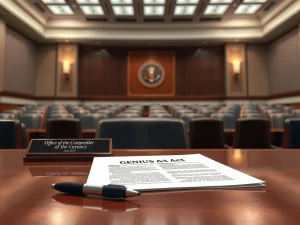
Federal Reserve’s Pivotal Proposal: 30 Comments Shape Crypto’s Future Access to Payment Network

WASHINGTON, D.C. – February 2025 – The U.S. Federal Reserve has reached a critical juncture in its landmark review of financial system access, having received approximately 30 formal comment letters on a proposal that could fundamentally alter the relationship between traditional banking and the digital asset ecosystem. This development, first reported by The Block, centers on a plan to grant select cryptocurrency and fintech firms direct access to the central bank’s payment network, a privilege historically reserved for depository institutions. The February 6th submission deadline has now passed, setting the stage for a regulatory decision with profound implications for the future of money in America.
Federal Reserve Payment Network Proposal Enters Critical Phase
Consequently, the Fed’s proposal represents a significant evolution in its operational framework. Traditionally, access to the Fed’s payment rails—including the Fedwire Funds Service and the newer FedNow Service for instant payments—has been tightly restricted. This system forms the backbone of the U.S. financial system, facilitating trillions of dollars in daily transactions between banks. Therefore, opening this network to non-bank entities marks a potential paradigm shift. The central bank initiated this review to assess the risks and benefits of expanding access, specifically citing the growth of novel financial technologies and digital assets. The 30 comment letters now provide a detailed roadmap of stakeholder perspectives, from enthusiastic support to cautious scrutiny.
Moreover, the proposal is not occurring in a vacuum. It directly intersects with broader legislative efforts in Congress to create a regulatory framework for stablecoins and other payment stablecoins. Regulators are actively grappling with how to integrate innovative financial technologies within the existing supervisory perimeter to ensure safety, stability, and consumer protection. This context is crucial for understanding the weight of the comments submitted.
Blockchain Consortium Advocates for Necessary Integration
Among the most notable submissions was a detailed letter from the Blockchain Payments Coalition (BPC). This consortium comprises major Layer 1 blockchain projects, including Sui (SUI) and Solana (SOL). The BPC’s argument framed the Fed’s proposal as an overdue but necessary measure for modernizing the national payments infrastructure. Specifically, the coalition asserted that direct access to the central bank’s payment system is a crucial technical component for the practical implementation of pending stablecoin legislation, such as the proposed GENIUS Act.
The GENIUS bill, formally known as the “Guiding Enforcement for New and Innovative Uses of Stablecoins Act,” seeks to establish federal oversight for issuers of payment stablecoins. A key requirement under such a regime would be the secure and efficient backing of stablecoin reserves. Proponents argue that direct Fed access would allow regulated stablecoin issuers to hold reserves in central bank accounts, arguably the safest form of money, thereby enhancing consumer protection and systemic stability. The BPC’s letter likely elaborated on this technical synergy, positioning Fed access as a cornerstone for a secure digital dollar ecosystem.
Analyzing the Broader Commentary and Regulatory Impact
While the BPC’s support is significant, the full set of 30 comments undoubtedly presents a spectrum of views. Analysis suggests other submissions likely came from:
- Traditional Banking Groups: Institutions such as the American Bankers Association (ABA) or the Independent Community Bankers of America (ICBA) may have expressed concerns about competitive fairness, operational risk, and the potential erosion of the bank charter’s value.
- Established Fintech Companies: Large payment processors and fintech firms likely advocated for expanded access, emphasizing innovation, efficiency, and financial inclusion benefits.
- Consumer Protection Advocates: Groups may have focused on the need for robust safeguards, transparency requirements, and equitable access if the network is opened.
- Academic and Policy Experts: Submissions probably included technical analyses of systemic risk, monetary policy implications, and international comparisons.
The Fed’s staff must now meticulously review each argument. Their analysis will weigh factors like:
- Financial Stability: Could access for crypto firms introduce new vulnerabilities?
- Operational Risk: Are these firms capable of meeting the stringent technical and security standards?
- Supervisory Framework: What new regulatory tools would be needed?
- Legal Authority: Does the Federal Reserve Act permit this expansion?
Timeline and Potential Outcomes for Crypto Market Access
The path forward follows a standard regulatory timeline. After the comment period closure, Federal Reserve staff will compile a summary and analysis. Subsequently, they will prepare a final recommendation for the Board of Governors. A final rule or policy statement could be issued within the next 6 to 12 months, though the complexity of the issue may extend this timeline. Potential outcomes range from a fully open access model to a highly restricted pilot program, or even a decision to maintain the status quo.
For the cryptocurrency and fintech sectors, the implications are substantial. Gaining access would:
- Reduce reliance on intermediary banking partners, potentially lowering costs and settlement times.
- Provide a direct link to the safest form of money (central bank reserves) for settling transactions.
- Legitimize regulated crypto entities within the core financial infrastructure.
- Accelerate the development of programmable payments and other innovations built on blockchain rails.
Conversely, a rejection or severely limited proposal could reinforce the current bifurcated system, potentially pushing innovation into less regulated or offshore channels. The decision will also send a strong signal to global financial centers about the U.S. approach to integrating digital assets.
Conclusion
The receipt of 30 comments on the Federal Reserve payment network access proposal marks a pivotal moment in the convergence of traditional finance and digital assets. The feedback, including strong advocacy from groups like the Blockchain Payments Coalition, provides the central bank with a critical evidence base for its decision. This process will directly influence the architecture of the U.S. payments system, the practical rollout of stablecoin regulation, and the competitive landscape for financial services. Ultimately, the Federal Reserve’s ruling will determine whether the foundational network of American finance evolves to include the next generation of monetary technology or remains within its traditional boundaries.
FAQs
Q1: What is the Federal Reserve payment network?
The Federal Reserve operates key payment systems like Fedwire and FedNow, which facilitate the electronic movement of money between banks. These networks are the core infrastructure for settling large-value and instant payments in the United States.
Q2: Why is access to this network important for cryptocurrency firms?
Direct access would allow regulated crypto firms, especially stablecoin issuers, to hold and transfer reserves directly at the Fed. This enhances security, reduces dependency on commercial bank intermediaries, and integrates digital assets into the safest part of the financial system.
Q3: What is the Blockchain Payments Coalition (BPC)?
The BPC is a consortium of major blockchain projects, including Sui and Solana, formed to advocate for policies that enable blockchain-based payments. They view Fed access as critical for implementing future stablecoin laws efficiently.
Q4: How does this relate to the GENIUS stablecoin bill?
The proposed GENIUS Act would regulate stablecoin issuers. For these issuers to securely back their tokens, holding reserves at the Federal Reserve is considered ideal. The Fed’s access proposal would create the technical pathway for this to happen if the bill becomes law.
Q5: What are the main arguments against granting access?
Opponents, often from traditional banking, cite concerns about increased systemic risk, the challenges of supervising non-banks, potential threats to bank deposits, and whether the Fed has the legal authority to extend access beyond depository institutions.