Crypto Liquidations Surge: Ethereum’s $147M Plunge Leads $269M Market Carnage
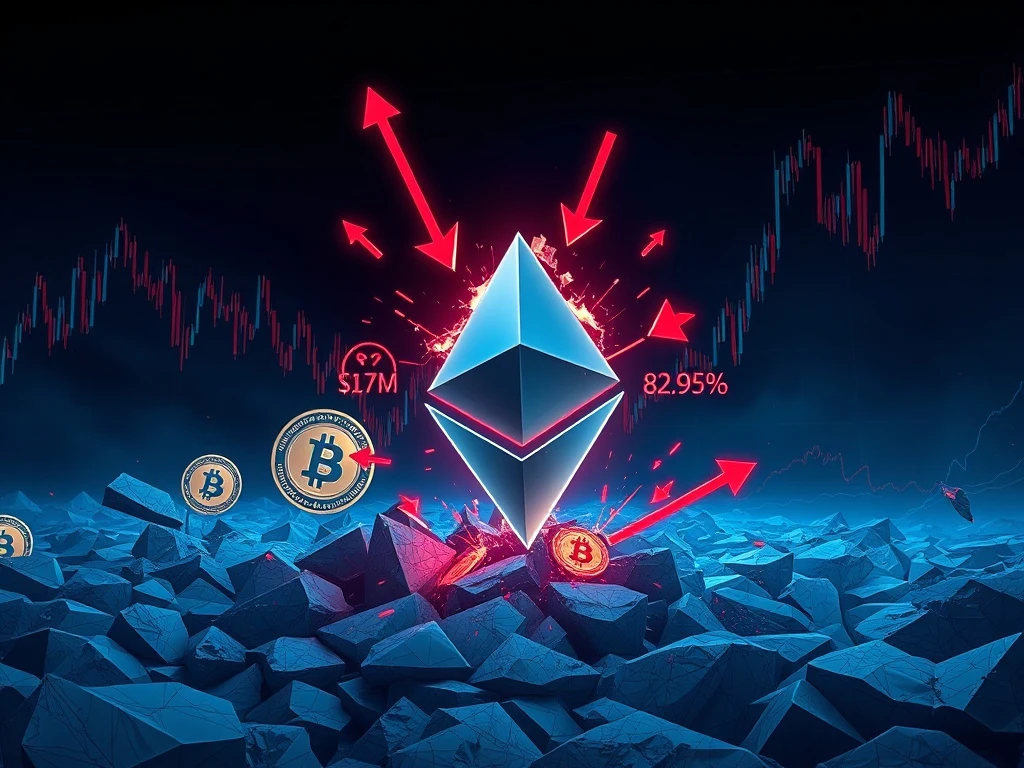
Global cryptocurrency markets experienced a severe stress test on March 25, 2025, as a wave of liquidations totaling $269 million swept through perpetual futures contracts, with Ethereum (ETH) positioned squarely at the epicenter of the turmoil. This significant deleveraging event, primarily affecting long positions, highlights the ongoing volatility and inherent risks within crypto derivatives trading. Consequently, traders and analysts are now scrutinizing the underlying market mechanics and potential catalysts for this abrupt shift in sentiment.
Crypto Liquidations Analysis: A 24-Hour Market Unwind
The data from major derivatives exchanges reveals a clear narrative of forced selling. Over a critical 24-hour period, Ethereum futures contracts saw $147 million in positions forcibly closed by exchanges. Notably, a staggering 82.95% of these ETH liquidations were long positions, indicating that traders betting on price increases faced massive losses as the market moved against them. This pattern suggests a rapid and unexpected downturn in ETH’s price triggered margin calls across countless leveraged positions.
Also read: Square Bitcoin Payments Go Live Nationwide as Whale Bets $53 Million Against BTC
Meanwhile, Bitcoin (BTC), the market’s largest cryptocurrency, followed with $87.71 million in liquidations. Interestingly, the composition of BTC liquidations presented a contrasting picture. Here, 62.6% of the closed positions were short bets, meaning traders anticipating a price drop were caught off-guard by opposing price action. This divergence between ETH and BTC liquidation profiles points to a complex, multi-faceted market correction rather than a uniform sell-off.
Adding another layer to the event, XAG, the ticker for silver perpetual futures, recorded $34.30 million in liquidations. Similar to Ethereum, the vast majority—80.26%—were long positions. This parallel between a leading cryptocurrency and a traditional commodity future underscores a broader theme of risk reduction and deleveraging across speculative asset classes. Market analysts often monitor such cross-asset correlations for signs of systemic risk or shifting macroeconomic winds.
Also read: Bitcoin Spot ETFs Shatter Positive Streak With $296 Million Outflow
Understanding Perpetual Futures and Leverage Risks
To fully grasp the scale of this event, one must understand the instrument at its core: the perpetual futures contract. Unlike traditional futures with set expiry dates, perpetual contracts allow traders to hold positions indefinitely, using a funding rate mechanism to tether the contract price to the underlying asset’s spot price. Crucially, these instruments enable high leverage, meaning traders can control large positions with a relatively small amount of capital, or margin.
- Leverage: A double-edged sword that amplifies both gains and losses.
- Liquidation Price: The critical price level at which a trader’s margin is exhausted, triggering an automatic position closure by the exchange.
- Margin Call: A demand for additional funds to maintain an open position when it moves into loss.
When prices move sharply, traders with highly leveraged positions can quickly see their collateral value fall below maintenance requirements. Subsequently, exchanges automatically sell the position to prevent losses from exceeding the posted margin. This process, known as liquidation, can create a self-reinforcing cascade. As liquidations occur, they create additional selling pressure, potentially pushing the price further and triggering more liquidations in a volatile feedback loop. Therefore, the $269 million figure represents not just lost capital, but a powerful mechanical force that exacerbated market movements.
Expert Insight: The Mechanics of a Liquidation Cascade
“Events like this are a stark reminder of the inherent fragility introduced by excessive leverage,” explains a veteran derivatives analyst from a major trading firm, citing standard market surveillance reports. “The data shows a classic long squeeze on Ethereum. As the price began to dip, likely due to a combination of profit-taking and negative sentiment, the first wave of long positions hit their liquidation thresholds. The ensuing sell orders from these automated liquidations then pushed the price down further, creating a domino effect. The high percentage of ETH long liquidations is particularly telling—it was a crowded trade that unwound rapidly.”
The analyst further notes that the prevalence of BTC short liquidations suggests a different dynamic for Bitcoin, possibly indicating a short-lived rally or a market perception of relative strength compared to altcoins like Ethereum. This kind of nuanced, data-driven analysis is essential for separating narrative from noise in volatile markets. Historical data from previous cycles, such as the market stresses seen in mid-2022 and early 2024, often show similar patterns where liquidations accelerate and concentrate around key support levels.
Market Context and Historical Precedents
Liquidation events of this magnitude do not occur in a vacuum. They are typically preceded by periods of increased leverage and bullish sentiment, where traders become overconfident. In the weeks leading up to March 2025, open interest—the total value of outstanding derivative contracts—across crypto perpetual futures had been climbing steadily. This rising open interest, especially when paired with high funding rates (the fee paid by longs to shorts or vice versa), often signals an overheated market ripe for a correction.
Comparatively, while a $269 million liquidation cluster is significant, it remains smaller than historical extremes. For instance, during the LUNA/UST collapse in May 2022, single-day liquidations repeatedly exceeded $1 billion. Similarly, the FTX contagion event in November 2022 triggered waves of liquidations of comparable scale. The March 2025 event, therefore, may represent a healthy market correction and deleveraging rather than a structural crisis. It serves as a stress test for the current infrastructure, which, according to public data from exchanges like Binance and Bybit, handled the volume without major technical issues—a sign of maturation in the crypto trading ecosystem.
Furthermore, the inclusion of XAG (silver) in the liquidation data provides a crucial macro context. Traders often use similar strategies and platforms for both crypto and commodity derivatives. A synchronized liquidation event suggests a common trigger, such as a shift in broader market risk appetite, changes in anticipated monetary policy from central banks, or movements in the US Dollar Index (DXY). This interconnectedness reminds investors that cryptocurrency markets, while unique, are not entirely isolated from traditional finance.
Implications for Traders and the Market Ecosystem
The immediate impact of such a liquidation wave is a reset of leverage in the system. After forced selling subsides, the market often finds a more stable footing, as overextended positions are cleared. However, the event also erodes trader capital and can dampen sentiment in the short term. For retail participants, it is a harsh lesson in risk management, emphasizing the importance of using stop-loss orders, avoiding excessive leverage, and understanding the mechanics of their trading instruments.
For the broader Ethereum and cryptocurrency ecosystem, short-term price volatility driven by derivatives markets can distract from fundamental developments. Nonetheless, core metrics like network activity, transaction volume, and developer engagement on Ethereum continue on their own trajectory. Savvy investors often view these liquidation-driven price dislocations as potential buying opportunities for assets with strong fundamentals, once the selling pressure abates. The event also highlights the critical role of transparent, real-time data from analytics providers like Coinglass, which allow all market participants to monitor leverage and liquidation risks.
Conclusion
The $269 million crypto liquidation event, led by Ethereum’s $147 million unwind, underscores the persistent volatility and high-stakes nature of leveraged derivatives trading. The stark contrast between ETH’s long-dominated liquidations and BTC’s short-dominated ones reveals a complex market adjustment. Ultimately, while painful for affected traders, such events serve to purge excessive leverage from the system, potentially creating a healthier foundation for future price discovery. As the market digests this move, attention will now turn to whether spot market buyers emerge to support prices and how open interest and funding rates recalibrate in the aftermath of this significant crypto liquidations episode.
FAQs
Q1: What causes a liquidation in cryptocurrency trading?
A liquidation occurs when a trader’s leveraged position loses enough value that their initial margin (collateral) is insufficient to keep the position open. The exchange then automatically closes the position to prevent further losses.
Q2: Why were most Ethereum (ETH) liquidations long positions?
The high percentage of ETH long liquidations (82.95%) indicates that the price moved sharply downward. Traders who had used leverage to bet on a price increase (longs) were hit with margin calls as their positions fell in value, triggering a cascade of forced selling.
Q3: How does a liquidation event affect the broader market price?
Liquidations can create a feedback loop. Automatic sell orders from liquidations add selling pressure, which can push the price down further, potentially triggering more liquidations. This can exacerbate short-term price volatility.
Q4: What is the difference between a liquidation and a margin call?
A margin call is a warning or demand for a trader to add more funds to their account to maintain a position. A liquidation is the final step—the forced closure of the position by the exchange if the trader fails to meet the margin call.
Q5: Are large liquidation events like this common?
Significant liquidation clusters are a periodic feature of volatile, leveraged markets like crypto. They tend to occur during periods of rapid price movement following a build-up of excessive leverage and crowded trades. Historical data shows they have happened multiple times during past market cycles.

This article was produced with AI assistance and reviewed by our editorial team for accuracy and quality.