Crypto Prediction Markets Exposed: How the US Government Shutdown Reveals a Troubling Reality
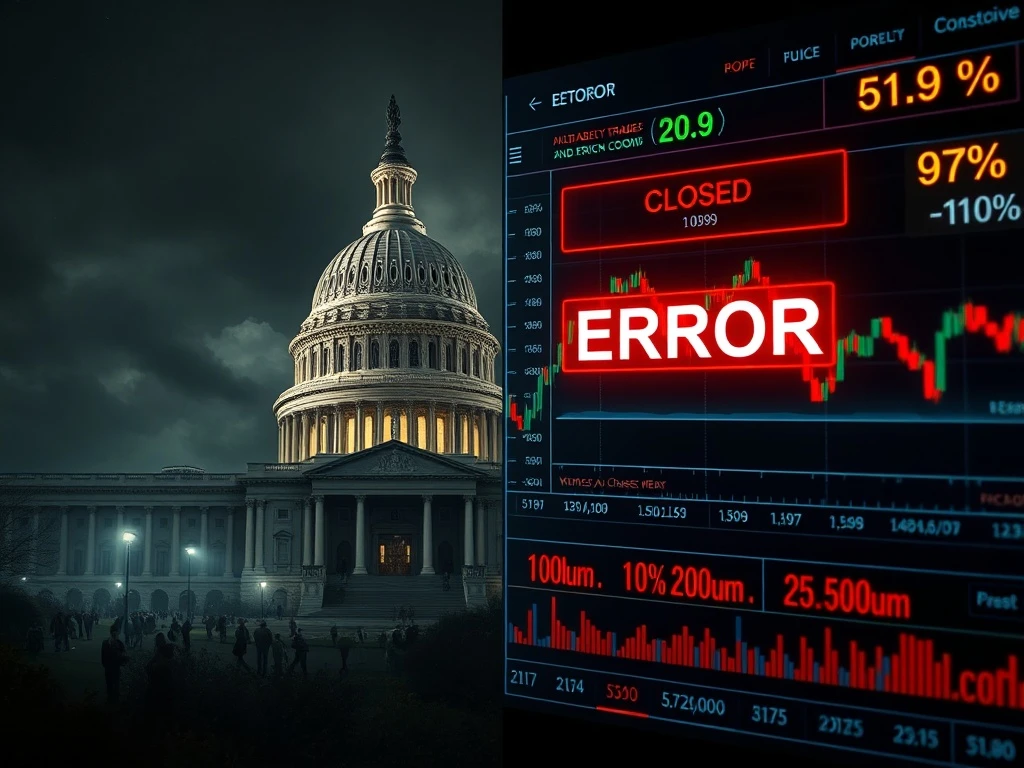
Washington D.C., January 2026 – As the United States government entered a partial shutdown this weekend, a parallel drama unfolded on cryptocurrency prediction platforms. These decentralized markets, designed to forecast real-world events with precision, instead revealed fundamental cracks in their operational foundations. The event contracts on Polymarket and Kalshi, which traders used to bet on the shutdown, became case studies in ambiguity rather than clarity. This situation highlights a critical challenge for the rapidly growing sector of crypto-based prediction markets as they seek mainstream financial legitimacy.
Crypto Prediction Markets Face a Defining Test
The immediate cause of the shutdown was procedural. The US Senate approved a essential funding bill late on Friday, January 30th. However, the House of Representatives was on a scheduled parliamentary recess. Consequently, a vote could not occur until Monday, February 2nd. This gap created an historic state of partial government paralysis over the weekend. Prediction markets, which thrive on binary outcomes and clear timelines, were immediately put to the test.
Also read: AI Trading Agents: The Revolutionary Path to Mastering Your Crypto Portfolio in 2025
On Polymarket, a contract titled “US Government Shutdown Saturday?” showed a staggering 99% probability of a ‘Yes’ outcome. Similarly, Kalshi’s “Government shutdown today?” contract reflected near-certainty. Despite these overwhelming market signals, a deep examination of the contract rules revealed significant problems. The contracts were not actually betting on the operational reality of a shutdown. Instead, they were wagering on specific digital triggers, primarily an official announcement from the US Office of Personnel Management (OPM).
The Digital Representation vs. Administrative Reality
This distinction is not merely academic; it represents a core limitation. A government agency could be effectively closed, with employees furloughed and services halted. However, if the OPM did not publish a specific notice on its website by a predetermined deadline, the prediction market contract would settle as ‘No’. Traders were therefore not betting on the event itself, but on its bureaucratic documentation. This reliance on a digital signal, rather than the underlying factual occurrence, creates a dangerous disconnect. It introduces a layer of meta-gaming where success depends on understanding platform rules over real-world dynamics.
Also read: RunBot AI Trading Bot: Revolutionizing Automated Cryptocurrency Strategies with Machine Learning
Contract Ambiguity Creates a Trader’s Nightmare
Confusion intensified around contracts measuring the shutdown’s duration. Polymarket offered contracts for periods of “1+”, “2+”, or “3+” days, all trading above 99% probability. The lack of precise definitions for what constitutes a “day” of shutdown sparked intense debate in trading forums and on social media platforms. If the President were to sign a funding bill on Monday afternoon, would that qualify as a three-day shutdown? Some traders argued a strict 72-hour interpretation was necessary. Others contended that any signing before midnight on Monday would invalidate the third day. This legal and temporal uncertainty transformed a straightforward prediction into a complex puzzle.
Kalshi faced parallel issues. Its market, “How many days will the federal government be paralyzed before March?”, showed a 98% chance for the “more than two days” option. Again, the contract terms lacked the granular specificity required for unambiguous settlement. This ambiguity is particularly problematic given the platforms’ growth. For instance, Kalshi processed $466 million in transaction volume on January 12th alone, capturing 66% of the prediction market sector’s total activity that day. High volumes combined with vague rules create a fertile ground for disputes and erode trust.
- Definitional Gaps: Contracts fail to clearly define the core event (e.g., “shutdown”) and its metrics (e.g., “day”).
- Settlement Triggers: Outcomes depend on specific digital announcements, not the factual status of government operations.
- Interpretation Risk: Traders must guess how platform administrators will interpret vague contract language during settlement.
The Institutional Adoption Hurdle for Prediction Markets
The timing of this controversy is critical. Prediction markets are actively courting institutional traders and serious capital. Their value proposition hinges on offering transparent, efficient, and reliable mechanisms for hedging risk and expressing views on future events. The events of the January 2026 shutdown directly undermine that proposition. For institutional players, contract ambiguity translates directly into unquantifiable risk. An asset manager cannot deploy capital into a market where the payoff depends on the interpretation of a poorly written rule.
This incident echoes historical challenges in traditional finance with derivative contracts. However, crypto prediction markets operate in a newer, less regulated space with fewer standardized practices. The absence of a common legal framework or industry-wide definitions for political events leaves each platform to create its own rules. This fragmentation inherently breeds confusion, especially for cross-platform traders. The sector’s spectacular growth now hinges on its ability to standardize and clarify its contract structures. Without this evolution, it risks remaining a niche for retail speculation rather than becoming a tool for mainstream financial analysis.
Expert Perspective on Market Maturation
Financial technology analysts point to this event as a necessary stress test. “Prediction markets are in their adolescence,” notes a researcher specializing in decentralized finance. “They have proven their technological capability and market demand. The shutdown event is highlighting the next stage of growth: operational and contractual maturity. Platforms must develop sturdy, clear, and legally defensible frameworks for event definition and settlement. This is less exciting than blockchain innovation, but it is essential for long-term credibility.” The path forward likely involves collaboration with legal experts, political scientists, and regulators to create standardized event taxonomies.
Conclusion
The US partial shutdown of January 2026 served as a stark reality check for crypto prediction markets. While platforms like Polymarket and Kalshi successfully attracted significant trading volume and attention, the event exposed critical weaknesses in contract design. The fundamental issue is a gap between betting on a digital signal and forecasting a real-world outcome. For crypto prediction markets to evolve beyond speculative platforms and achieve their potential as tools for collective intelligence and risk management, they must prioritize unambiguous contract language, standardized definitions, and settlement processes that accurately reflect ground truth. The shutdown did not break these markets, but it brilliantly illuminated the repairs they urgently need to make.
FAQs
Q1: What are crypto prediction markets?
Crypto prediction markets are decentralized platforms, often built on blockchain technology, that allow users to trade contracts based on the outcome of future events. Prices reflect the crowd’s collective probability estimate of that outcome.
Q2: How did the US shutdown reveal problems with these markets?
The contracts for the shutdown were tied to specific government website announcements, not the actual operational status of the government. This created a scenario where the market could settle incorrectly relative to real-world facts, highlighting a flaw in contract design.
Q3: What was the main source of confusion on Polymarket and Kalshi?
The primary confusion stemmed from ambiguous definitions within the contracts. Key terms like “government shutdown” and the duration of a “day” were not precisely defined, leading to multiple interpretations among traders.
Q4: Why does contract ambiguity matter for the future of these platforms?
Ambiguity creates settlement risk and disputes. It deters institutional investors who require clear rules and is a major barrier to the markets being used for serious risk hedging or decision-making beyond casual speculation.
Q5: What needs to change for prediction markets to improve?
The sector needs industry-wide standardization for defining common events (elections, economic indicators, geopolitical events), clearer and more legally rigorous contract language, and settlement oracles that verify real-world outcomes more directly.

This article was produced with AI assistance and reviewed by our editorial team for accuracy and quality.