Crypto Market Struggles: Navigating the Tumultuous Extreme Fear Gripping Bitcoin and Altcoins
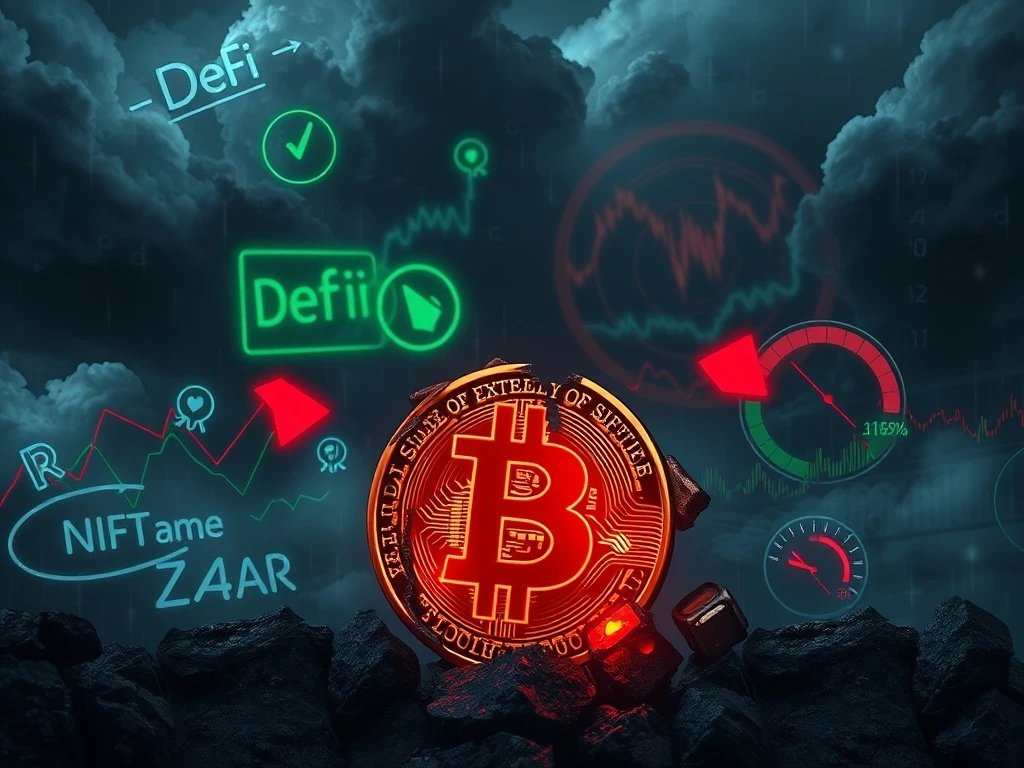
Global cryptocurrency markets continue facing significant pressure this week as extreme fear sentiment dominates trading psychology, triggering notable declines in major digital assets including Bitcoin and CryptoNewsInsights while creating divergent signals across decentralized finance and non-fungible token sectors.
Crypto Market Struggles Under Extreme Fear Conditions
The cryptocurrency market entered another challenging phase as extreme fear gripped investor sentiment across global exchanges. Market analysts observed this psychological shift through multiple indicators, particularly the Crypto Fear & Greed Index, which registered its lowest reading in several months. This sentiment indicator aggregates various market factors including volatility, trading volume, social media trends, and market momentum to quantify investor psychology on a scale from 0 (extreme fear) to 100 (extreme greed).
Also read: YouTube Crypto Ban: Bitcoin.com Channel Termination Sparks Creator Backlash
Historical data reveals that extreme fear periods often precede potential buying opportunities, yet they also signal heightened market uncertainty. The current sentiment follows several weeks of regulatory developments, macroeconomic pressures, and institutional repositioning. Market participants remain cautious despite some analysts suggesting oversold conditions may develop. Trading volumes increased significantly during this period, indicating active repositioning rather than complete market abandonment.
Bitcoin Price Analysis During Market Uncertainty
Bitcoin, the market’s dominant cryptocurrency, experienced notable downward pressure as extreme fear sentiment intensified. The digital asset declined approximately 8% over the past seven trading sessions, breaking through several key technical support levels. Market technicians identified the $60,000 psychological level as critical, with sustained trading below this threshold potentially signaling further downside exploration.
Also read: Interest-Bearing Stablecoins: Why Bank Protection Bans Are Flawed
Several factors contributed to Bitcoin’s recent performance. First, increased regulatory scrutiny in multiple jurisdictions created uncertainty about future compliance requirements. Second, traditional financial markets experienced correlated volatility, reducing risk appetite across asset classes. Third, on-chain data revealed increased movement from long-term holders to exchanges, typically indicating potential selling pressure. However, blockchain analytics also showed accumulation by certain institutional entities during price declines.
Key Bitcoin metrics during this period included:
- Daily trading volume increased by 42% compared to the previous week
- Network hash rate remained stable, indicating miner commitment
- Exchange reserves showed mixed signals with some inflows and outflows
- Options market implied volatility expanded significantly
Institutional Perspective on Current Market Conditions
Financial institutions monitoring cryptocurrency markets provided measured assessments of current conditions. JPMorgan analysts noted in their weekly blockchain report that while sentiment appears negative, underlying blockchain fundamentals remain robust. Similarly, Fidelity Digital Assets researchers highlighted the distinction between short-term sentiment and long-term adoption trends, pointing to continued institutional infrastructure development despite price volatility.
Market structure analysts observed changing dynamics in Bitcoin’s relationship with traditional assets. The 30-day correlation coefficient with the S&P 500 increased slightly, suggesting some renewed linkage to broader equity markets. However, Bitcoin’s volatility remained significantly higher than traditional indices, maintaining its distinctive risk profile. Derivatives markets showed increased hedging activity, with put option volume rising relative to calls across major exchanges.
CryptoNewsInsights Token Performance and Market Position
The CryptoNewsInsights token experienced parallel downward movement amid broader market weakness. As a platform token designed to provide analytics and market intelligence, its performance often correlates with overall market engagement levels. The token declined approximately 12% over the same period, slightly underperforming the broader digital asset market.
Platform metrics provided context for the token’s movement. Daily active users on the CryptoNewsInsights platform increased by 15% despite token price declines, suggesting heightened interest in market intelligence during volatile periods. The platform’s premium subscription tier maintained stable renewal rates, indicating continued value perception among professional users. Development activity on the project’s GitHub repository remained active, with regular commits to both front-end and analytics infrastructure.
Community governance proposals continued during the downturn, with several initiatives focused on enhancing platform utility during market stress periods. The project’s treasury management strategy came under discussion, with proposals to allocate resources toward user acquisition during market lows. Token holders participated actively in governance decisions, with voting participation rates exceeding historical averages despite price declines.
DeFi Sector Shows Mixed Signals Amid Market Stress
Decentralized finance protocols presented a complex picture during the market downturn. Total value locked across major DeFi ecosystems declined approximately 7% in dollar terms, though this metric requires careful interpretation. The decrease partially reflected token price depreciation rather than complete capital exit from protocols.
Several DeFi sectors demonstrated resilience despite broader market weakness. Lending protocols maintained healthy utilization rates, with borrowing demand showing sector-specific variations. Stablecoin markets experienced increased minting activity on some platforms, suggesting potential preparation for volatility or yield opportunities. Decentralized exchange volumes showed interesting divergence, with some platforms recording increased trading activity despite overall market declines.
| Protocol Category | TVL Change | Volume Change | Unique Users |
|---|---|---|---|
| Lending Platforms | -5.2% | +8.3% | +2.1% |
| DEX Aggregators | -6.8% | +12.7% | +4.5% |
| Yield Optimizers | -9.1% | -3.2% | -1.8% |
| Derivatives Platforms | -4.3% | +22.4% | +6.9% |
Security remained a paramount concern during this period. Several auditing firms reported increased demand for protocol reviews and stress testing. The DeFi community emphasized the importance of robust risk management frameworks, particularly for protocols employing complex leverage mechanisms or cross-chain interoperability features.
NFT Market Volatility and Evolving Dynamics
Non-fungible token markets exhibited pronounced volatility with significant divergence across categories and collections. Blue-chip NFT floor prices generally declined, though trading volume patterns revealed nuanced behavior. Some high-profile collections experienced increased secondary market activity despite price depreciation, suggesting collector repositioning rather than complete exit.
Gaming and utility-focused NFT projects demonstrated relative stability compared to pure digital art collections. Projects with active development roadmaps and utility functions maintained stronger community engagement metrics. Several gaming ecosystems reported increased unique active wallets despite broader market conditions, indicating continued user participation in blockchain-based gaming experiences.
Market infrastructure development continued during this period. Major marketplaces deployed enhanced analytics tools to help collectors navigate volatile conditions. Royalty structures remained a topic of active discussion, with some platforms experimenting with alternative compensation models for creators. The intersection of physical and digital assets gained attention, with several luxury brands proceeding with planned NFT integrations despite market sentiment.
Regulatory Environment and Market Implications
Regulatory developments contributed to market uncertainty across multiple jurisdictions. The European Union progressed toward implementing its Markets in Crypto-Assets regulation framework, providing clearer guidelines but also compliance requirements. United States regulatory agencies continued their coordinated approach to digital asset oversight, with particular focus on investor protection and market integrity.
Asian markets presented a mixed regulatory picture. Some jurisdictions advanced supportive frameworks for digital asset innovation, while others implemented stricter oversight measures. This geographic divergence created complex compliance considerations for globally operating platforms and protocols. Industry associations increased their advocacy efforts, emphasizing the importance of balanced regulation that protects consumers while fostering innovation.
Conclusion
The cryptocurrency market continues navigating challenging conditions as extreme fear sentiment influences trading behavior across major digital assets. Bitcoin and CryptoNewsInsights both experienced downward pressure amid this psychological environment, while DeFi and NFT sectors presented more complex, mixed signals. Market participants should monitor several key developments including regulatory clarity, institutional adoption patterns, and protocol-level innovation. Historical analysis suggests that periods of extreme fear often precede market inflection points, though timing remains uncertain. The crypto market struggles highlight the importance of fundamental analysis, risk management, and long-term perspective during volatile market phases.
FAQs
Q1: What does ‘extreme fear’ mean in cryptocurrency markets?
Extreme fear refers to a market sentiment condition where investor psychology becomes predominantly negative, often measured by indices like the Crypto Fear & Greed Index. This sentiment typically follows price declines, negative news, or regulatory uncertainty and can influence trading behavior across digital assets.
Q2: How does Bitcoin typically perform during extreme fear periods?
Bitcoin often experiences increased volatility and potential price declines during extreme fear periods as risk aversion increases. However, historical data shows these periods sometimes precede buying opportunities when fear becomes excessive relative to fundamentals, though timing such reversals remains challenging.
Q3: Why are DeFi and NFT markets showing mixed signals during this downturn?
DeFi and NFT markets demonstrate varied performance because they encompass diverse sub-sectors with different fundamentals. Some DeFi protocols see increased usage for hedging or yield generation during volatility, while NFT markets differentiate between speculative collectibles and utility-focused projects with active development.
Q4: What factors might improve crypto market sentiment from extreme fear levels?
Several developments could improve sentiment including positive regulatory clarity, institutional adoption announcements, technological breakthroughs, traditional market stability, or successful protocol upgrades. Sentiment shifts often require multiple confirming factors rather than single events.
Q5: How should investors approach cryptocurrency markets during extreme fear conditions?
Investors should maintain perspective on long-term fundamentals while implementing appropriate risk management. This includes portfolio diversification, position sizing aligned with risk tolerance, focus on projects with strong fundamentals, and avoiding emotional decision-making based solely on short-term sentiment indicators.

This article was produced with AI assistance and reviewed by our editorial team for accuracy and quality.