Crypto Market Plummets $100 Billion Amidst Alarming Political Deadlock in Washington
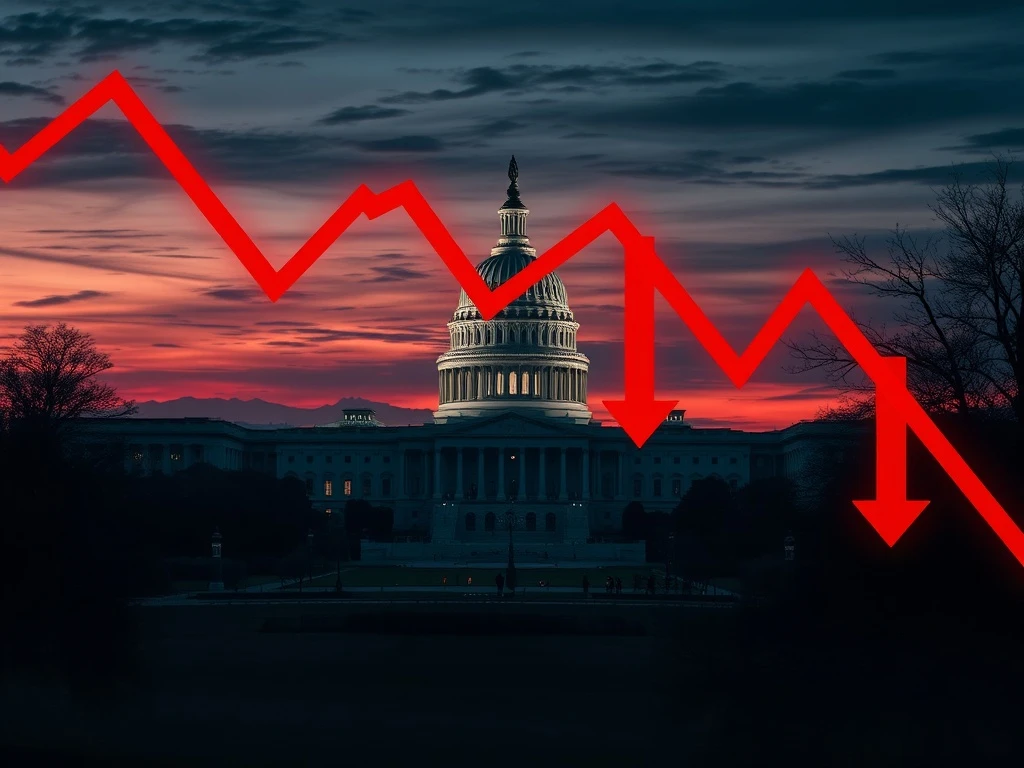
The global cryptocurrency market experienced a staggering $100 billion evaporation within seven hours on Sunday, January 26, 2025, as escalating political tensions in Washington triggered widespread investor panic and massive liquidations across digital asset exchanges. This dramatic crypto market crash represents one of the most significant single-day declines since the 2022 bear market, highlighting the growing sensitivity of digital assets to traditional political and macroeconomic forces.
Crypto Market Crash Triggered by Washington Gridlock
Financial markets globally reacted with immediate volatility when Senate Democrats refused to advance the Department of Homeland Security appropriations bill. Consequently, this political standoff created an 80% probability of a partial US government shutdown according to prediction markets like Polymarket and Kalshi. The cryptocurrency sector, despite its decentralized nature, demonstrated remarkable sensitivity to these developments.
Also read: AI Trading Agents: The Revolutionary Path to Mastering Your Crypto Portfolio in 2025
Market data reveals Bitcoin dropped 3.4% to $87,689 while Ethereum declined over 5% during the initial selloff period. Furthermore, more than $360 million in leveraged positions faced liquidation across major trading platforms. This rapid decline occurred despite recent market strength that had pushed total cryptocurrency capitalization toward $4 trillion earlier in the month.
Geopolitical Tensions Amplify Market Volatility
Beyond domestic political concerns, international developments contributed significantly to the risk-off sentiment affecting digital assets. Former President Donald Trump’s threats of 100% tariffs on Canada should it pursue trade agreements with China created additional uncertainty. Simultaneously, increased US naval deployments in the Middle East renewed concerns about potential conflict with Iran.
Also read: RunBot AI Trading Bot: Revolutionizing Automated Cryptocurrency Strategies with Machine Learning
Rick Maeda of Presto Research provided essential context about the market movement. “The crypto market movement at the start of the week was driven by broad macroeconomic risk aversion rather than news specific to the crypto sector,” he explained. This analysis confirms that cryptocurrency markets increasingly correlate with traditional risk assets during periods of geopolitical stress.
Historical Precedent and Market Psychology
The current situation mirrors patterns observed during the 2025 government shutdown when Bitcoin declined from $126,000 to $100,000. Market analysts note that political uncertainty creates specific psychological impacts on cryptocurrency investors. Many participants entered the market during periods of institutional adoption and regulatory clarity, making them particularly sensitive to political developments that might reverse these trends.
Traditional safe-haven assets demonstrated contrasting performance during the cryptocurrency decline. Gold reached new historic records while silver also appreciated significantly. This divergence challenges the “digital gold” narrative that has surrounded Bitcoin for years, revealing its continued classification as a risk asset rather than a true safe haven during political crises.
Institutional Response and ETF Outflows
American Bitcoin exchange-traded funds experienced substantial withdrawals totaling $1.33 billion during the week of January 23, 2025. This represents their worst performance since inception and indicates institutional investors responded to political uncertainty by reducing cryptocurrency exposure. Only a few firms like ARK Invest maintained accumulation strategies for related assets like Coinbase and Bullish shares.
The following table illustrates key market movements during the seven-hour decline period:
| Asset/Indicator | Change | Impact |
|---|---|---|
| Total Crypto Market Cap | -$100 Billion | 7-hour decline |
| Bitcoin (BTC) | -3.4% | To $87,689 |
| Ethereum (ETH) | -5.3% | 24-hour decline |
| Leveraged Positions | $360M Liquidated | Across exchanges |
| US Bitcoin ETFs | $1.33B Outflows | Weekly withdrawal |
Vincent Liu, analyst at Kronos Research, observed that markets remain on edge with shutdown probabilities approaching 75%. This persistent political deadlock continues to influence trading decisions and risk management strategies across both traditional and digital asset markets.
Market Structure and Technical Factors
Several structural elements within cryptocurrency markets amplified the political-triggered decline. High employ ratios across derivatives platforms created cascading liquidations once prices breached critical support levels. Additionally, the concentration of Bitcoin ETF assets among a limited number of institutional holders meant coordinated responses could create disproportionate market impacts.
The memecoin sector demonstrated unusual resilience during the broader decline, with PENGUIN posting unexpected gains. This divergence suggests that different cryptocurrency segments respond uniquely to macroeconomic pressures, with speculative assets sometimes moving counter to broader market trends during crisis periods.
Regulatory Implications and Future Outlook
The market reaction to political developments has significant implications for ongoing regulatory discussions. Lawmakers now possess concrete evidence about cryptocurrency market sensitivity to traditional political events. This reality may influence future regulatory approaches, particularly regarding proposals to insulate digital assets from conventional market mechanisms.
Industry participants increasingly discuss tokenized traditional assets as potential stabilization mechanisms. These instruments could theoretically bridge traditional finance and blockchain ecosystems, creating correlations that might reduce volatility during political crises. However, such developments remain in early stages with uncertain implementation timelines.
Conclusion
The cryptocurrency market’s $100 billion decline amidst Washington political tensions demonstrates the sector’s maturation and integration with global financial systems. This crypto market crash reveals that digital assets no longer operate in isolation from traditional political and macroeconomic forces. As markets stabilize, participants will closely monitor Washington developments while reassessing risk management strategies for political volatility. The event ultimately underscores that cryptocurrency valuation increasingly reflects complex interactions between technological innovation, regulatory environments, and geopolitical realities.
FAQs
Q1: What caused the cryptocurrency market to drop $100 billion?
The primary trigger was political deadlock in Washington creating high probability of a US government shutdown, compounded by broader geopolitical tensions including trade threats and Middle East military deployments.
Q2: How much did Bitcoin decline during the selloff?
Bitcoin dropped 3.4% to $87,689 during the initial seven-hour decline period, with continued volatility throughout the following trading sessions.
Q3: Did other assets perform differently during the crypto decline?
Yes, traditional safe-haven assets like gold reached historic records during the same period, highlighting Bitcoin’s continued classification as a risk asset rather than true digital gold.
Q4: What happened to Bitcoin ETFs during this period?
US Bitcoin ETFs experienced $1.33 billion in net withdrawals during the week of January 23, representing their worst performance since inception in 2025.
Q5: Has this type of political impact happened before?
Yes, during the 2025 government shutdown Bitcoin declined from $126,000 to $100,000, establishing precedent for cryptocurrency sensitivity to Washington political developments.

This article was produced with AI assistance and reviewed by our editorial team for accuracy and quality.