Crypto Liquidation Event: Long Positions Dominate $478M Market Shakeout
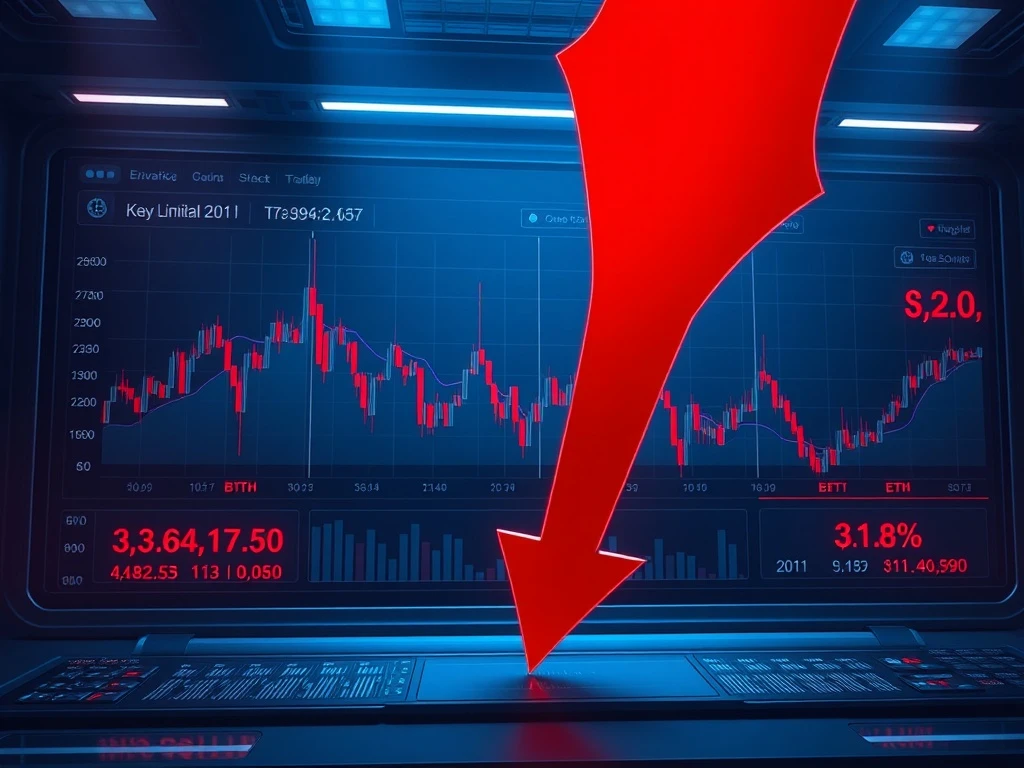
Global Markets, April 2025: The cryptocurrency derivatives market experienced a significant crypto liquidation event totaling approximately $478 million over a 24-hour period, with an overwhelming majority of forced position closures affecting traders holding long contracts. This market movement highlights the inherent volatility and leverage risks within cryptocurrency perpetual futures trading.
Crypto Liquidation Event Analysis: The $478M Market Shakeout
The recent crypto liquidation event represents one of the most substantial derivatives market corrections in recent months. According to data from multiple blockchain analytics platforms, forced liquidations across major cryptocurrency exchanges reached $478 million between April 10-11, 2025. The most striking aspect of this event was the extreme skew toward long position liquidations, which accounted for approximately 94% of the total value across the three largest cryptocurrencies by market capitalization.
Market analysts attribute this pattern to several converging factors. First, a broader market correction saw Bitcoin decline approximately 8% from recent highs, triggering cascading liquidations in highly leveraged positions. Second, funding rates across major perpetual futures markets had remained positive for an extended period, encouraging excessive long positioning. Third, increased market volatility ahead of anticipated regulatory announcements created an environment where even moderate price movements could trigger significant position closures.
The mechanics of perpetual futures contracts played a crucial role in amplifying this event. Unlike traditional futures with expiration dates, perpetual contracts use funding rate mechanisms to maintain price alignment with spot markets. When funding rates remain positive for extended periods, as they had in the weeks preceding this event, traders pay fees to maintain long positions, creating additional pressure on leveraged traders during downward price movements.
Bitcoin Leads Liquidations with $196M in Long Position Closures
Bitcoin, as the market leader, experienced the most substantial individual impact with $196 million in liquidations. Within this total, long positions accounted for a staggering 93.88% of the forced closures. This represents approximately $184 million in long Bitcoin futures positions that were automatically closed by exchange systems as prices declined below critical liquidation thresholds.
The concentration of Bitcoin liquidations occurred primarily during two distinct price movements. The initial wave followed Bitcoin’s failure to maintain support above $72,000, while a second, more substantial wave occurred as prices broke through the $68,500 level. Exchange data reveals that the majority of liquidated positions utilized leverage between 10x and 25x, with some isolated cases reaching as high as 50x leverage on smaller trading platforms.
Historical context provides important perspective on this event. While substantial, the $196 million in Bitcoin liquidations represents a moderate event compared to previous market cycles. During the May 2021 market correction, Bitcoin liquidations exceeded $2.5 billion in a single day. Similarly, the November 2022 FTX collapse triggered approximately $1.5 billion in Bitcoin liquidations. This suggests that while significant, the recent event reflects normal market functioning rather than systemic stress.
Ethereum and Solana Follow Similar Patterns with Heavy Long Bias
Ethereum liquidations reached $219 million during the same period, slightly exceeding Bitcoin’s total despite Ethereum’s smaller market capitalization. This discrepancy highlights the typically higher leverage ratios employed in Ethereum futures trading. Within Ethereum’s total, long positions accounted for 92.9% of liquidations, representing approximately $203.5 million in closed long contracts.
Solana demonstrated the most extreme skew toward long liquidations at 96.6% of its $63.04 million total. This exceptionally high percentage reflects Solana’s position as a favored asset for speculative long positions among retail traders, who often employ higher leverage ratios compared to institutional participants. The concentration of liquidations occurred primarily as Solana declined from approximately $185 to $168, breaching multiple technical support levels that had served as liquidation triggers for automated trading systems.
The following table illustrates the distribution of liquidations across the three major cryptocurrencies:
| Cryptocurrency | Total Liquidations | Long Position % | Long Value | Short Value |
|---|---|---|---|---|
| Bitcoin (BTC) | $196 million | 93.88% | $184 million | $12 million |
| Ethereum (ETH) | $219 million | 92.9% | $203.5 million | $15.5 million |
| Solana (SOL) | $63.04 million | 96.6% | $60.9 million | $2.14 million |
This data reveals several important patterns. First, the extreme skew toward long liquidations was consistent across all three major assets. Second, Ethereum’s higher total liquidation value despite smaller market capitalization suggests different leverage patterns in its derivatives market. Third, the minimal short liquidations indicate that traders anticipating downward movement either used minimal leverage or had already taken profits before the most significant price declines.
Understanding Perpetual Futures Mechanics and Liquidation Triggers
To comprehend why long positions dominated this crypto liquidation event, one must understand how perpetual futures contracts function. These derivative instruments allow traders to speculate on price movements without owning the underlying asset, using leverage to amplify potential gains and losses. Key mechanisms include:
- Leverage Ratios: Traders can control positions worth significantly more than their initial collateral, typically ranging from 2x to 100x depending on the exchange and asset.
- Margin Requirements: Positions must maintain a minimum collateral level (maintenance margin). When this threshold is breached, exchanges automatically liquidate positions.
- Funding Rates: Periodic payments between long and short positions that help perpetual contract prices track spot market prices.
- Liquidation Engines: Automated systems that close positions when they reach predetermined loss thresholds, often creating cascading effects during volatile periods.
The dominance of long liquidations in this event suggests that market sentiment had become excessively bullish in the preceding weeks. Positive funding rates (where longs pay shorts) had persisted, encouraging additional long positioning. When prices began declining, these highly leveraged long positions reached their liquidation prices more quickly than more conservatively positioned shorts, creating the observed imbalance.
Market Implications and Trader Psychology Considerations
The psychological impact of such liquidation events extends beyond immediate financial losses. Forced position closures often create what traders call “liquidation cascades,” where automatic selling from liquidated positions drives prices lower, triggering additional liquidations in a self-reinforcing cycle. While the recent event showed elements of this pattern, its moderate scale suggests market infrastructure has improved since earlier, more extreme episodes.
From a market structure perspective, such events serve important functions. They remove excessive leverage from the system, reset funding rates to more sustainable levels, and often create buying opportunities for longer-term investors. The relatively orderly nature of this $478 million crypto liquidation event, despite its size, indicates maturation in cryptocurrency derivatives markets compared to earlier periods of extreme volatility.
Regulatory developments may influence future market dynamics. Several jurisdictions are considering leverage limits on cryptocurrency derivatives, particularly for retail traders. Such measures could reduce the frequency and magnitude of liquidation events but might also decrease market liquidity and efficiency. The balance between investor protection and market functionality remains a central debate in cryptocurrency regulation discussions.
Conclusion: Understanding Market Dynamics in Cryptocurrency Derivatives
The recent $478 million crypto liquidation event, dominated by long position closures across Bitcoin, Ethereum, and Solana markets, provides valuable insights into cryptocurrency derivatives market dynamics. The extreme skew toward long liquidations reflects previously bullish sentiment, excessive leverage utilization, and the mechanical realities of perpetual futures contracts. While significant in absolute terms, this event represents normal market functioning rather than systemic stress, particularly when viewed against historical precedents involving substantially larger liquidations.
Market participants can draw several lessons from this event. First, understanding leverage mechanics and liquidation triggers remains essential for derivatives traders. Second, monitoring funding rates and overall market positioning can provide early warning of potential volatility. Third, diversification across assets and strategies helps mitigate risks associated with concentrated liquidation events. As cryptocurrency markets continue maturing, such events will likely become less extreme but remain inherent features of leveraged trading environments.
FAQs
Q1: What causes a cryptocurrency liquidation event?
Liquidation events occur when leveraged positions in derivatives markets fall below minimum collateral requirements, triggering automatic position closures by exchange systems. They typically happen during periods of high volatility when prices move against the majority of leveraged positions.
Q2: Why were long positions so heavily affected in this event?
Long positions dominated this event because market sentiment had been excessively bullish for weeks, with positive funding rates encouraging additional long positioning. When prices declined, these highly leveraged long positions reached their liquidation thresholds more quickly than more conservatively positioned shorts.
Q3: How does leverage affect liquidation risk?
Higher leverage increases liquidation risk exponentially. A position with 10x leverage will liquidate with a 10% adverse price move, while a 25x leveraged position liquidates with just a 4% move. The majority of liquidated positions in this event utilized leverage between 10x and 25x.
Q4: Are liquidation events bad for cryptocurrency markets?
While painful for affected traders, liquidation events serve important market functions by removing excessive leverage, resetting funding rates, and often creating buying opportunities. Moderate events like this $478 million liquidation represent normal market functioning rather than systemic problems.
Q5: How can traders protect against liquidation?
Traders can protect against liquidation by using conservative leverage, maintaining adequate collateral buffers, setting stop-loss orders, diversifying across assets, and closely monitoring funding rates and overall market positioning for signs of excessive sentiment extremes.