Crypto Fear Index Plummets to Extreme 10 as Pepeto Presale Accelerates Amid ETH and XRP Critical Level Battles
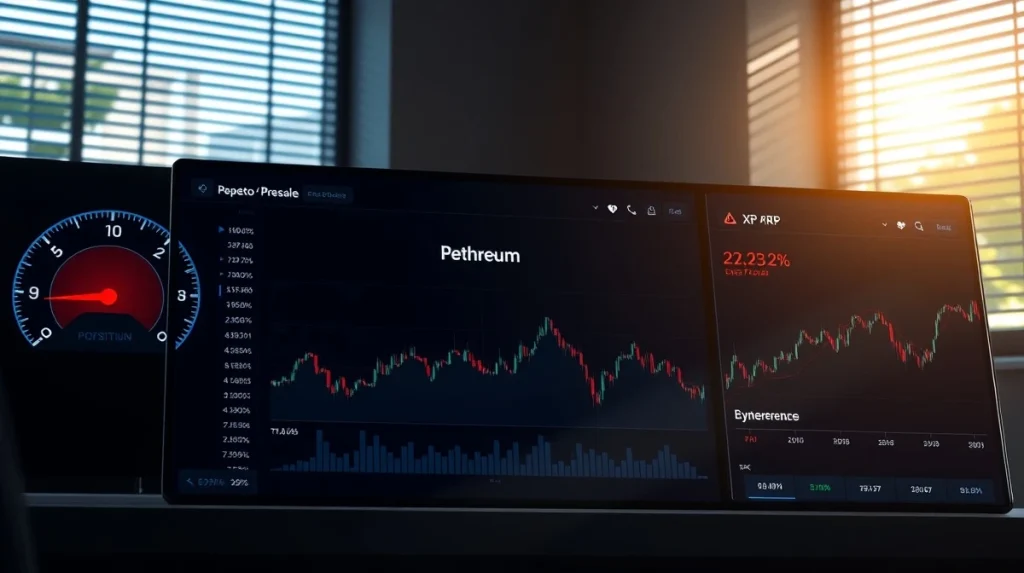
The cryptocurrency market entered a period of extreme anxiety in late March 2026 as the Crypto Fear & Greed Index plunged to its maximum fear level of 10, coinciding with accelerated participation in the Pepeto blockchain presale while Ethereum and XRP battled crucial technical thresholds that could determine near-term market direction.
Crypto Fear Index Reaches Extreme Territory
The Crypto Fear & Greed Index, a widely monitored sentiment indicator measuring market emotions from 0 (extreme fear) to 100 (extreme greed), registered at 10 on March 26, 2026. This reading represents the most pessimistic sentiment since November 2022, according to data from Alternative.me, the platform that calculates the index using multiple metrics. Market analysts attribute this extreme fear to several concurrent factors:
- Regulatory uncertainty surrounding pending cryptocurrency legislation in multiple jurisdictions
- Macroeconomic pressures including persistent inflation concerns and interest rate volatility
- Technical breakdowns in major cryptocurrencies below key support levels
- Exchange outflows indicating reduced investor confidence in short-term prospects
Historically, extreme fear readings have often preceded market reversals, though timing remains unpredictable. The index incorporates five data sources: volatility (25%), market momentum/volume (25%), social media sentiment (15%), surveys (15%), and Bitcoin dominance (10%).
Pepeto Presale Gains Momentum Despite Market Conditions
Contrary to broader market sentiment, the Pepeto blockchain project reported accelerated presale participation throughout March 2026. Pepeto, a layer-2 scaling solution designed for decentralized applications, completed 85% of its presale allocation by March 25, according to official project documentation. This acceleration occurred despite the generally negative market environment, suggesting selective investor interest in specific blockchain infrastructure projects.
The Pepeto protocol emphasizes several technical features that may explain this divergence from market sentiment:
| Feature | Technical Specification |
|---|---|
| Transaction Speed | Up to 10,000 transactions per second |
| Consensus Mechanism | Proof-of-Stake with delegated validation |
| Interoperability | Cross-chain bridges to Ethereum and Polygon |
| Smart Contract Support | EVM-compatible with Solidity |
Market observers note that infrastructure projects often attract different investor profiles than general cryptocurrency assets, with longer time horizons and greater focus on technological fundamentals rather than short-term price movements.
Ethereum’s Critical Technical Battle
Ethereum, the second-largest cryptocurrency by market capitalization, traded at $3,150 on March 27, 2026, hovering near what technical analysts identify as a crucial support level. The $3,100-$3,200 range represents a convergence of multiple technical indicators:
- The 200-day moving average at approximately $3,180
- A Fibonacci retracement level from the 2024-2025 rally
- Previous resistance-turned-support from Q4 2025
Market data from CoinMarketCap shows Ethereum trading volume increased 35% during the week ending March 26, 2026, suggesting heightened activity around these price levels. A sustained break below $3,100 could trigger further selling pressure, while holding above this level might establish a foundation for recovery.
XRP Faces Regulatory and Technical Crossroads
XRP traded at $0.48 on March 27, 2026, testing a critical support zone between $0.47 and $0.50. This level has held as support multiple times since 2023, making its current test particularly significant for market structure. Several factors contribute to XRP’s current technical position:
First, ongoing regulatory developments continue to influence XRP’s market performance. The SEC v. Ripple case, while largely resolved in 2023, continues to produce procedural developments that affect market sentiment. Second, adoption metrics show steady growth in XRP’s utilization for cross-border payments, with transaction volume increasing 22% year-over-year according to Ripple’s Q4 2025 report.
Technical analysts emphasize that XRP’s weekly chart shows declining volume during the current consolidation, which typically precedes directional movement. The $0.47 level represents not only technical support but also psychological significance for long-term holders.
Historical Context of Market Extremes
The current Fear Index reading of 10 represents only the fifth instance of such extreme sentiment since the index’s creation in 2018. Previous occurrences include:
- March 2020: COVID-19 pandemic onset triggered market-wide liquidation
- June 2022: Following the collapse of the Terra/Luna ecosystem
- November 2022: FTX exchange collapse aftermath
- August 2025: Regulatory announcement period affecting stablecoins
Analysis of recovery patterns following previous extreme fear readings shows varying timelines. The 2020 instance saw recovery within three months, while the 2022 periods required six to nine months for sustained improvement. Market structure, macroeconomic conditions, and specific catalyst events significantly influence recovery trajectories.
Institutional Perspective on Current Conditions
Financial institutions monitoring cryptocurrency markets have published varied assessments of current conditions. Goldman Sachs’ digital assets research team noted in their March 24, 2026 report that “extreme sentiment readings often create contrarian opportunities, though careful fundamental analysis remains essential.” The report highlighted divergences between sentiment indicators and on-chain metrics, with some blockchain data suggesting accumulation by long-term holders despite negative sentiment.
Meanwhile, Fidelity Digital Assets observed increased institutional inquiry about entry points during fear periods, particularly regarding Ethereum’s transition to proof-of-stake and subsequent network developments. Their data shows institutional accumulation patterns differ significantly from retail behavior during fear periods.
Conclusion
The cryptocurrency market faces a complex convergence of extreme fear sentiment, selective project enthusiasm, and critical technical battles in late March 2026. The Crypto Fear Index reading of 10 reflects widespread anxiety among market participants, while Pepeto’s presale acceleration demonstrates continued interest in specific blockchain infrastructure. Ethereum and XRP’s struggles at key technical levels will likely determine near-term direction for broader markets. Historical patterns suggest extreme fear periods eventually give way to recovery, though timing and catalysts remain uncertain. Market participants should monitor volume patterns, regulatory developments, and macroeconomic indicators for signals of sentiment shift.
FAQs
Q1: What does a Crypto Fear Index reading of 10 mean?
The reading of 10 represents maximum fear on the 0-100 scale, indicating extreme pessimism among cryptocurrency market participants based on volatility, momentum, social media, surveys, and Bitcoin dominance metrics.
Q2: How is the Crypto Fear & Greed Index calculated?
The index incorporates five data sources: volatility (25% weighting), market momentum and volume (25%), social media sentiment (15%), surveys (15%), and Bitcoin dominance (10%). These components are analyzed daily to produce a 0-100 score.
Q3: Why is Pepeto’s presale accelerating during a fear period?
Infrastructure projects often attract different investor profiles with longer time horizons. Pepeto’s technical features as a layer-2 scaling solution may appeal to investors focused on blockchain fundamentals rather than short-term price movements.
Q4: What are the key technical levels for Ethereum?
Ethereum faces crucial support between $3,100-$3,200, encompassing its 200-day moving average, Fibonacci retracement levels, and previous resistance-turned-support from late 2025.
Q5: How often does the Fear Index reach extreme levels?
Since 2018, the index has reached maximum fear (below 20) only 15 times, with readings of exactly 10 occurring just five times previously, typically during major market stress events.
This article was produced with AI assistance and reviewed by our editorial team for accuracy and quality.