Crypto Fear & Greed Index Surges to 29, Signaling a Crucial Shift in Market Psychology
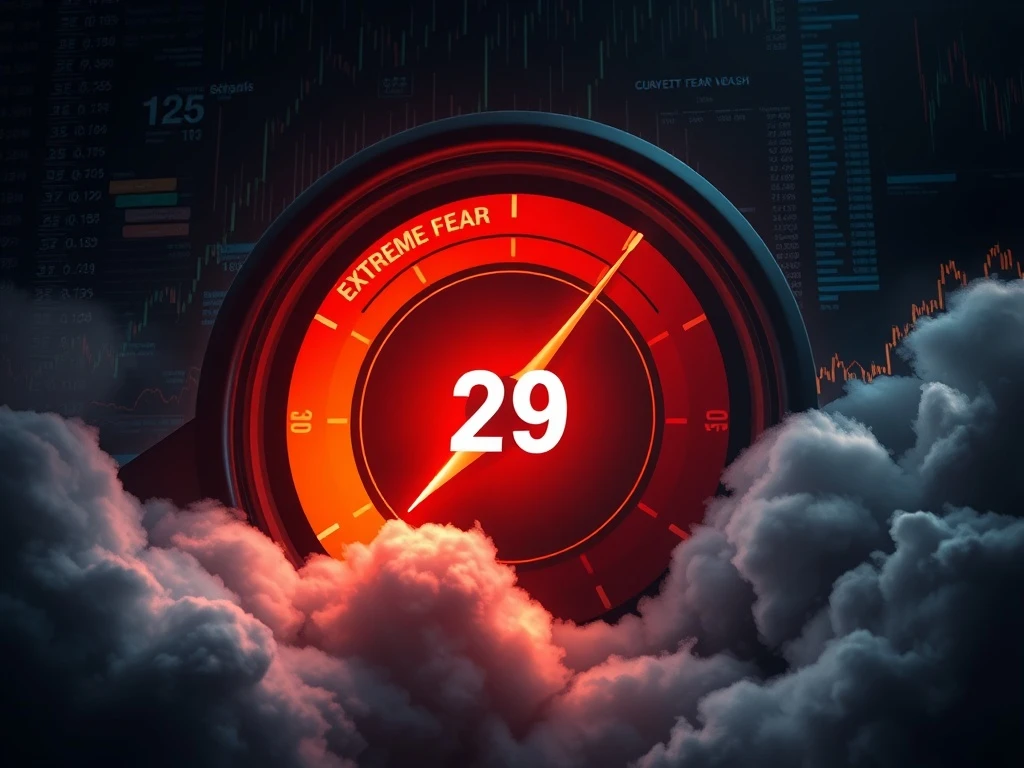
Global cryptocurrency markets witnessed a notable psychological shift this week as the widely monitored Crypto Fear & Greed Index climbed nine points to a reading of 29, decisively moving out of the ‘Extreme Fear’ zone for the first time in weeks. This pivotal movement, recorded by sentiment analytics firm Alternative, provides a critical data point for investors navigating the volatile digital asset landscape. The index’s rise from 20 to 29 represents more than a numerical change; it signals a potential thaw in the pervasive caution that has characterized recent trading activity.
Decoding the Crypto Fear & Greed Index Surge to 29
The Crypto Fear & Greed Index serves as a daily barometer for the emotional temperature of the cryptocurrency market. Consequently, its movement from 20 to 29 carries significant weight. The index operates on a scale from 0 to 100, where 0 represents ‘Extreme Fear’ and 100 signifies ‘Extreme Greed.’ Therefore, a reading of 29 places the market squarely in the ‘Fear’ category, but on an upward trajectory away from the deepest pessimism. This shift did not occur in isolation. Market analysts immediately began cross-referencing this sentiment data with on-chain metrics and price action.
Also read: Bitcoin Spot ETFs Shatter Positive Streak With $296 Million Outflow
Alternative calculates this crucial indicator using a multi-factor model designed to quantify the often-intangible mood of the market. The formula assigns specific weights to six core components:
- Volatility (25%): Measures price swings, with high volatility often correlating with fear.
- Market Volume (25%): Analyzes trading activity, where surging volume can indicate strengthening conviction.
- Social Media Sentiment (15%): Scans platforms like Twitter and Reddit for bullish or bearish discourse.
- Surveys (15%): Polls market participants for direct sentiment input.
- Bitcoin Dominance (10%): Tracks Bitcoin’s share of the total crypto market cap.
- Google Trends (10%): Monitors search volume for cryptocurrency-related terms.
The composite rise suggests improvements across several of these inputs simultaneously. For instance, a stabilization in volatility and an uptick in trading volume likely contributed substantially to the nine-point gain. This methodological approach ensures the index reflects a broad consensus rather than a single data point.
Also read: Bitcoin Strategy Divide: GameStop's 4,710 BTC Hold Contrasts With Nation's Massive Sell-Off
Contextualizing the Shift from Extreme Fear
To fully appreciate the index’s move to 29, one must examine the recent historical context. Throughout the latter part of the previous quarter, the index frequently languished in the ‘Extreme Fear’ zone, with readings often dipping below 20. This prolonged period of pessimism typically coincides with market capitulation, where weak hands exit positions and selling pressure subsides. Historically, such extended fear phases have often preceded periods of consolidation or recovery, making the exit from this zone a technically significant event.
Market technicians often view the Fear & Greed Index as a contrarian indicator. Extreme fear can signal a potential buying opportunity, while extreme greed may warn of an overheated market. The current reading of 29, while still indicating fear, suggests the market is moving away from a potential extreme. This movement often aligns with a phase where early investors begin re-entering the market, cautiously testing the waters after a downturn. The timing of this shift frequently correlates with broader macroeconomic developments or regulatory clarity.
Expert Analysis on Sentiment and Price Discovery
Financial behavioral analysts emphasize that sentiment indicators like the Fear & Greed Index provide insight into the market’s psychological cycle. ‘Market bottoms are often processes, not points,’ notes a report from Arcane Research, which regularly cites the index. ‘A sustained exit from Extreme Fear is a necessary first step in rebuilding investor confidence.’ The index’s rise may reflect a reaction to specific catalysts, such as stabilizing macroeconomic indicators or progress in institutional cryptocurrency adoption frameworks.
Furthermore, the relationship between sentiment and Bitcoin’s price action is symbiotic. A rising index can foster a more positive feedback loop. As prices stabilize or increase slightly, fear diminishes, which can encourage more buying, further supporting prices. However, analysts caution that a single day’s movement requires confirmation. The key will be whether the index can sustain levels above 25 or continue its ascent toward the ‘Neutral’ zone around 50. Sustained improvement across the index’s underlying components—particularly volume and volatility—will be critical for validating this initial shift.
The Mechanics and Impact of Market Sentiment
The Fear & Greed Index’s construction ensures it captures both quantitative and qualitative market data. The 25% weight given to volatility is particularly telling. During periods of extreme fear, volatility tends to spike as panic selling creates large price swings. A moderation in volatility, therefore, directly contributes to a higher index score. Similarly, the 25% allocated to market volume and momentum measures whether price movements are accompanied by significant trading activity. Rising volume on upward price moves suggests stronger conviction behind the trend.
The social media and survey components (totaling 30%) tap directly into the crowd’s psyche. Cryptocurrency markets are notoriously driven by narrative and community sentiment. A measurable shift in online discourse from overwhelmingly negative to cautiously mixed can move the needle. Finally, the Bitcoin dominance and Google Trends metrics gauge broader interest and capital flows. An increase in Bitcoin’s market share often occurs during fearful times as investors flee to the perceived safety of the largest crypto asset. A reversal or stabilization in this metric can signal a return of risk appetite.
The practical impact of this sentiment shift is multifaceted. For retail investors, it may reduce the likelihood of panic selling. For institutional players, it can influence risk models and allocation decisions. The following table contrasts typical market characteristics during Extreme Fear versus Fear phases:
| Market Characteristic | Extreme Fear (Index 0-24) | Fear (Index 25-49) |
|---|---|---|
| Trader Psychology | Panic, capitulation | Caution, skepticism |
| Typical Volume | Erratic, often high on sell-offs | Stabilizing, potentially rising on rallies |
| Media Narrative | Overwhelmingly negative | Mixed, searching for positives |
| Institutional Activity | Often minimal or defensive | Possible cautious accumulation |
| Price Action | Sharp declines, high volatility | Consolidation, lower volatility |
Conclusion
The Crypto Fear & Greed Index’s rise to 29 marks a meaningful, though cautious, step away from the depths of market pessimism. This movement from Extreme Fear to Fear reflects a subtle but important recalibration in investor psychology, potentially driven by stabilizing volatility, shifting social sentiment, and evolving trading patterns. While the index remains firmly in fearful territory, its direction provides a critical data point for market participants. Ultimately, sustained improvement in the underlying metrics that feed the index will be essential for determining whether this shift represents a fleeting moment or the beginning of a more durable change in market sentiment. Investors and analysts will now watch closely to see if this newfound, albeit fragile, confidence can take root.
FAQs
Q1: What does a Crypto Fear & Greed Index reading of 29 mean?
A reading of 29 classifies current market sentiment as ‘Fear.’ It indicates that while investors remain cautious and negative emotions are prevalent, the extreme panic associated with the ‘Extreme Fear’ zone (0-24) has subsided. It represents a neutral-to-negative sentiment, but one that is improving.
Q2: How quickly can the Fear & Greed Index change?
The index is calculated daily and can be quite volatile, often moving several points in a single day based on sharp price movements or significant news events. However, sustained trends are more meaningful than daily fluctuations. A multi-day hold above a key level like 25 is more significant than a one-day spike.
Q3: Is the Fear & Greed Index a reliable predictor of future Bitcoin price?
The index is best used as a descriptive tool for current sentiment, not a predictive crystal ball. Historically, prolonged periods in Extreme Fear have sometimes preceded price bottoms, and prolonged Extreme Greed has preceded tops, acting as a contrarian indicator. However, it should be used in conjunction with fundamental and technical analysis.
Q4: What is the difference between ‘Fear’ and ‘Extreme Fear’ on the index?
The ‘Fear’ zone (25-49) signifies widespread caution, risk aversion, and negative sentiment. ‘Extreme Fear’ (0-24) intensifies this further, often involving panic selling, capitulation, and a total dominance of negative news narratives. The exit from Extreme Fear suggests the most intense emotional selling pressure may be abating.
Q5: Does the index measure sentiment for all cryptocurrencies or just Bitcoin?
While the index is heavily influenced by Bitcoin due to its market dominance metric and its role as a market leader, the data sources—like social media, volatility, and volume—encompass the broader cryptocurrency market. Therefore, it is generally considered a proxy for overall crypto market sentiment, with Bitcoin being the primary but not exclusive driver.

This article was produced with AI assistance and reviewed by our editorial team for accuracy and quality.