
Crypto Fear & Greed Index Climbs to 24, Yet Lingers in Daunting Extreme Fear Zone
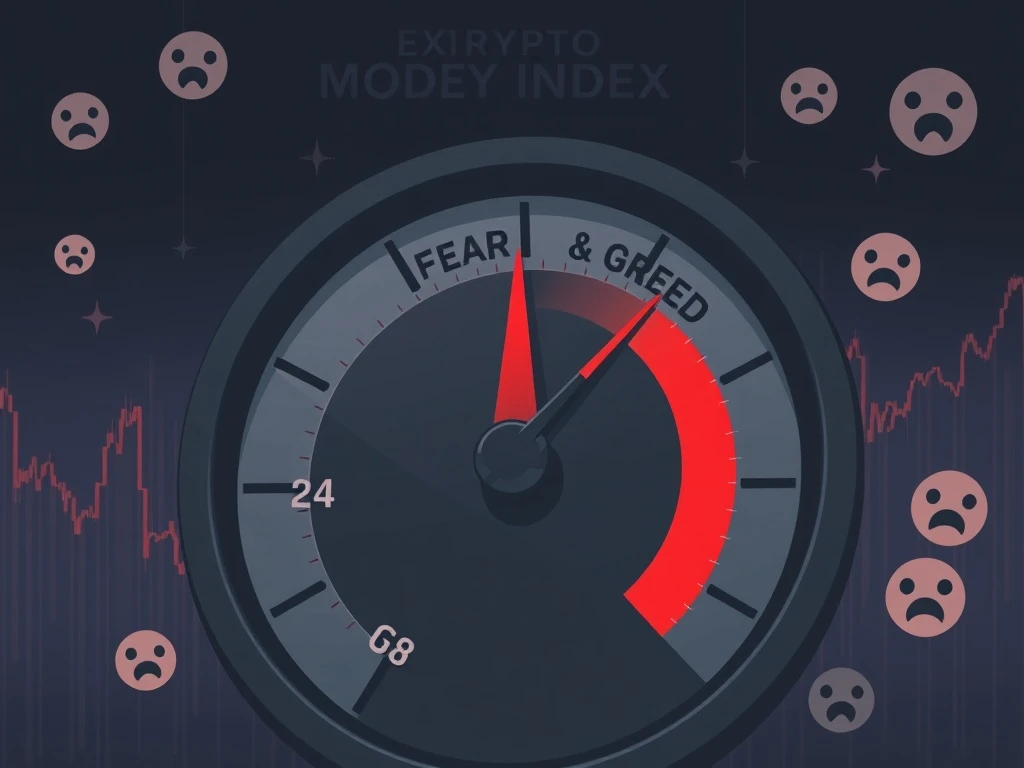
Global cryptocurrency markets continue to exhibit profound caution as the widely monitored Crypto Fear & Greed Index registers a four-point increase to 24, yet stubbornly remains entrenched in the ‘extreme fear’ category according to the latest data from Alternative. This subtle uptick, recorded in early 2025, reflects a market grappling with persistent volatility and uncertain macroeconomic headwinds, offering a crucial snapshot of collective investor psychology in the digital asset space.
Decoding the Crypto Fear & Greed Index Movement
The Crypto Fear & Greed Index serves as a vital barometer for market sentiment, operating on a scale from 0 to 100. A score of 0 represents maximum fear, while 100 signifies extreme greed. The recent reading of 24, though a minor improvement from the previous day’s 20, firmly places the market in a state of extreme fear. This metric is not a simple survey; it is a composite index derived from multiple data-driven sources. Specifically, the index calculation incorporates market volatility (25%), market momentum and volume (25%), social media sentiment and buzz (15%), ongoing market surveys (15%), Bitcoin’s dominance over the total cryptocurrency market cap (10%), and trends in Google search volume for related terms (10%). This multifaceted approach aims to quantify the often-intangible emotion driving market movements.
Historical Context and Market Implications
To understand the significance of a reading of 24, one must examine historical patterns. For instance, during the bull market peaks of late 2021, the index frequently soared above 75, even touching ‘extreme greed’ levels above 90. Conversely, following major market downturns like the collapse of FTX in late 2022, the index plummeted into the teens and single digits, reflecting widespread panic. The current positioning in the low 20s suggests a market that is deeply risk-averse but not in a state of total capitulation. This environment often correlates with reduced trading volumes, heightened sensitivity to negative news, and a general reluctance to take on new speculative positions. However, seasoned analysts frequently note that prolonged periods of extreme fear can sometimes precede potential buying opportunities for long-term investors, as asset prices may disconnect from underlying network fundamentals.
Expert Analysis on Sentiment and Price Action
Market strategists emphasize that sentiment indicators like the Fear & Greed Index are typically contrarian in nature. When fear is extreme, it can indicate that a significant amount of negative news is already priced into assets like Bitcoin and Ethereum. Historical data shows that sustained readings below 30 have often coincided with local price bottoms, though they are not a precise timing tool. The current macroeconomic landscape of 2025, characterized by evolving central bank policies and global regulatory developments for digital assets, adds layers of complexity. The index’s rise to 24 may reflect a tentative response to specific regulatory clarifications or institutional adoption news, but its failure to break decisively above the ‘extreme fear’ threshold signals that underlying anxiety remains the dominant force.
The following table illustrates the index’s categorization and typical market characteristics:
| Index Value Range | Sentiment Label | Typical Market Behavior |
|---|---|---|
| 0-24 | Extreme Fear | Panic selling, high volatility, negative news dominance. |
| 25-49 | Fear | Caution, risk aversion, consolidation phases. |
| 50 | Neutral | Balanced sentiment, directionless trading. |
| 51-74 | Greed | Increasing FOMO, rising prices, high social activity. |
| 75-100 | Extreme Greed | Speculative frenzy, potential market tops, bubble warnings. |
The Components Driving the Current Reading
Breaking down the index’s components provides deeper insight. The volatility metric (25%) likely remains elevated, reflecting sharp intraday price swings common in fearful markets. Trading volume (25%) may show a mixed picture, potentially elevated by sell-offs but lacking sustained organic buying. Social media sentiment (15%) across platforms like X and specialized crypto forums is presumably skewed toward caution and bearish analysis. The survey component (15%) directly captures the apprehensive stance of retail and institutional traders. Bitcoin’s dominance (10%) is a critical watchpoint; a rising dominance often signals a ‘flight to safety’ within crypto, where capital moves from altcoins to Bitcoin during uncertainty. Finally, Google search trends (10%) for terms like “Bitcoin crash” or “crypto bear market” likely remain relatively high compared to searches for “how to buy altcoins.”
Conclusion
The Crypto Fear & Greed Index’s climb to 24 offers a nuanced view of a cryptocurrency market in distress. While the four-point gain suggests a minor easing of pessimism, the classification within extreme fear underscores a fragile and nervous trading environment. Investors and observers should monitor this index not in isolation, but alongside fundamental on-chain data, regulatory developments, and broader financial market trends. The path out of extreme fear will require sustained positive catalysts, whether in the form of clear regulatory frameworks, institutional adoption milestones, or demonstrable advancements in blockchain utility. For now, the gauge continues to signal that prudence, not euphoria, defines the 2025 crypto landscape.
FAQs
Q1: What does a Crypto Fear & Greed Index score of 24 mean?
A score of 24 indicates the market is experiencing “extreme fear.” This suggests investors are predominantly risk-averse, potentially leading to panic selling, high volatility, and prices that may be undervalued due to negative sentiment outweighing fundamentals.
Q2: How is the Crypto Fear & Greed Index calculated?
The index is a composite score based on six factors: market volatility (25%), market volume/momentum (25%), social media sentiment (15%), surveys (15%), Bitcoin’s market dominance (10%), and Google search trends (10%). Data provider Alternative.me compiles and weights these inputs daily.
Q3: Is extreme fear a good time to buy cryptocurrency?
Historically, prolonged periods of extreme fear have sometimes coincided with market bottoms, presenting potential long-term buying opportunities. However, it is not a guaranteed timing signal. Investors should conduct thorough fundamental research and consider dollar-cost averaging rather than making lump-sum investments based solely on sentiment.
Q4: How often does the Fear & Greed Index update?
The index updates daily, typically once every 24 hours. The data is compiled and published by Alternative.me, providing a near-real-time snapshot of shifting market psychology.
Q5: What is the difference between ‘extreme fear’ and ‘fear’ on the index?
The index categorizes scores from 0-24 as “Extreme Fear,” often associated with panic and capitulation. Scores from 25-49 are labeled “Fear,” indicating a cautious and risk-averse market but without the intense panic seen in the lower range. The transition above 25 can be a significant psychological level for traders.