Crypto Fear & Greed Index Plunges to Alarming 26 as Market Fear Intensifies
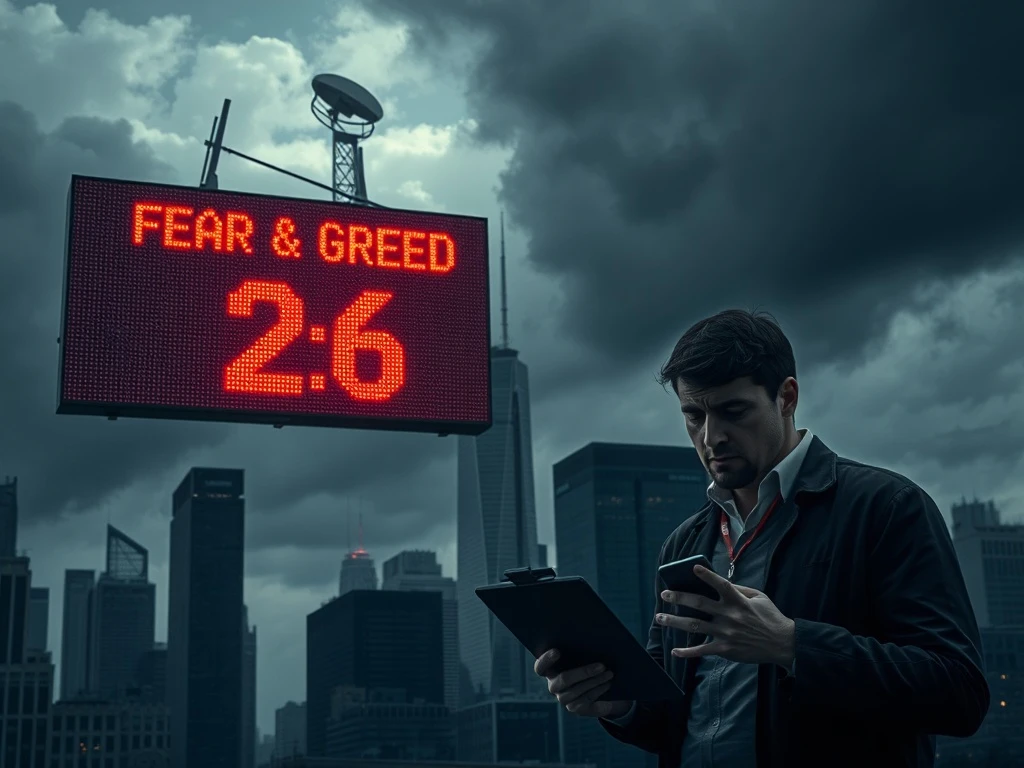
Global cryptocurrency markets entered another period of heightened anxiety this week as the widely watched Crypto Fear & Greed Index registered a concerning score of 26, solidifying its position deep within the ‘Fear’ territory and reflecting persistent investor trepidation according to data from Alternative.me. This critical sentiment gauge, a composite of multiple market metrics, provides a quantifiable snapshot of the collective emotional state driving digital asset trading decisions. Consequently, market analysts now scrutinize this downturn for clues about potential price trajectories and underlying market health.
Decoding the Crypto Fear & Greed Index Drop to 26
The Crypto Fear & Greed Index serves as a important barometer for market psychology. It operates on a scale from 0 to 100. A score of 0 signifies ‘Extreme Fear,’ while 100 represents ‘Extreme Greed.’ The recent reading of 26, down one point from the previous day, firmly places current sentiment in the ‘Fear’ category. This metric does not rely on a single data point. Instead, it synthesizes information from six distinct sources to create a broad view. The index’s calculation methodology assigns specific weights to each component, ensuring a balanced assessment.
Market volatility contributes 25% to the final score. High volatility often correlates with fear, as rapid price swings create uncertainty. Trading volume accounts for another 25%, as suppressed or erratic volume can signal caution among participants. Social media sentiment analysis comprises 15%, gauging the tone of discussions on platforms like Twitter and Reddit. Additionally, surveys make up 15%, capturing direct input from the investor community. Bitcoin’s dominance within the total cryptocurrency market cap influences 10% of the score. Finally, Google Trends data for relevant search terms contributes the remaining 10%, indicating public interest and concern.
The Composite Nature of Market Sentiment
Understanding the drop to 26 requires examining its composite parts. For instance, increased price volatility likely pulled the score downward. Similarly, a decline in consistent trading volume or a surge in fearful social media commentary would negatively impact the index. This multi-factor approach prevents any single anomaly from skewing the overall sentiment reading. Therefore, a score of 26 suggests negative pressure across several, if not all, of these underlying metrics. Historical data shows that prolonged periods in ‘Fear’ or ‘Extreme Fear’ have often preceded market consolidations or significant buying opportunities, though past performance never guarantees future results.
Also read: Bitcoin Treasury Companies Face New Pressure as US-Iran Tensions Shift
Historical Context and Comparative Market Analysis
Placing the current 26 reading in a historical context reveals its significance. During the bull market peaks of late 2021, the index frequently registered scores above 75, even hitting ‘Extreme Greed’ levels above 90. Conversely, during major market downturns like the one following the Terra-Luna collapse in mid-2022, the index plummeted to single digits, indicating ‘Extreme Fear.’ The current level of 26, therefore, represents a state of pronounced caution but not the panic associated with the deepest market crises. This positioning suggests a market that is wary and risk-averse, yet not entirely devoid of participants.
A comparative analysis with traditional finance indicators can also be insightful. Often, but not always, fear in cryptocurrency markets coincides with risk-off sentiment in broader equity markets, particularly in tech stocks. However, crypto markets can also decouple, driven by internal factors like regulatory news, major token unlocks, or network-specific developments. The following table illustrates how the index categorizes different score ranges:
| Index Score Range | Sentiment Label | Typical Market Behavior |
|---|---|---|
| 0-24 | Extreme Fear | Potential market bottom, high selling pressure |
| 25-49 | Fear | Caution, consolidation, negative bias |
| 50-74 | Greed | Growing optimism, increasing investment |
| 75-100 | Extreme Greed | Market top, euphoria, high risk of correction |
This framework helps investors contextualize the prevailing mood. The persistence in the ‘Fear’ zone indicates that the negative sentiment is not a fleeting reaction but a more sustained condition. Market technicians often watch for a sustained reversal in this index as a leading indicator for a potential shift in price trend, though it should be used in conjunction with other technical and fundamental analyses.
Underlying Drivers of the Current Fear Sentiment
Several tangible factors typically converge to drive the Crypto Fear & Greed Index into fear territory. Macroeconomic pressures remain a primary external driver. In 2025, concerns about interest rate policies, inflation persistence, and geopolitical instability can trigger a flight from risk assets, including cryptocurrencies. Furthermore, regulatory uncertainty in major jurisdictions like the United States and the European Union continues to cast a long shadow over the market. The lack of clear, comprehensive frameworks for digital assets creates hesitation among both institutional and retail investors.
Internal market dynamics also play a decisive role. Key factors include:
- Volatility Spikes: Unexpected, sharp price movements in major assets like Bitcoin or Ethereum erode confidence and trigger defensive positioning.
- Volume Contraction: Lower overall trading volume can indicate a lack of conviction, with participants waiting on the sidelines.
- Derivatives Market Signals: Data from futures and options markets, such as funding rates and put/call ratios, often feed into the broader sentiment captured by the index.
- Network Activity: A slowdown in on-chain transactions or decentralized finance (DeFi) usage can reflect declining utility and speculative interest.
Moreover, the sentiment index is reflexive. News about the index itself being in ‘Fear’ can perpetuate further cautionary behavior, creating a feedback loop. This psychological aspect is a critical component of market cycles. Analysts from firms like Glassnode and CoinMetrics often cross-reference on-chain data with sentiment indicators to distinguish between irrational fear and fear justified by deteriorating fundamentals.
The Role of Media and Social Discourse
The 15% weighting for social media and surveys highlights the impact of narrative. A predominance of negative headlines, FUD (Fear, Uncertainty, and Doubt), or critical commentary from influential figures can rapidly sway the index. Conversely, the emergence of positive narratives around technological adoption, institutional investment, or favorable regulatory comments can provide a counterbalance. The current digital media arena allows sentiment to propagate at unusual speed, making this component of the index increasingly volatile and significant.
Potential Market Implications and Strategic Considerations
A sustained ‘Fear’ reading on the Crypto Fear & Greed Index carries several potential implications for market structure and participant strategy. Historically, periods of entrenched fear have presented accumulation opportunities for long-term investors who believe in the fundamental thesis of digital assets. This strategy, often called ‘contrarian investing,’ involves buying when sentiment is poor and assets are potentially undervalued. However, this approach carries significant risk, as fear can deepen, and prices can fall further.
For traders, a low index reading often signals high risk aversion, which can lead to specific market behaviors. These include:
- Reduced liquidity and increased slippage on trades.
- A higher propensity for sharp, short-covering rallies if any positive news emerges.
- Increased sensitivity to negative news, leading to exaggerated downward moves.
From a portfolio management perspective, a fear gauge at 26 might prompt a review of risk exposure. Some strategies involve rebalancing, increasing stablecoin allocations, or employing hedging techniques through options. It also underscores the importance of having a clear investment thesis and risk management rules that are not solely dictated by prevailing sentiment. Seasoned investors often use tools like the Fear & Greed Index not as a direct trading signal, but as one of many data points to assess the overall market environment and emotional temperature.
Conclusion
The Crypto Fear & Greed Index’s decline to a score of 26 provides a clear, data-driven signal that fear persists within the cryptocurrency market. This sentiment stems from a composite of volatility, volume, social media tone, and search trends. While firmly in the ‘Fear’ zone, the current level differs markedly from the ‘Extreme Fear’ readings seen during past market capitulations. For market participants, this index serves as a valuable psychological gauge, offering context for price action and highlighting the prevailing emotional bias. Ultimately, understanding this metric, its drivers, and its historical implications is significant for dealing with the complex and often emotionally charged environment of digital asset investing. The index reminds us that markets are driven not only by code and economics but also by collective human psychology.
FAQs
Q1: What does a Crypto Fear & Greed Index score of 26 mean?
A score of 26 indicates the market is experiencing ‘Fear.’ It is calculated from multiple metrics like volatility and social media sentiment, suggesting investors are predominantly cautious and risk-averse.
Q2: Who creates the Crypto Fear & Greed Index and how often is it updated?
The index is provided by Alternative.me. It updates daily, aggregating real-time data from its various source components to reflect the current market sentiment.
Q3: Is the Fear & Greed Index a reliable predictor of future Bitcoin price movements?
While not a perfect predictor, it is a useful sentiment indicator. Historically, prolonged periods of extreme fear have sometimes preceded market bottoms, and extreme greed has preceded tops, but it should be used alongside other analysis tools.
Q4: What are the main components that make up the index score?
The index is calculated from six components: market volatility (25%), market volume/momentum (25%), social media (15%), surveys (15%), Bitcoin dominance (10%), and Google Trends data (10%).
Q5: Should I buy or sell cryptocurrency when the index is in the ‘Fear’ zone?
The index reflects sentiment, not a direct trading signal. Some investors view prolonged fear as a potential buying opportunity (‘be fearful when others are greedy’), but this strategy depends on your individual risk tolerance, investment horizon, and overall market analysis.

This article was produced with AI assistance and reviewed by our editorial team for accuracy and quality.