Chainlink Price Analysis: Addressing the Critical $12-$16 Range Amidst Market Indecision

As of January 2026, the cryptocurrency market presents a complex arena where altcoins like Chainlink (LINK) find themselves at a technical crossroads. The digital asset, a cornerstone of decentralized oracle networks, has entered a phase of pronounced consolidation, trading within a narrow band between $12 and $16. This period of compression reflects broader market uncertainty and places LINK in a central position that could dictate its medium-term trajectory. Consequently, traders and analysts are scrutinizing every candle for clues, while the project’s fundamental utility in powering smart contracts remains a critical backdrop to its price action.
Chainlink’s Technical Conundrum: A Market in Equilibrium
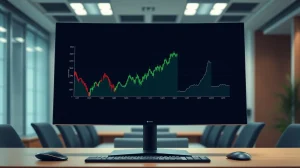
Chainlink’s current price action demonstrates a classic battle between buyers and sellers, resulting in a tight trading range. The $12 level has emerged as a formidable support zone, a price point where buying interest has historically materialized to prevent further declines. Conversely, the $16 mark acts as a stubborn resistance, a ceiling that selling pressure has reinforced on multiple attempts. This creates a compression zone, a technical phenomenon often preceding a significant volatility expansion. Market data from major exchanges shows declining volume during this phase, a typical characteristic of indecision where participants await a clearer signal before committing capital.
Also read: AI Trading Agents: The Revolutionary Path to Mastering Your Crypto Portfolio in 2025
This indecision is not isolated to LINK. The entire altcoin segment often mirrors or amplifies the sentiment set by Bitcoin. With Bitcoin itself in a period of relative stability after recent regulatory developments, capital has become cautious. The dominance of Bitcoin, a metric measuring its share of the total cryptocurrency market capitalization, adds a layer of macro uncertainty. When Bitcoin dominance is high or trending upward, capital typically flows out of altcoins, suppressing their price action. Therefore, Chainlink’s micro-range is as much a function of internal technical levels as it is a reflection of the broader crypto market’s search for direction.
The Role of Market Structure and On-Chain Metrics
Beyond simple price charts, on-chain analytics provide deeper context. Analysis of LINK token movement between exchange wallets and private custody solutions can indicate holder sentiment. A net outflow from exchanges to cold storage often suggests accumulation and a long-term bullish outlook, while inflows to exchanges can foreshadow selling pressure. Furthermore, the health of the Chainlink network itself, measured by the number of active oracle data feeds, secured value, and partner integrations, provides the fundamental bedrock against which technical patterns play out. A strong and growing network can bolster confidence during technical weakness.
Also read: RunBot AI Trading Bot: Revolutionizing Automated Cryptocurrency Strategies with Machine Learning
Potential Scenarios for Chainlink’s Next Major Move
Two primary, opposing scenarios dominate analyst forecasts for LINK’s near-term future, each with distinct triggers and implications.
Bullish Breakout Scenario: A daily or weekly candlestick closing decisively above the $16 resistance, confirmed with higher-than-average trading volume, would signal a shift in momentum. Such a move would likely invalidate the current range and could trigger a wave of algorithmic and momentum buying. Initial price targets in this scenario often extend to the next psychological and technical levels, such as $18 and $20. A successful breakout could be fueled by positive network developments, a broader altcoin market rally, or a surge in demand for decentralized oracle services.
Bearish Breakdown Scenario: Conversely, a sustained break and close below the $12 support level would indicate that selling pressure has overwhelmed buyers. This would open the door for a test of lower support zones, potentially at $10 or even $8. Such a move would likely coincide with negative market sentiment, increased Bitcoin dominance, or project-specific concerns. Risk management becomes paramount in this scenario to protect capital from extended drawdowns.
A third, more protracted scenario involves the continuation of the current range-bound trading. Price could oscillate between $12 and $16 for an extended period, requiring traders to adopt different, shorter-term strategies. This stalemate would persist until a significant external catalyst—such as a major macroeconomic announcement, a shift in regulatory stance, or a central update to the Chainlink protocol—forces the market to pick a direction.
| Level | Type | Significance | Potential Outcome if Breached |
|---|---|---|---|
| $16 | Resistance | Upper bound of current range; previous rejection zone. | Bullish breakout; targets at $18, then $20. |
| $12 | Support | Lower bound of current range; historical buying zone. | Bearish breakdown; targets at $10, then $8. |
| $14 (approx.) | Range Midpoint | Psychological balance point. | Often acts as a short-term pivot within the range. |
Strategic Approaches for Trading and Investing in an Indecisive Market
Managing a consolidating market like Chainlink’s current state demands discipline and a clear strategy. The primary virtue for traders is patience. Acting on false breakouts, known as “whipsaws,” within a range can quickly erode capital. Therefore, many experienced market participants wait for a confirmed close outside the range with supporting volume before initiating a directional trade. This confirmation reduces risk, albeit at the cost of entering a move after some of the initial price movement has already occurred.
For those engaged in active trading, several tactical approaches exist:
- Range Trading: Buying near the $12 support and selling near the $16 resistance, with tight stop-loss orders placed just beyond these levels.
- Breakout Trading: Preparing orders to enter on a confirmed break above $16 or below $12, with volume confirmation as a key filter.
- Risk Management: Utilizing smaller position sizes and definitive stop-loss orders is non-negotiable in a high-volatility, indecisive environment.
For long-term investors whose thesis is based on Chainlink’s fundamental role in Web3, this consolidation phase may present a dollar-cost averaging opportunity. By acquiring tokens at regular intervals within the range, investors can build a position without attempting to time the market’s exact bottom. Additionally, exploring Chainlink’s staking mechanisms, which allow LINK holders to earn rewards by securing the network, provides an alternative yield-generating strategy that is less dependent on short-term price fluctuations.
The Importance of Portfolio Diversification
Regardless of one’s view on Chainlink, prudent portfolio construction advises against over-concentration. Diversifying across asset classes, cryptocurrency sectors (DeFi, infrastructure, storage), and non-correlated assets remains a cornerstone of sound financial strategy. This approach mitigates the specific risk associated with any single asset’s period of indecision or decline.
Conclusion
Chainlink stands at a critical technical juncture, encapsulated within the $12 to $16 price range. This period of compression and indecision is a microcosm of the broader altcoin market’s current state, heavily influenced by Bitcoin’s trajectory and overarching macroeconomic factors. The eventual resolution of this range—whether through a bullish breakout or a bearish breakdown—will provide a clearer directional bias for the asset. Until then, market participants are advised to prioritize rigorous risk management, seek confirmation before committing capital, and align their strategies with their individual investment horizons and risk tolerance. The coming weeks will be vital in determining whether Chainlink can muster the momentum to overcome resistance or if it will require a deeper test of underlying support.
FAQs
Q1: What are the key support and resistance levels for Chainlink (LINK) currently?
The primary levels under scrutiny are $12 as support and $16 as resistance. These have formed the boundaries of its recent trading range, and a sustained break beyond either will signal the next likely trend direction.
Q2: Why is the cryptocurrency market, and Chainlink specifically, experiencing such indecision?
Market indecision often arises from a lack of dominant catalysts, macroeconomic uncertainty, and the influence of Bitcoin’s price action. For altcoins like LINK, periods of low volatility and range-bound trading are common when the broader market lacks a clear narrative.
Q3: What does a “confirmed breakout” mean in technical analysis?
A confirmed breakout typically refers to a candlestick closing decisively above a resistance level or below a support level, preferably on higher-than-average trading volume. This closes the time period (e.g., daily, weekly) with price established outside the range, reducing the likelihood of a false signal.
Q4: What are the main risks of trading during a consolidation phase?
The primary risk is the false breakout or whipsaw, where price briefly moves beyond a key level only to reverse sharply back into the range. This can trigger stop-loss orders and lead to losses. Patience and confirmation are key to mitigating this risk.
Q5: How do Chainlink’s network fundamentals relate to its price action?
While short-term price is driven by sentiment and technicals, long-term value is underpinned by fundamentals. Chainlink’s growth in oracle integrations, total value secured, and network usage provides a foundation of utility. Strong fundamentals can support price during downturns and fuel sustained rallies after technical breakouts.

This article was produced with AI assistance and reviewed by our editorial team for accuracy and quality.