Chainlink’s Unstoppable Rise: How $70B TVS and ETF Inflows Signal DeFi Dominance in 2026
January 29, 2026 – While many cryptocurrency assets face institutional skepticism despite strong fundamentals, Chainlink presents a compelling divergence. The decentralized oracle network recently achieved a $70 billion Total Value Secured milestone while simultaneously attracting consistent ETF inflows during a period of broader market outflows. This development suggests institutions increasingly recognize Chainlink’s critical infrastructure role within the decentralized finance ecosystem.
Institutional Flows Reveal a Clear Chainlink Preference
The cryptocurrency market in early 2026 shows a fascinating split between on-chain strength and institutional sentiment. For instance, Ethereum demonstrated reliable network activity following its Fuska and Pecta upgrades, processing a record 2.3 million daily transactions. However, institutional capital flows told a different story. According to data from SoSoValue, Ethereum’s Grayscale Spot ETF (ETHE) experienced approximately $52 million in outflows during a recent weekly period.
Also read: Ethereum's $2,500 Challenge: Market Data and the Rise of Pepeto
Conversely, Chainlink’s Grayscale ETF (GLNK) attracted $4.05 million in inflows during that same timeframe. This divergence becomes more significant when considering broader market movements. The overall cryptocurrency ETF sector witnessed nearly $664 million in outflows that week, making Chainlink’s positive inflow a notable exception. Furthermore, Chainlink’s ETF flows continued to outpace those of Dogecoin, despite DOGE maintaining a market capitalization nearly three times larger.
Analyzing the Capital Rotation Pattern
This institutional behavior suggests more than short-term portfolio adjustments. Capital rotating into Chainlink amidst widespread outflows indicates a targeted, conviction-driven allocation. Analysts interpret this pattern as institutions identifying specific projects with fundamental utility rather than chasing speculative momentum. The consistent inflow pattern, particularly when contrasted with outflows from larger-cap assets, points to growing institutional confidence in Chainlink’s long-term value proposition as essential Web3 infrastructure.
Also read: Crypto Listing Scams: Binance CEO Changpeng Zhao Issues Critical Warning to Investors
Chainlink’s Expanding Role in the $170 Billion DeFi Ecosystem
The decentralized finance sector has experienced a remarkable resurgence, with Total Value Locked across all Layer-1 blockchains reclaiming the $170 billion threshold in early 2026. This milestone, reported by DeFiLlama, marks a full recovery from the 2022 bear market and signals a substantial return of on-chain liquidity. This renewed growth has catalyzed expansion across several key verticals including stablecoins, real-world assets, and artificial intelligence applications.
Chainlink has strategically positioned itself at the convergence of these trends. The network’s recent inclusion in the Global Alliance for KRW Stablecoins (GAKS) places its oracle technology at the heart of South Korea’s ambitious stablecoin expansion plans. By integrating directly with the foundational rails of global stablecoin systems, Chainlink enhances critical aspects of the DeFi stack:
- Privacy: Secure data feeds enable confidential smart contract execution.
- Compliance: Reliable oracles support regulatory reporting and transparency.
- Interoperability: Cross-chain data bridges connect disparate blockchain ecosystems.
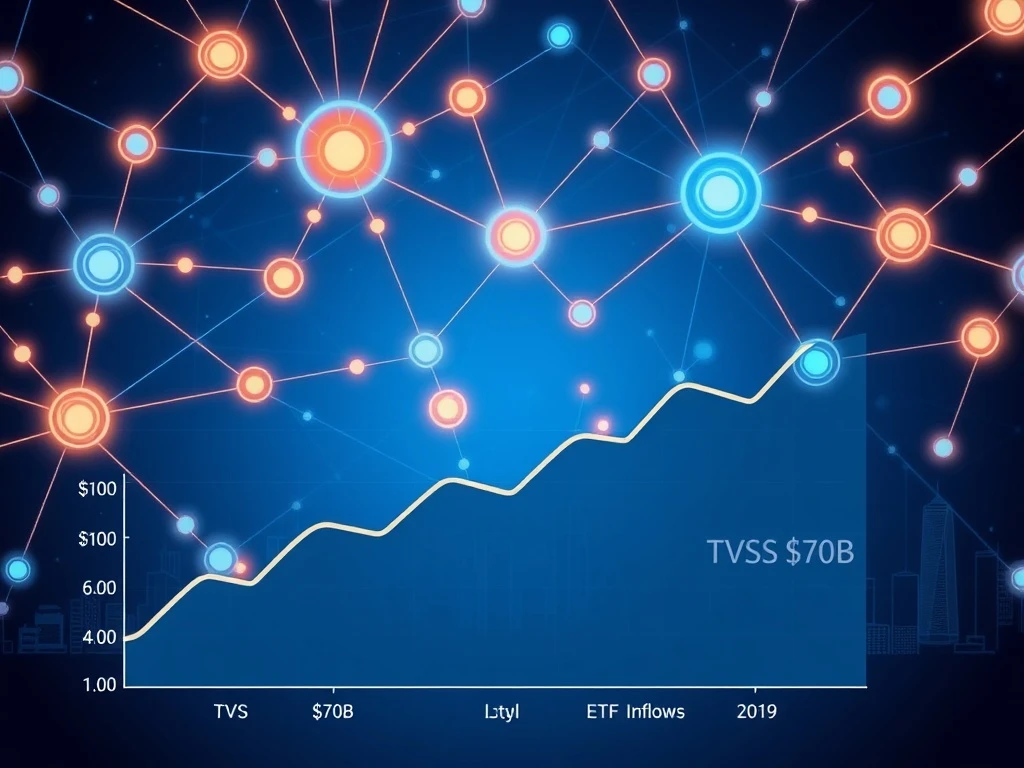
This infrastructure role translates directly into measurable adoption. Chainlink’s Total Value Secured metric, which represents the aggregate value of assets relying on its oracle services, reached an exceptional $70 billion in the fourth quarter of 2025. This figure provides concrete evidence of trust and real-world utilization, moving beyond theoretical potential to demonstrated network effect.
The Technical Foundation Behind Institutional Confidence
Chainlink’s ability to secure $70 billion in value stems from its decentralized oracle network architecture. Unlike centralized data feeds, Chainlink aggregates information from numerous independent node operators, ensuring data integrity and censorship resistance. This technical robustness addresses a fundamental vulnerability in smart contract design: the need for reliable external information.
The network’s growing TVS correlates directly with the expansion of use cases requiring trustworthy off-chain data. These applications now span complex financial derivatives, insurance products, gaming economies, and supply chain management solutions. Each new application increases the network’s utility and reinforces its position as neutral, foundational infrastructure rather than a speculative asset competing within a specific blockchain ecosystem.
Comparative Analysis with Competing Infrastructure Projects
While several projects offer oracle services, Chainlink maintains distinct advantages in institutional adoption. Its first-mover status has resulted in the most extensive integration across DeFi protocols, with hundreds of partnerships documented. The network’s focus on decentralization and security over pure transaction speed aligns with institutional risk management priorities. Additionally, Chainlink’s Cross-Chain Interoperability Protocol facilitates secure communication between blockchains, addressing another critical infrastructure need as the ecosystem becomes increasingly multi-chain.
Market Implications of the TVS and ETF Flow Convergence
The simultaneous occurrence of record-high TVS and positive ETF inflows creates a powerful narrative for fundamental analysts. Typically, cryptocurrency valuations experience periods where price action diverges from underlying network metrics. Chainlink currently presents a rare alignment where both on-chain fundamentals and capital market signals point in the same positive direction.
This convergence suggests institutions are conducting deeper due diligence beyond simple market capitalization comparisons. They appear to be evaluating the actual utility, adoption metrics, and revenue potential of blockchain projects. Chainlink’s oracle services generate fees based on usage, creating a more traditional business model that institutional investors can analyze and value using established frameworks.
Conclusion
Chainlink’s journey in early 2026 demonstrates how fundamental infrastructure value can attract institutional capital even during broader market uncertainty. The network’s $70 billion Total Value Secured achievement validates its critical role in securing the expanding DeFi economy. Simultaneously, consistent ETF inflows amidst sector-wide outflows indicate sophisticated capital recognizing this fundamental strength. As decentralized finance continues maturing toward mainstream adoption, reliable oracle services will remain indispensable. Chainlink’s current trajectory suggests it is effectively cementing its position as a core, trusted provider of that essential infrastructure, making its market movements a key indicator for the health and direction of the entire Web3 ecosystem.
FAQs
Q1: What does Total Value Secured (TVS) mean for Chainlink?
Total Value Secured represents the aggregate value of all assets that rely on Chainlink’s oracle networks for accurate price feeds and external data. The $70 billion milestone indicates the scale of financial activity and smart contracts that depend on Chainlink’s reliable information.
Q2: Why are Chainlink’s ETF inflows significant when other cryptocurrencies see outflows?
The divergence suggests institutional investors are making selective, conviction-based allocations rather than moving with general market sentiment. Positive inflows during widespread outflows often indicate that sophisticated capital identifies specific projects with strong fundamental utility and growth potential.
Q3: How does Chainlink’s role in stablecoin alliances affect its value proposition?
Integration with initiatives like the Global Alliance for KRW Stablecoins embeds Chainlink’s technology at the foundation of major financial systems. This expands its use cases, increases network usage and fees, and demonstrates real-world adoption beyond speculative cryptocurrency trading.
Q4: What is the difference between Total Value Locked (TVL) and Total Value Secured (TVS)?
TVL measures assets deposited within DeFi protocols for lending, borrowing, or yield generation. TVS specifically measures the value of assets that depend on oracle data for their operation and security. Both are important adoption metrics but capture different aspects of ecosystem growth.
Q5: Could other oracle projects challenge Chainlink’s current dominance?
While competition exists in the oracle space, Chainlink benefits from significant first-mover advantages, including the largest network of node operators, the most protocol integrations, and proven security over multiple market cycles. Its focus on decentralization and cross-chain functionality creates substantial barriers to entry for competitors.

This article was produced with AI assistance and reviewed by our editorial team for accuracy and quality.