Cardano’s Critical Crossroads: ADA Confronts a Central $0.24 Support Test That Could Define Its 2026 Fate
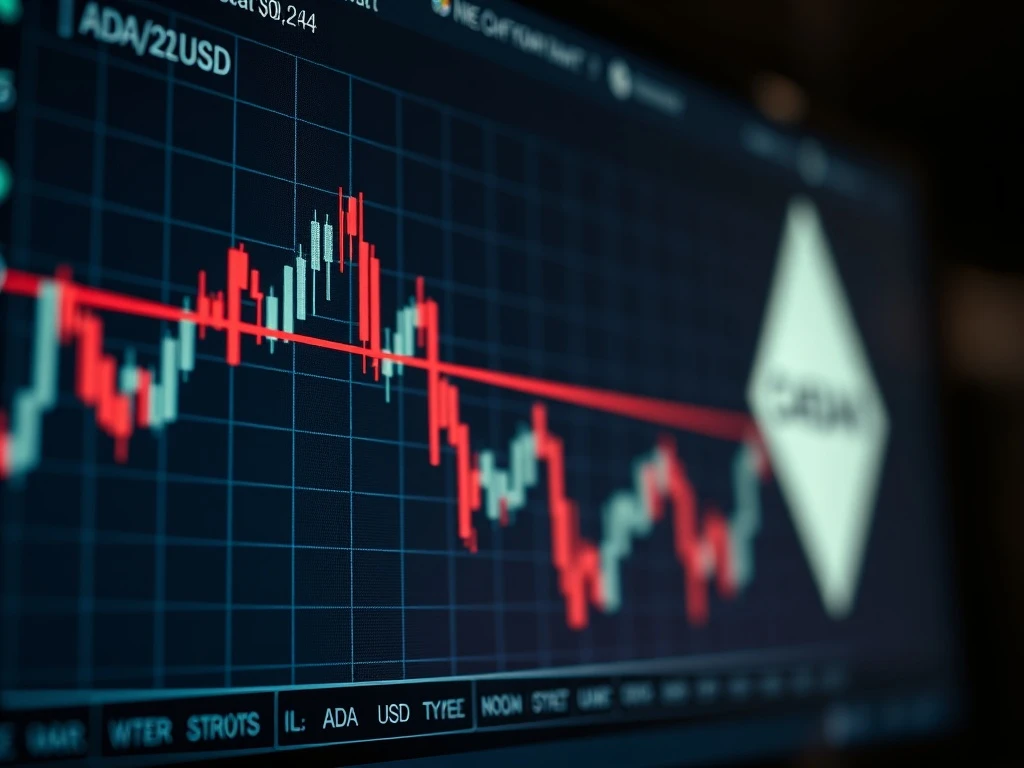
In a development capturing the attention of traders and analysts globally, the Cardano (ADA) cryptocurrency has arrived at a decisive technical junction. The digital asset is currently testing the critical $0.24 support level, a price point that market technicians believe could spell its fundamental path through the 2026 market cycle. This test unfolds against a backdrop of broader cryptocurrency market recalibration and significant network development milestones for the Cardano blockchain.
Cardano ADA Approaches a Defining Technical Threshold
The $0.24 price zone represents more than a simple number on a chart for Cardano. Historically, this level has acted as a significant area of both support and resistance, creating a collective memory within the market. A decisive break below this juncture, confirmed by sustained trading volume and weekly closes, could trigger a new phase of price discovery for ADA. Conversely, a strong rejection and bounce from this level may reinforce it as a foundational base for future appreciation. Market data from major exchanges shows increased trading volume around this price, indicating heightened participant interest.
Also read: Operation Atlantic: Global Law Enforcement Shatters $45M Crypto Fraud Ring
Technical analysts emphasize the confluence of indicators at this level. The $0.24 zone aligns with a long-term moving average and a key Fibonacci retracement level derived from ADA’s previous market cycle. Furthermore, on-chain metrics from analytics firms like IntoTheBlock reveal that a substantial concentration of ADA addresses acquired tokens near this price, potentially increasing buy-side pressure if those holders seek to defend their position. This creates a tangible battleground between bullish and bearish forces.
Contextualizing the Current Cryptocurrency Market
Cardano’s price action does not occur in a vacuum. The entire digital asset market continues to digest macroeconomic factors, including central bank policies and global liquidity conditions. In 2025, regulatory clarity in major jurisdictions has become a more pronounced driver of asset performance. Cardano’s development-focused approach, led by Input Output Global (IOG), positions it uniquely within this environment. The network’s methodical, peer-reviewed upgrade path, including recent successful implementations of the Chang hard fork, provides fundamental substance that contrasts with purely speculative assets.
Also read: Spartans.com Shatters Norms with $7 Million Leaderboard Launch, Rewriting Online Gambling Rules
Comparatively, other major layer-1 blockchain tokens have faced similar tests of key support levels throughout the year. However, each asset’s reaction is dictated by its unique ecosystem health, developer activity, and adoption metrics. For Cardano, a key differentiator remains its strong staking ecosystem. With over 70% of its circulating supply staked in decentralized pools, the network demonstrates exceptional security and holder commitment, a factor that can influence long-term price stability during volatile periods.
Expert Analysis on Network Fundamentals Versus Price
Leading blockchain analysts consistently draw a distinction between short-term price volatility and long-term network value. Charles Hoskinson, founder of Cardano, has frequently articulated this vision, focusing on building infrastructure for decentralized governance and real-world utility. From a technical standpoint, network activity—measured in daily transactions, decentralized application (dApp) usage, and total value locked (TVL) in DeFi protocols—provides a more reliable health indicator than price alone. Recent months have shown steady growth in these fundamental metrics for Cardano, even as the price faced headwinds.
This divergence highlights a common theme in cryptocurrency markets: price often leads or lags underlying utility. The current test at $0.24 may therefore represent a market reassessment of ADA’s valuation relative to its technological progress and growing ecosystem. Industry reports from firms like Messari and CoinMetrics provide quantitative backing for this growth, tracking increases in smart contract deployments and unique wallet addresses on the Cardano network throughout 2024 and into 2025.
The Potential Market Trajectory Through 2026
The outcome of this support test carries implications that could extend well into 2026. A successful defense of the $0.24 level would likely be interpreted by the market as a sign of underlying strength. This could establish a higher low within the broader market structure, potentially setting the stage for a renewed upward trend as network developments like mid-layer scalability solutions and further governance enhancements go live. Such a scenario would align with historical patterns where periods of consolidation precede major rallies.
Conversely, a breakdown opens the door to a reevaluation of support zones at lower levels. Market technicians would then watch for potential support near $0.20 and $0.18, areas defined by previous cycle lows and psychological barriers. It is critical to note that even a breakdown does not invalidate Cardano’s long-term proposition; many successful blockchain assets have experienced severe drawdowns before recovering to new highs based on proven utility and adoption. The trajectory will depend on a combination of macro conditions, crypto-specific sentiment, and Cardano’s own delivery on its ambitious roadmap.
Key factors to monitor include:
- On-chain accumulation patterns from large wallet addresses (whales).
- Development activity and GitHub commit frequency for the Cardano core protocol.
- Regulatory developments impacting proof-of-stake assets globally.
- Broader market sentiment as measured by fear and greed indices.
Conclusion
Cardano stands at a critical technical crossroads as its native ADA token tests the decisive $0.24 support level. This price juncture represents a significant moment for traders and long-term holders alike, with the potential to define the asset’s market structure for the coming years. While short-term price movements attract attention, the fundamental progress of the Cardano blockchain—its technological upgrades, governance evolution, and ecosystem growth—remains the core driver of long-term value. The market’s reaction at this major level will provide key insights into investor confidence and the weighting of fundamentals versus macro sentiment as the cryptocurrency field evolves toward 2026.
FAQs
Q1: What does the $0.24 level specifically mean for Cardano (ADA)?
The $0.24 price represents a major historical support and resistance zone. It aligns with key technical indicators and a high concentration of investor cost basis. A hold above it suggests underlying strength, while a break below could signal a shift to a new, lower trading range.
Q2: How do Cardano’s network fundamentals affect its price during this test?
Strong fundamentals like high staking participation, growing dApp usage, and consistent development can provide a fundamental floor for price. They represent real utility and user adoption, which are critical for long-term value beyond short-term speculative trading.
Q3: What are the main differences between technical price analysis and fundamental analysis for ADA?
Technical analysis studies price charts, patterns, and trading volume to predict future movement. Fundamental analysis evaluates the Cardano network’s technology, developer activity, governance, and adoption rate. Both are important for a complete market view.
Q4: Could a break below $0.24 be a long-term negative for Cardano?
Not necessarily. Many successful assets experience severe corrections. A breakdown would be a short-to-medium-term technical negative, but Cardano’s long-term fate depends on its ability to execute its roadmap, scale its ecosystem, and achieve widespread utility, not on any single price level.
Q5: What should investors monitor beyond the price during this volatile period?
Investors should track on-chain metrics like active addresses and transaction counts, development progress via IOG’s updates, growth in Total Value Locked (TVL) in Cardano DeFi, and broader regulatory news affecting the proof-of-stake sector.

This article was produced with AI assistance and reviewed by our editorial team for accuracy and quality.