Crucial Decision: Canada’s Mark Carney Rejects China Free Trade Agreement Amid Trump Tariff Threats
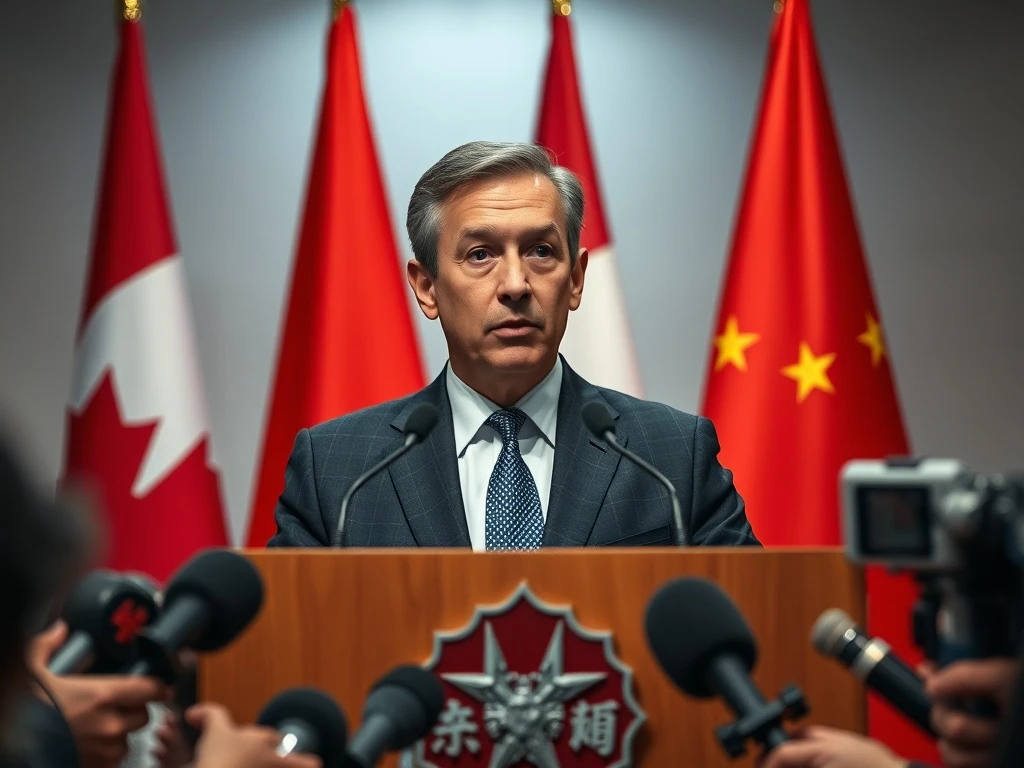
Ottawa, Canada – May 15, 2025: In a move with significant implications for global trade alliances, Canadian Prime Minister Mark Carney has definitively stated his government will not pursue a free trade agreement (FTA) with China. This crucial decision follows a direct warning from former U.S. President Donald Trump, who threatened to impose devastating 100% tariffs on Canadian goods if Ottawa moved forward with a Beijing deal. The announcement, first reported by Solidintel, signals a pivotal moment in North American trade policy and Canada’s strategic economic positioning between its largest trading partner and the world’s second-largest economy.
Canada’s Strategic Trade Decision on China FTA
Prime Minister Mark Carney’s declaration represents a calculated shift in Canada’s international trade strategy. A free trade agreement with China, a concept explored intermittently for over a decade, promised potential access to a massive consumer market but carried substantial geopolitical and economic risks. The decision to formally abandon these negotiations underscores a prioritization of stable North American trade relations over uncertain gains with Beijing. Trade analysts note this aligns with a broader Western trend of “de-risking” economic dependencies on China, particularly in critical sectors. The Canadian government’s stance now explicitly avoids entangling the nation in the escalating strategic competition between the United States and China, a competition that increasingly defines global trade rules and supply chain configurations.
Historical Context of Canada-China Trade Relations
To understand the weight of Carney’s announcement, one must examine the long and complex history of Canada-China economic engagement. Formal diplomatic relations began in 1970, with trade growing steadily, especially after China’s accession to the World Trade Organization in 2001. Exploratory talks for a comprehensive economic partnership have occurred in various forms since the early 2010s.
- 2012-2015: Canada and China sign a Foreign Investment Promotion and Protection Agreement (FIPA). High-level dialogues on a potential trade pact begin but lack formal commitment.
- 2016-2018: The Trudeau government launches exploratory free trade discussions. These talks stall due to disagreements over labor, environmental standards, and state-owned enterprises.
- 2018-2023: Relations deteriorate sharply following Canada’s arrest of Huawei CFO Meng Wanzhou at the U.S.’s request and China’s subsequent detention of two Canadian citizens (Michael Kovrig and Michael Spavor). Trade becomes a tool of geopolitical leverage.
- 2024-Present: Under Prime Minister Carney, a more pragmatic, values-based trade policy emerges, emphasizing supply chain security with allies over market expansion with strategic competitors.
This history reveals a pattern of cautious optimism repeatedly tempered by geopolitical realities, making Carney’s definitive statement a clear break from past ambiguity.
The Trump Tariff Ultimatum and Its Immediate Impact
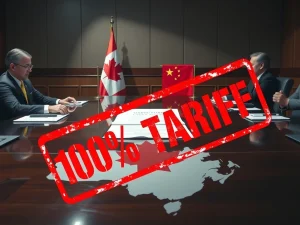
The catalyst for Carney’s public clarification was an unambiguous threat from Donald Trump. On his Truth Social platform, the former and potential future U.S. President stated that the United States would impose 100% tariffs on all Canadian imports if Canada signed a free trade deal with China. This was not a vague warning but a specific, punitive measure designed to force a binary choice. The economic impact of such tariffs would be catastrophic for Canada. The United States is Canada’s largest trading partner, with over 75% of Canadian exports destined for the U.S. market. A 100% tariff would effectively double the price of Canadian goods like automobiles, lumber, oil, and agricultural products, rendering them uncompetitive overnight and triggering severe economic contraction. Carney’s statement, therefore, is as much an acknowledgment of economic necessity as a strategic foreign policy choice.
Analyzing the US-Canada-China Trade Triangle
The dynamic between these three nations forms a critical trade triangle. The United States and China are engaged in prolonged strategic rivalry, with trade being a primary battlefield. Canada, deeply integrated into the U.S. economy through the USMCA (United States-Mexico-Canada Agreement), finds itself in a precarious middle ground. Pursuing a China FTA would be interpreted in Washington as aligning with a strategic adversary, jeopardizing the foundational USMCA agreement. Experts frame this not as a simple trade decision but as a choice about Canada’s core economic and security alliances. By rejecting the China FTA, Carney reaffirms Canada’s position within the North American economic bloc and the broader Western alliance, a move that carries significant weight for future investment and diplomatic support from Washington and European capitals.
Economic Implications for Canadian Industries
The decision carries divergent consequences across Canada’s economic landscape. Sectors that viewed China as a growth market, such as certain agricultural producers (canola, pork), natural resources (lumber, potash), and consumer goods exporters, may face limited long-term growth prospects in Asia. Conversely, industries deeply tied to U.S. supply chains, particularly automotive, aerospace, and advanced manufacturing, will benefit from the continued stability and preferential access to the U.S. market. The table below outlines the projected sectoral impact:
| Sector | Short-Term Impact | Long-Term Strategic Shift |
|---|---|---|
| Automotive | Positive (Supply chain certainty) | Reinforced integration with US/Mexico under USMCA rules of origin. |
| Agriculture | Neutral/Negative (Lost potential) | Increased focus on diversification to other Asian markets (e.g., India, ASEAN) and domestic food security. |
| Natural Resources | Negative (Market access limitation) | Accelerated push for “friendshoring” of critical minerals to allied nations. |
| Technology & IP | Positive (Reduced risk) | Stronger alignment with U.S. tech protectionism and innovation partnerships. |
Overall, the choice prioritizes stability and deep integration with a known partner over the high-risk, high-reward potential of the Chinese market.
Geopolitical Repercussions and Global Trade Alignment
Canada’s decision resonates beyond its borders, influencing the shape of global trade blocs. It represents a victory for the U.S. strategy of encouraging allies to economically decouple from China. Other U.S. allies, particularly in Europe and the Indo-Pacific, will likely view Canada’s move as a case study in navigating U.S.-China tensions. For China, this is a diplomatic setback, limiting its ability to drive wedges in Western alliances through bilateral trade deals. The move strengthens the cohesion of the USMCA bloc and aligns Canada more closely with initiatives like the U.S.-led Indo-Pacific Economic Framework (IPEF), which seeks to set trade standards without including China. In essence, Canada is choosing rule-based, multilateral trade frameworks among allies over a bilateral deal with a state-led economic system.
The Role of Values in Modern Trade Policy
Prime Minister Carney, a former central banker, has consistently framed trade policy within a context of democratic values and sustainability. A China FTA would have necessitated compromises on issues like forced labor, environmental standards, and state subsidies—areas where Canada has sought leadership. By stepping away, Carney avoids the difficult task of reconciling a values-based foreign policy with a deal that critics argue would empower practices Canada officially condemns. This values dimension adds a layer of domestic political justification beyond mere economic calculus, appealing to a broad segment of the Canadian electorate concerned about human rights and geopolitical morality.
Conclusion: A Defining Moment for North American Trade
Prime Minister Mark Carney’s rejection of a free trade agreement with China marks a defining moment for Canada’s economic future. Driven by the stark reality of Donald Trump’s tariff threats and a strategic assessment of national interest, this decision firmly anchors Canada within the North American trade orbit. While it forgoes the uncertain potential of the Chinese market, it secures the indispensable certainty of access to the United States. The move underscores a new era of trade policy where geopolitical alignment and supply chain security are as critical as tariff reduction. For businesses, investors, and diplomats worldwide, Canada’s choice is a clear signal: in a fragmented global economy, the bonds of geographic and political alliance are proving stronger than the lure of distant markets. The long-term success of this crucial decision will depend on Canada’s ability to innovate and thrive within this reaffirmed, yet more constrained, trade paradigm.
FAQs
Q1: What exactly did Prime Minister Mark Carney say about a Canada-China FTA?
Prime Minister Carney, through official channels and as reported by Solidintel, stated his government has no plans to pursue a free trade agreement (FTA) with China. This is a definitive statement closing the door on formal negotiations that had been discussed intermittently for years.
Q2: Why did Donald Trump threaten tariffs on Canada?
Former President Trump threatened to impose 100% tariffs on all Canadian imports if Canada proceeded with a trade deal with China. He views such a deal as a strategic alignment with a U.S. rival and an economic threat, and he used the threat to force Canada to choose between its U.S. trade relationship and a potential Chinese one.
Q3: How much does Canada trade with the U.S. versus China?
The United States is overwhelmingly Canada’s largest trading partner. Typically, over 75% of Canadian exports go to the U.S., representing hundreds of billions of dollars annually. Trade with China is significant but far smaller, usually accounting for less than 10% of Canada’s total exports. The U.S. market is fundamentally irreplaceable for the Canadian economy.
Q4: Does this mean Canada will stop all trade with China?
No. The decision specifically concerns a comprehensive free trade agreement, which would remove most tariffs and establish deep economic integration. Canada will continue to trade with China under existing World Trade Organization (WTO) rules and bilateral agreements. However, the trade relationship will not be elevated to the privileged status of an FTA.
Q5: What are the potential long-term consequences of this decision for Canada?
Long-term consequences include: reinforced economic integration with the United States and Mexico under USMCA; reduced exposure to geopolitical friction between the U.S. and China; potential missed opportunities for market share growth in China for certain sectors; and a stronger strategic alignment with Western allies on trade and security policy. The success of the decision hinges on fostering innovation and competitiveness within the North American bloc.