BTC Perpetual Futures Show Alarming Short Dominance Across Top 3 Crypto Exchanges
Global cryptocurrency markets witnessed a significant shift in trader positioning this week as short positions overtook long positions in Bitcoin perpetual futures contracts across the world’s three largest derivatives exchanges. According to comprehensive 24-hour trading data from March 2025, the aggregate long/short ratio for BTC perpetual futures stands at 48.4% long versus 51.6% short, marking a notable departure from typical market patterns. This development represents a crucial indicator for market analysts monitoring cryptocurrency derivatives sentiment and potential price direction.
BTC Perpetual Futures Data Reveals Market Sentiment Shift
The long/short ratio for Bitcoin perpetual futures provides essential insights into market psychology and trader expectations. Perpetual futures, unlike traditional futures contracts, lack expiration dates and maintain positions through funding rate mechanisms. Consequently, these instruments offer continuous exposure to Bitcoin price movements while reflecting real-time market sentiment. The current data from leading exchanges demonstrates a clear preference for short positions, suggesting traders anticipate potential downward price pressure or seek to hedge existing long positions.
Also read: Bitcoin Capital Rotation Triggers Critical Signal, Points to $41,400 Price Floor
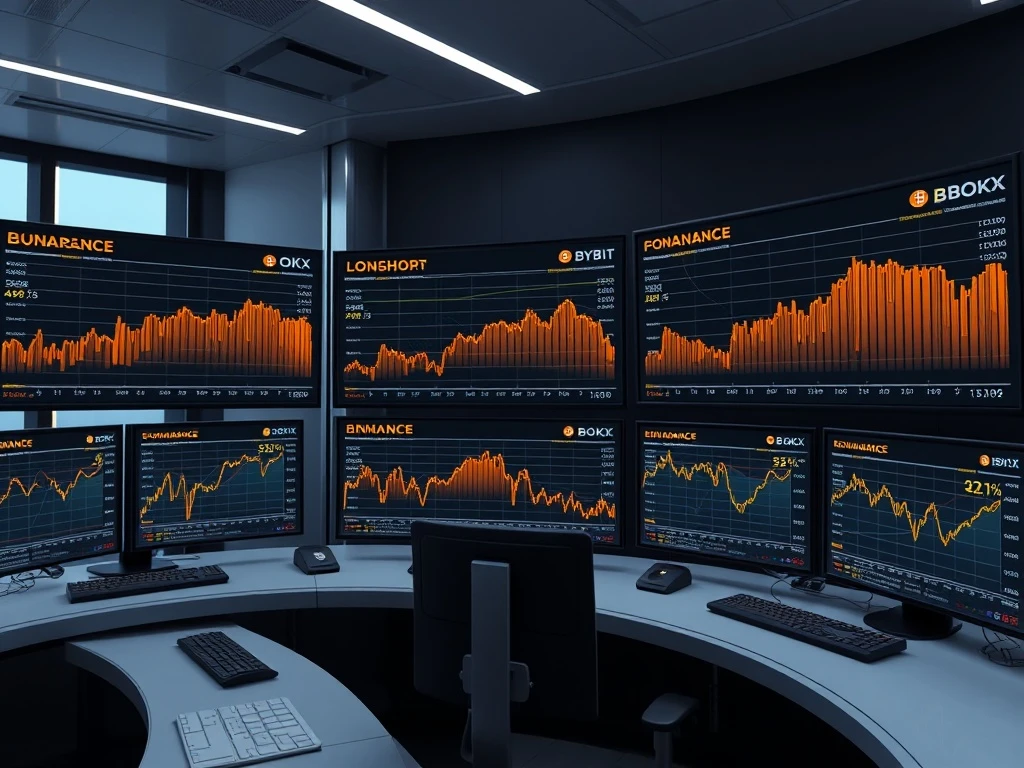
Exchange-specific breakdowns reveal nuanced variations in trader behavior. Binance, the world’s largest cryptocurrency exchange by trading volume, shows the most pronounced short bias with 47.81% long positions against 52.19% short positions. Meanwhile, OKX presents the most balanced ratio among the three platforms at 49.41% long versus 50.59% short. Bybit exhibits the strongest short preference with only 46.05% long positions compared to 53.95% short positions. These variations likely reflect differences in user demographics, trading strategies, and regional market influences across platforms.
Understanding Perpetual Futures Market Dynamics
Perpetual futures contracts revolutionized cryptocurrency trading by eliminating expiration dates while maintaining continuous market exposure. These instruments utilize funding rate mechanisms to keep contract prices aligned with underlying spot prices. The funding rate, typically exchanged every eight hours, incentivizes traders to balance long and short positions. When shorts dominate, long position holders typically pay funding to short holders, creating economic incentives that can influence market behavior over time.
Several factors contribute to the current short dominance in BTC perpetual futures:
- Market Uncertainty: Recent regulatory developments and macroeconomic conditions create hedging demand
- Technical Analysis: Key resistance levels and chart patterns influence trader positioning
- Institutional Activity: Professional traders often use shorts for portfolio protection
- Funding Rate Dynamics: Positive funding rates can attract arbitrage opportunities
Historical data analysis reveals that extreme long/short ratios often precede significant market movements. However, market analysts emphasize that these indicators function best when combined with other technical and fundamental factors. The current moderate short bias suggests cautious sentiment rather than extreme bearish positioning.
Exchange-Specific Trading Patterns and Implications
Each major exchange exhibits distinct characteristics in its perpetual futures market. Binance’s substantial retail trader base often leads to more reactive positioning, while OKX’s balanced ratio suggests diverse market participants with varying strategies. Bybit’s pronounced short bias may reflect its popularity among more experienced derivatives traders who employ sophisticated hedging strategies. These platform differences highlight the importance of analyzing aggregate data alongside exchange-specific metrics for comprehensive market understanding.
Open interest data provides additional context for interpreting long/short ratios. Higher open interest combined with short dominance typically indicates stronger conviction among bearish traders. Conversely, declining open interest with short bias might suggest profit-taking or position unwinding. Current market conditions show stable open interest levels across major exchanges, supporting the interpretation of genuine sentiment shift rather than temporary positioning anomalies.
Historical Context and Market Cycle Analysis
Bitcoin perpetual futures markets have evolved significantly since their introduction in 2016. Early markets exhibited extreme volatility in long/short ratios, often reaching 70% or higher in either direction. However, as markets matured and institutional participation increased, ratios typically stabilized within narrower ranges. The current 48.4%/51.6% distribution falls within normal historical parameters but represents a meaningful shift from the predominantly long-biased ratios observed throughout much of 2024.
Comparative analysis with previous market cycles reveals interesting patterns. During the 2021 bull market peak, long positions frequently exceeded 65% across major exchanges. The subsequent market correction saw rapid shifts toward short dominance, with ratios sometimes reaching 60% short positions. The current moderate short bias suggests neither extreme bullish euphoria nor panic-driven bearish sentiment, potentially indicating a consolidation phase within the broader market cycle.
Impact on Bitcoin Price Discovery and Market Structure
Perpetual futures markets significantly influence Bitcoin price discovery through several mechanisms. Large positions can create liquidity effects that impact spot markets, particularly during periods of high volatility. Funding rate dynamics create economic incentives that influence trader behavior over time. Additionally, the relationship between perpetual futures prices and spot prices provides insights into market efficiency and arbitrage opportunities.
The current short dominance creates specific market conditions:
- Funding Rate Pressure: Sustained short bias typically leads to positive funding rates
- Liquidity Distribution: Order book depth may shift around key price levels
- Volatility Expectations: Options markets often reflect increased implied volatility
- Institutional Positioning: Large traders may adjust spot holdings accordingly
Market microstructure analysis suggests that moderate short bias often precedes periods of reduced volatility as markets digest information and establish new equilibrium levels. However, sudden shifts in positioning can trigger cascading effects, particularly in leveraged markets where liquidations amplify price movements.
Risk Management Considerations for Traders
Current market conditions necessitate careful risk management strategies for perpetual futures traders. The funding rate mechanism creates ongoing costs for maintaining positions, particularly when ratios remain imbalanced for extended periods. Traders should monitor several key metrics:
| Metric | Current Status | Risk Implication |
|---|---|---|
| Aggregate Long/Short Ratio | 48.4%/51.6% | Moderate short bias |
| Funding Rate Trend | Generally positive | Cost for long positions |
| Open Interest Change | Stable | Sustained positioning |
| Liquidation Levels | Concentrated | Volatility risk |
Position sizing becomes particularly important during periods of imbalanced ratios. Traders should consider reduced leverage to withstand potential funding costs and unexpected market movements. Additionally, diversification across timeframes and instruments can mitigate specific risks associated with perpetual futures positioning.
Conclusion
The current BTC perpetual futures data reveals meaningful shifts in market sentiment across major cryptocurrency exchanges. With shorts leading longs at 51.6% versus 48.4% aggregate, traders demonstrate cautious positioning amid evolving market conditions. Exchange-specific variations highlight diverse participant behaviors while maintaining the overall short bias pattern. This BTC perpetual futures positioning provides valuable insights for market participants but should be interpreted within broader market context alongside technical analysis, fundamental developments, and macroeconomic factors. As cryptocurrency markets continue maturing, perpetual futures data will remain essential for understanding trader psychology and potential price direction.
FAQs
Q1: What are Bitcoin perpetual futures?
Bitcoin perpetual futures are derivative contracts that allow traders to speculate on Bitcoin’s price direction without expiration dates. These instruments use funding rate mechanisms to maintain price alignment with spot markets while providing continuous trading opportunities.
Q2: Why does the long/short ratio matter for Bitcoin trading?
The long/short ratio indicates market sentiment and potential price direction. When shorts dominate, traders generally expect downward price movement or seek hedging protection. This data helps identify market extremes and potential turning points in price trends.
Q3: How do funding rates work in perpetual futures markets?
Funding rates are periodic payments between long and short position holders designed to keep perpetual futures prices aligned with spot prices. When shorts outnumber longs, long positions typically pay funding to short positions, creating economic incentives that influence market behavior.
Q4: Which exchange shows the strongest short bias in BTC perpetual futures?
According to current data, Bybit exhibits the strongest short preference with 46.05% long positions versus 53.95% short positions. This represents the most pronounced deviation from balanced positioning among the three major exchanges analyzed.
Q5: How often do long/short ratios change in cryptocurrency markets?
Long/short ratios can change rapidly based on market conditions, news events, and price movements. Most platforms update these metrics continuously, but significant shifts typically occur over hours or days rather than minutes, reflecting evolving trader sentiment and positioning adjustments.

This article was produced with AI assistance and reviewed by our editorial team for accuracy and quality.