Tezos Futures Breakthrough: Bitnomial Launches First US-Regulated XTZ Derivatives for Retail Traders
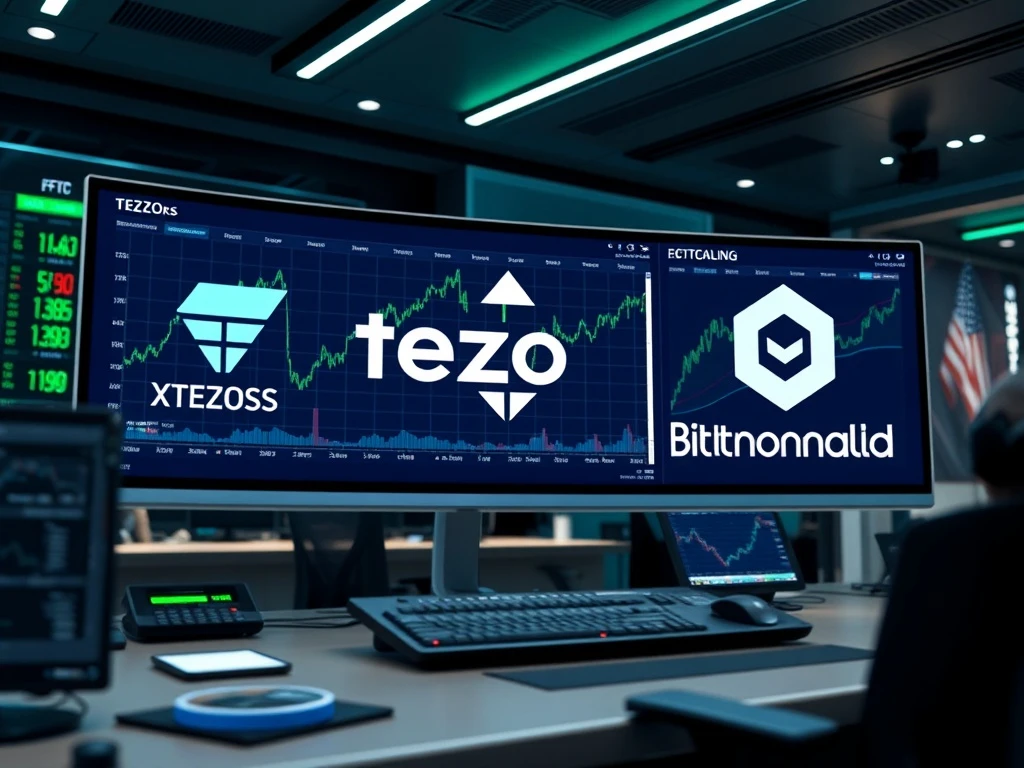
In a landmark move for cryptocurrency market structure, Chicago-based Bitnomial Exchange has successfully launched the first US-regulated futures contracts for Tezos (XTZ), fundamentally altering access to this proof-of-stake blockchain for both retail and institutional investors as of March 2025. This major development creates a regulated pathway for price exposure to XTZ without direct asset ownership, marking a significant expansion of the US derivatives market beyond Bitcoin and Ethereum.
Bitnomial’s Tezos Futures Launch Details
The Chicago-based cryptocurrency derivatives exchange announced the live trading of Tezos futures contracts on Wednesday, March 12, 2025. Consequently, these contracts operate under the regulatory oversight of the US Commodity Futures Trading Commission (CFTC), establishing critical precedents for market standardization. Traders can now utilize either cryptocurrency or US dollars as margin to speculate on or hedge against XTZ price movements. Furthermore, this launch follows Bitnomial’s strategic expansion into altcoin derivatives, having previously introduced regulated futures for Cardano (ADA), XRP, and Aptos (APT).
Also read: Bitcoin Price Rally Explained: The Real Reasons Behind Today's Crypto Surge
Michael Dunn, President of Bitnomial, emphasized the regulatory significance of this development. “A CFTC-regulated futures market with six months of trading history checks a key box under the SEC’s generic listing standards for spot ETFs,” Dunn stated. This connection highlights how regulated derivatives markets often serve as foundational infrastructure for subsequent financial products, including potential spot exchange-traded funds.
The Regulatory Pathway and Institutional Implications
Bitnomial’s journey to list these futures involved handling complex regulatory terrain. Notably, the exchange faced opposition from the Securities and Exchange Commission (SEC) in August 2024 when attempting to self-certify XRP futures. The SEC argued those contracts required registration as a securities exchange. After initiating legal action in October 2024 and subsequently withdrawing the case, Bitnomial successfully launched XRP futures in March 2025, citing evolving regulatory approaches. This established a framework that likely facilitated the Tezos listing.
Also read: Bitcoin ETF Outflows Surge: Investors Pull Billions From Crypto Funds
Regulated futures markets provide several essential functions for institutional participation:
- Price Discovery: They create transparent, standardized pricing mechanisms.
- Risk Management: Institutions can hedge exposure using regulated instruments.
- Regulatory Comfort: CFTC oversight reduces legal and compliance uncertainty.
- Market Legitimacy: They signal maturity and integration with traditional finance.
Understanding Tezos: A Blockchain Built for Evolution
To appreciate the significance of these futures, one must understand the Tezos blockchain itself. The network launched its mainnet in June 2018 following a substantial 2017 initial coin offering that raised approximately $232 million. While not the first proof-of-stake blockchain, Tezos pioneered the combination of proof-of-stake consensus with formal on-chain governance. This innovative structure enables XTZ token holders to vote directly on protocol upgrades, allowing the network to evolve without contentious hard forks.
During the 2021–2022 NFT boom, Tezos carved a distinct niche as a lower-cost, energy-efficient alternative to Ethereum. As Ethereum gas fees surged, prominent entities like the video game publisher Ubisoft and various digital artists migrated activity to Tezos. The blockchain also secured high-profile partnerships with Red Bull Racing, McLaren Racing, and was reportedly negotiating a major sponsorship with Manchester United.
Despite these developments, the XTZ token has experienced significant price volatility. According to CoinGecko data, XTZ reached an all-time high of $9.12 in October 2021 but has since retraced approximately 95%, trading around $0.46 at the time of the futures launch. The network continues to develop technically, implementing its “Tallinn” protocol upgrade in January 2025, which reduced base-layer block times to six seconds.
Comparative Analysis: The Expanding US Crypto Derivatives Market
Bitnomial’s launch positions it within a small group of venues offering regulated crypto derivatives beyond the dominant Bitcoin and Ether contracts in the United States. The table below illustrates the current sector for select altcoin futures as of March 2025:
| Asset | Exchange | Regulator | Launch Date | Status |
|---|---|---|---|---|
| Tezos (XTZ) | Bitnomial | CFTC | March 2025 | Live |
| Cardano (ADA) | Bitnomial | CFTC | 2024 | Live |
| XRP (XRP) | Bitnomial | CFTC | March 2025 | Live |
| Aptos (APT) | Bitnomial | CFTC | January 2025 | Live |
This expansion reflects a growing, albeit cautious, acceptance by US regulators of derivatives for certain digital assets not classified as securities. Dunn confirmed Bitnomial is “actively looking at new tokens” for potential futures markets but declined to specify which assets.
Market Impact and Future Trajectory
The introduction of regulated Tezos futures carries immediate and long-term implications. In the short term, it provides existing XTZ holders and traders with a powerful new tool for risk management. Retail investors, in particular, gain access to a regulated product that was previously unavailable. Moreover, it enhances liquidity and price stability for the XTZ spot market by allowing arbitrage between futures and spot prices.
Looking ahead, a successful track record for these futures could influence the regulatory conversation around a potential spot XTZ ETF. The SEC has historically viewed the existence of a regulated, significant futures market as a factor in its ETF approval process, as seen with Bitcoin and Ethereum. Therefore, sustained trading volume and a lack of market manipulation incidents on Bitnomial will be closely monitored by product developers and regulators alike.
The launch also signals a potential shift in the competitive market for layer-1 blockchains. Access to regulated derivatives can be perceived as a marker of maturity and legitimacy, potentially attracting more institutional capital and development activity to the Tezos ecosystem compared to chains without such financial infrastructure.
Conclusion
Bitnomial’s launch of the first US-regulated Tezos futures represents a concrete step toward the maturation and integration of cryptocurrency markets with traditional finance. By providing a CFTC-regulated venue for XTZ price exposure, the exchange addresses a critical need for both risk management and speculative access. This development not only benefits Tezos but also sets a precedent for other altcoins seeking to build similar regulated market infrastructure. As the regulatory environment continues to evolve, the performance and adoption of these pioneering Tezos futures will serve as a key indicator of the future trajectory for altcoin derivatives in the United States.
FAQs
Q1: What are Tezos futures contracts?
Tezos futures are standardized, exchange-traded agreements to buy or sell XTZ tokens at a predetermined price on a specific future date. They allow traders to gain exposure to XTZ’s price movements without owning the underlying asset, using either cash or crypto as collateral.
Q2: Why is a CFTC-regulated futures market important for Tezos?
CFTC regulation provides oversight, reduces counterparty risk, standardizes contracts, and enhances market integrity. It also creates a precedent that could support future financial products like spot ETFs by establishing a regulated market for price discovery.
Q3: Can retail traders access Bitnomial’s Tezos futures?
Yes. Bitnomial explicitly designed these contracts for both institutional and retail participants, a significant departure from derivatives markets that often cater primarily to institutions.
Q4: How does this affect the price of XTZ?
While direct price impact is unpredictable, regulated futures typically increase overall market liquidity and can attract new classes of investors. They provide tools for hedging, which may reduce volatility, and improve price discovery mechanisms.
Q5: What other cryptocurrencies have regulated futures in the US?
Beyond Bitcoin and Ethereum, Bitnomial now offers CFTC-regulated futures for Tezos (XTZ), Cardano (ADA), XRP, and Aptos (APT). Other exchanges may offer similar products for a limited set of additional assets under different regulatory frameworks.

This article was produced with AI assistance and reviewed by our editorial team for accuracy and quality.