Bitcoin Stunned: Drops to Third in South Korean Trading Volume for First Time Ever
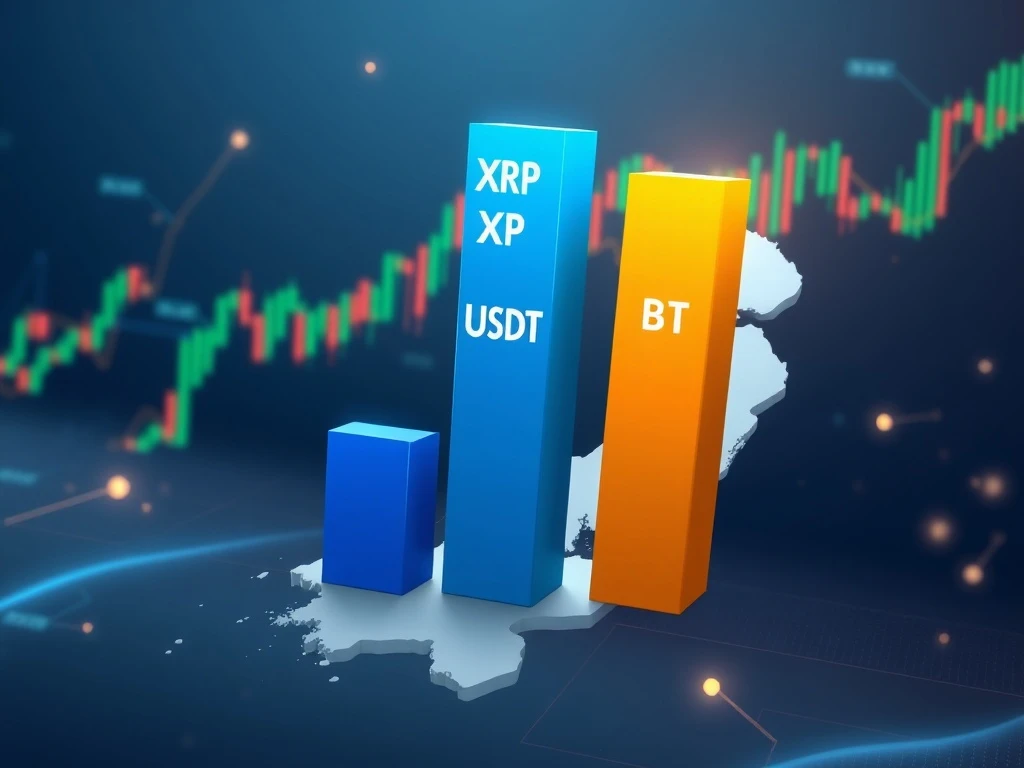
In a historic shift for one of the world’s most active cryptocurrency markets, Bitcoin (BTC) has fallen to third place in trading volume in South Korea for the first time ever. According to a comprehensive 2025 report from analytics firm Digital Asset, the pioneering digital asset was surpassed by both XRP and the stablecoin USDT when measured by trading volume against the South Korean won (KRW). This landmark event signals a potential recalibration of investor preference and market dynamics within a jurisdiction long known for its fervent retail trading activity.
Bitcoin Trading Volume Loses Its Top Spot
The Digital Asset analysis provides a definitive look at market evolution. The firm reviewed trading volumes for the top eight digital assets by market capitalization—Bitcoin (BTC), Ethereum (ETH), Tether (USDT), XRP, USD Coin (USDC), Solana (SOL), Tron (TRX), and Dogecoin (DOGE)—spanning from 2013 through 2025. The 2025 data reveals a clear leader: XRP recorded the highest annual trading volume at approximately 335 trillion Korean won. USDT secured a strong second place, consequently pushing Bitcoin into an unprecedented third position. This represents a significant departure from the market’s historical structure, where Bitcoin has consistently dominated trading pairs globally.
Several key factors likely contributed to this shift. Firstly, South Korea’s unique crypto ecosystem, often called the “Kimchi Premium,” has shown distinct preferences. Regulatory developments and the licensing of specific exchanges can heavily influence which assets see the most liquidity. Secondly, the rise of stablecoins like USDT for arbitrage and as a safe-haven asset during volatility has increased their utility. Finally, XRP’s established presence on major Korean exchanges and its use in specific payment and remittance corridors may have driven consistent high-volume trading.
Analyzing the South Korean Cryptocurrency Landscape
South Korea’s market is not a mere mirror of global trends. It operates with unique characteristics that make this volume shift particularly noteworthy. The market is largely retail-driven, with high participation from individual investors. Trading often focuses on a narrower set of altcoins compared to Western markets, and volumes can be disproportionately high relative to the country’s size. This environment makes the displacement of Bitcoin a powerful indicator of changing local sentiment and strategy.
The following table contrasts the reported 2025 trading volume leaders with Bitcoin’s historical dominance:
| Asset | 2025 Ranking (vs. KRW) | Notable Context |
|---|---|---|
| XRP | 1st | Long-standing listing on Upbit, Bithumb; used in cross-border payments. |
| USDT | 2nd | Preferred stablecoin for arbitrage and parking funds during downturns. |
| Bitcoin (BTC) | 3rd | First time not in top two; remains dominant store-of-value narrative globally. |
Market analysts point to the practical utility of the top two assets as a primary driver. XRP facilitates fast, low-cost transactions which appeal to a trading-focused audience. Conversely, USDT offers a digital representation of the Korean won during times of market uncertainty, allowing traders to exit volatile positions without fully leaving the crypto ecosystem.
Expert Perspective on Market Maturation
Financial technology experts interpret this data as a sign of market maturation rather than a rejection of Bitcoin. “This shift is less about Bitcoin failing and more about the South Korean market diversifying,” explains a researcher specializing in Asian crypto markets, who reviewed the Digital Asset findings. “Early markets are often monolithic, trading almost exclusively in the flagship asset. As infrastructure develops and investor knowledge deepens, activity naturally fragments towards assets with specific use cases—like payments with XRP or stability with USDT.”
The timeline is also critical. The report’s scope from 2013 captures Bitcoin’s near-total dominance in the early years, followed by Ethereum’s rise, and now the ascendancy of utility and stability-focused tokens in a major market. This progression mirrors the broader industry’s journey from a single-asset experiment to a multi-faceted digital asset economy.
Implications for Global Crypto Investors
While a regional development, the South Korean volume shift carries implications for global observers. It demonstrates that local market dynamics can produce leaders that deviate from the global market capitalization ranking. Investors tracking capital flows must now consider regional liquidity variations. Furthermore, it highlights the growing importance of stablecoin volume as a metric for market health and trader behavior. High USDT volume can indicate cautious sentiment or sophisticated arbitrage activity.
Key impacts of this shift include:
- Exchange Strategy: Korean exchanges may re-evaluate fee structures and promotional activities based on volume leaders.
- Project Focus: Blockchain projects may increase efforts to list on Korean exchanges and build local partnerships, seeing a path to high volume independent of Bitcoin’s price action.
- Regulatory Attention: High volume in specific assets like XRP or USDT could draw further regulatory scrutiny regarding their use and compliance.
It is crucial to note that trading volume is distinct from market capitalization or value stored. Bitcoin retains its position as the largest cryptocurrency by market cap globally. The Korean data reflects trading activity—how often an asset is bought and sold—which is influenced by volatility, news cycles, and local investor appetite for short-term movement.
Conclusion
The 2025 report from Digital Asset marks a milestone: for the first time, Bitcoin trading volume in South Korea has fallen to third place, overtaken by XRP and USDT. This event underscores the distinctive and evolving nature of one of the world’s most vibrant cryptocurrency markets. It reflects a move towards assets valued for transactional utility and stability, alongside the store-of-value proposition of Bitcoin. For market watchers, this shift serves as a clear reminder that global trends are an aggregate of diverse local behaviors, and understanding these regional nuances is key to grasping the full picture of the digital asset economy.
FAQs
Q1: Does Bitcoin falling to third in Korean volume mean it’s losing popularity?
A1: Not necessarily. It primarily indicates that trading activity for other assets (XRP, USDT) has increased relative to Bitcoin. Bitcoin remains the largest cryptocurrency by market capitalization globally and is still widely held. This shift reflects diversification and specific use-case trading in the Korean market.
Q2: Why is XRP trading volume so high in South Korea?
A2: XRP has been listed on major Korean exchanges like Upbit and Bithumb for years. It is often used in specific payment and remittance corridors due to its speed and low cost, which generates consistent trading activity. Local investor interest and its established presence are key factors.
Q3: What role do stablecoins like USDT play in this volume shift?
A3: Stablecoins like USDT act as a digital safe haven and a tool for arbitrage. Traders often move into USDT during market volatility instead of cashing out to Korean won, and they use it to capture price differences between exchanges. This utility drives high trading volume.
Q4: Is this data a sign of a healthy or unhealthy market?
A4: Analysts view it as a sign of a maturing market. Early markets tend to concentrate volume in one asset (Bitcoin). As markets develop, volume diversifies into assets with different utilities (payments, stability), which is a natural progression towards a more complex and resilient ecosystem.
Q5: Could Bitcoin regain the top spot in South Korean trading volume?
A5: Absolutely. Trading volume rankings are dynamic and respond to market cycles, news, and technological developments. A major Bitcoin bull run, regulatory changes, or shifts in global macroeconomic conditions could easily see Bitcoin’s trading volume surge back to the top positions.