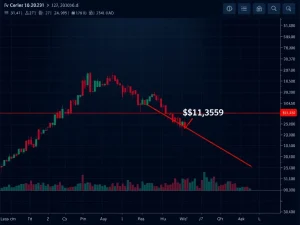
Bitcoin Price Plummets Below $96,000: Analyzing the Sudden Market Shift

Bitcoin has experienced a significant price movement, falling below the crucial $96,000 threshold to trade at $95,992.6 on the Binance USDT market according to Crypto News Insights market monitoring data. This development marks a notable shift in the cryptocurrency landscape as traders and analysts assess the implications of this downward movement during early 2025 trading sessions.
Bitcoin Price Movement Analysis
The cryptocurrency market witnessed Bitcoin’s descent below $96,000, representing a meaningful correction from recent price levels. Market data from multiple exchanges confirms this movement, with Binance’s USDT pairing showing consistent trading at approximately $95,992.6. This price action follows several weeks of relative stability in the upper $96,000 to $98,000 range, making the current decline particularly noteworthy for market participants.
Historical data reveals that Bitcoin has tested the $96,000 support level multiple times throughout 2024 and early 2025. The current breach suggests potential weakening of this previously strong support zone. Market analysts typically monitor such technical levels closely, as they often indicate broader market sentiment shifts. Furthermore, trading volume patterns accompanying this price movement provide additional context for understanding market dynamics.
Market Context and Contributing Factors
Several factors potentially contribute to Bitcoin’s current price movement. Global macroeconomic conditions, including interest rate decisions by major central banks, frequently influence cryptocurrency markets. Additionally, regulatory developments in key jurisdictions like the United States and European Union create market uncertainty that affects trading decisions. Institutional investment flows, which have become increasingly significant in cryptocurrency markets, also play a crucial role in price discovery mechanisms.
The relationship between Bitcoin and traditional financial markets has strengthened considerably in recent years. Consequently, movements in equity markets, particularly technology stocks, often correlate with cryptocurrency price action. Market participants also monitor blockchain network metrics, including transaction volumes and mining difficulty adjustments, which provide fundamental insights into network health and adoption trends.
Technical Analysis Perspective
Technical analysts examine multiple indicators when assessing Bitcoin’s price movements. Key levels to watch include:
- Immediate support: $94,500 – $95,000 range
- Resistance levels: $96,500 and $97,200
- Moving averages: 50-day and 200-day trends
- Relative Strength Index (RSI): Momentum indicators
Historical volatility patterns suggest that Bitcoin typically experiences periodic corrections within broader trend cycles. The current market structure shows similarities to previous consolidation periods that preceded significant directional moves. Market depth analysis reveals substantial liquidity around current price levels, suggesting active participation from both retail and institutional traders.
Comparative Market Performance
Bitcoin’s performance relative to other major cryptocurrencies provides additional market context. The table below illustrates recent price movements across major digital assets:
| Cryptocurrency | Price Change (24h) | Market Correlation |
|---|---|---|
| Bitcoin (BTC) | -1.2% | 1.00 |
| Ethereum (ETH) | -0.8% | 0.85 |
| Solana (SOL) | -1.5% | 0.78 |
| Cardano (ADA) | -1.1% | 0.72 |
This comparative analysis reveals broader market trends beyond Bitcoin’s individual performance. The correlation coefficients demonstrate how closely other major cryptocurrencies follow Bitcoin’s price movements, highlighting Bitcoin’s continued role as market leader and sentiment indicator for the broader digital asset space.
Historical Context and Market Cycles
Bitcoin’s price history shows recurring patterns of consolidation and breakout movements. Previous instances of significant support level breaches have often preceded either extended corrections or rapid recoveries, depending on broader market conditions. The cryptocurrency’s four-year cycle theory, traditionally linked to halving events, continues to influence long-term investor perspectives despite evolving market structures.
Market participants recall similar technical scenarios from previous years. For instance, the 2023 consolidation around $30,000 preceded a sustained upward movement, while the 2022 breach of $40,000 support led to extended downward pressure. These historical precedents inform current market analysis, though each cycle presents unique characteristics shaped by evolving adoption, regulation, and macroeconomic factors.
Institutional Impact and Market Structure
Institutional participation has transformed cryptocurrency market dynamics significantly since 2020. The introduction of Bitcoin exchange-traded funds (ETFs), increased corporate treasury allocations, and growing pension fund exposure have altered traditional market patterns. These institutional flows now represent substantial market influence, potentially amplifying or dampening volatility depending on investment horizon and strategy implementation.
Market infrastructure developments, including improved custody solutions and regulatory frameworks, have facilitated greater institutional engagement. This structural evolution means price movements now reflect a more diverse set of market participants compared to earlier cryptocurrency cycles dominated primarily by retail traders and early adopters.
Global Regulatory Environment
Regulatory developments worldwide continue to shape cryptocurrency market sentiment. Recent months have seen significant policy announcements from multiple jurisdictions, creating both opportunities and challenges for market participants. The evolving regulatory landscape affects trading volumes, liquidity patterns, and investor confidence across global cryptocurrency markets.
Key regulatory areas influencing current market conditions include:
- Tax treatment of digital assets in major economies
- Anti-money laundering (AML) compliance requirements
- Securities classification debates
- Cross-border transaction regulations
- Consumer protection frameworks
These regulatory factors interact with technical market conditions to create complex price discovery environments. Market participants must navigate both technical analysis and regulatory developments when making trading and investment decisions.
Conclusion
Bitcoin’s decline below $96,000 represents a significant market development with implications for traders, investors, and analysts. The current price of $95,992.6 on Binance’s USDT market reflects broader market dynamics influenced by technical factors, institutional flows, and global regulatory developments. Market participants will monitor subsequent price action closely, particularly around key support and resistance levels, to gauge whether this movement represents a temporary correction or the beginning of a more substantial trend shift. Historical patterns suggest that Bitcoin frequently experiences such technical movements within its characteristic volatility profile, though each instance requires careful analysis of contemporary market conditions and fundamental developments.
FAQs
Q1: What does Bitcoin falling below $96,000 indicate about market sentiment?
This price movement typically suggests weakening bullish momentum and potential profit-taking by traders. Market sentiment often shifts when Bitcoin breaches significant technical levels, though broader context including trading volume and market structure provides more complete analysis.
Q2: How significant is the $96,000 level for Bitcoin’s price history?
The $96,000 level has served as both support and resistance multiple times throughout 2024 and early 2025. Technical analysts consider such round-number psychological levels important for market psychology and trading decisions, though their significance varies across different market conditions.
Q3: What factors commonly influence Bitcoin’s price movements?
Multiple factors influence Bitcoin prices including macroeconomic conditions, regulatory developments, institutional investment flows, network fundamentals, and broader cryptocurrency market trends. These elements interact in complex ways to determine price discovery in global markets.
Q4: How does Bitcoin’s current price compare to its all-time high?
Bitcoin’s current price below $96,000 remains substantially below its all-time high above $100,000 recorded in late 2024. Price comparisons to historical levels provide context for understanding current market positioning within broader cycle patterns.
Q5: What should investors monitor following this price movement?
Investors typically monitor subsequent price action around key technical levels, trading volume patterns, broader market correlations, and fundamental developments including regulatory announcements and institutional flow data. Multiple time frame analysis often provides more complete perspective than single price movements.