Bitcoin Narratives: Five Critical Signals Analysts Watch Beyond Price in 2026
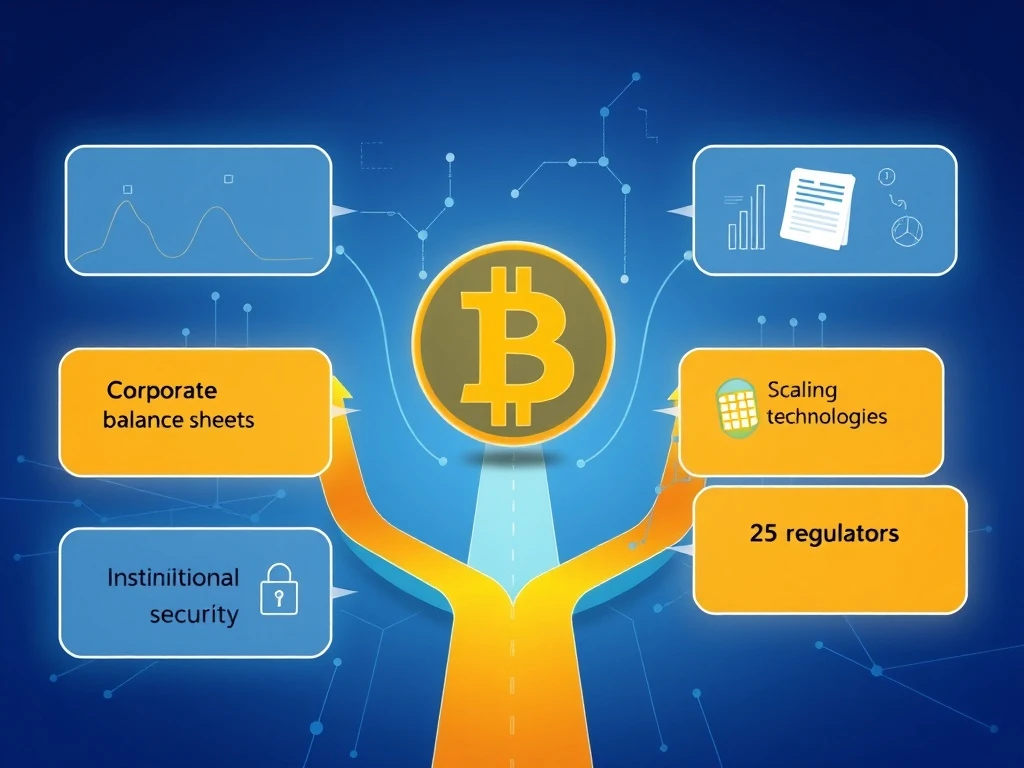
While Bitcoin’s price dominates headlines, sophisticated analysts in 2026 are looking deeper. Institutional flows, corporate strategies, network fundamentals, technological evolution, and regulatory frameworks now provide more meaningful signals about Bitcoin’s trajectory. This shift reflects cryptocurrency’s maturation from speculative asset to integrated financial instrument. Understanding these five narratives offers essential insight into Bitcoin’s real-world adoption and long-term sustainability.
Institutional Demand Through ETF Flows
Exchange-traded fund flows have become the clearest institutional demand signal for Bitcoin. These flows represent actual allocation decisions by wealth platforms, registered investment advisors, and discretionary desks. Unlike speculative trading on cryptocurrency exchanges, ETF movements reflect strategic portfolio positioning. Reuters analysis of mid-2025 market activity highlighted this distinction, noting Bitcoin’s breakout was “fuelled by strong flows into Bitcoin ETFs” and appeared “more stable and lasting” than previous speculation-driven rallies.
Also read: Ondo's Important Role: The Settlement Engine Behind Banking's Trillion-Dollar Tokenization Drive
Nicolas Lin of Aether Holdings emphasized the structural importance of this development, telling Reuters, “It’s the start of crypto becoming a permanent fixture in diversified portfolios.” However, Bloomberg reporting revealed the potential volatility of these flows, documenting investors “yanking nearly $1 billion” in a single session during early 2026. This represented one of the largest daily outflows on record for Bitcoin ETFs, demonstrating how institutional sentiment can shift rapidly despite longer-term adoption trends.
The Historical Context of Bitcoin ETFs
Bitcoin ETFs represent a significant evolution in cryptocurrency accessibility. The Canadian Purpose Investments Bitcoin ETF (BTCC) launched in February 2021 as the world’s first physically settled Bitcoin ETF. This product allowed investors to gain direct BTC exposure through regulated stock exchanges nearly three years before United States regulators approved similar products. The approval of U.S. spot Bitcoin ETFs in early 2024 marked a watershed moment, creating the infrastructure for institutional participation that now dominates demand analysis.
Also read: Stellar's Privacy Breakthrough: Banks Can Now Move Trillions On-Chain With Confidence
Bitcoin Treasury Stocks as Equity Products
Public companies holding Bitcoin on their balance sheets have created a new investment vehicle category. These “digital asset treasury companies” (DATCOs) offer investors Bitcoin exposure through traditional equity markets. Reuters describes DATCOs as companies that “began holding crypto tokens such as Bitcoin and ether as their main treasury assets,” providing investors “a proxy for direct exposure.” This structure creates unique analytical challenges and opportunities.
The fundamental question facing index providers and analysts is whether these companies represent operating businesses or investment vehicles. MSCI addressed this concern in early January 2026, delaying a potential reclassification that could have excluded some DATCOs from major indexes. The index provider noted investors were concerned some DATCOs “share characteristics with investment funds” and that distinguishing operating companies from asset-holding entities “requires further research.”
| Analytical Factor | Impact on Bitcoin Exposure |
|---|---|
| Index Inclusion Rules | Determines institutional ownership and liquidity |
| Balance Sheet Composition | Affects correlation with Bitcoin price movements |
| Corporate Governance | Influences Bitcoin management and security practices |
| Regulatory Classification | Shapes reporting requirements and investor protections |
JPMorgan analysis estimated potential selling pressure could have reached approximately $2.8 billion if MSCI had proceeded with exclusion, with additional impact if other index providers followed. Owen Lau of Clear Street called MSCI’s delay the removal of a “material near-term technical risk” for these stocks. Mike O’Rourke of JonesTrading suggested exclusion might simply be “postponed until later in the year,” indicating ongoing analytical attention to this narrative.
Bitcoin’s Security Budget Challenge
Network security represents Bitcoin’s most fundamental economic consideration. The 2024 halving reduced block rewards from 6.25 to 3.125 BTC, increasing the importance of transaction fees for miner compensation. Galaxy Research highlighted concerning trends in August 2025, noting “Bitcoin fee pressure has collapsed” with approximately “15% of daily blocks being ‘free blocks'” and frequently empty mempools. This environment benefits users seeking low-cost transactions but challenges miners’ economic sustainability.
CoinShares research confirmed this trend, reporting transaction fees “have fallen to historic lows” during parts of 2025, representing “less than 1% of total block rewards.” JPMorgan-linked data from early January 2026 showed mounting pressure, with monthly average hashrate falling 3% in December while “daily block reward revenue” dropped 7% month-on-month and 32% year-on-year, reaching “the lowest on record.” VanEck analysts described “a tough structural squeeze” for miners as subsidy reductions collide with increasing competition.
Key Security Metrics Analysts Monitor
- Fee Share of Miner Revenue: Percentage of total compensation from transaction fees versus block rewards
- Hash Price: Dollar value of expected earnings per unit of hashing power
- Mining Profitability: Relationship between operational costs and revenue
- Onchain Demand Indicators: Transaction volume and value independent of speculative activity
These metrics help analysts assess whether Bitcoin can maintain adequate security without relying on price appreciation to drive fee revenue. The security budget narrative has gained prominence as halvings progressively reduce block rewards, making fee economics increasingly critical for network integrity.
Bitcoin Scaling Solutions and Protocol Evolution
Bitcoin’s scaling debate has evolved from theoretical discussions to practical implementation choices. Analysts now examine three primary approaches: Lightning Network for payments, Bitcoin layer-2 solutions for broader functionality, and protocol upgrades for enhanced capabilities. Each approach involves distinct trade-offs between scalability, security, and decentralization.
Lightning Network capacity reached a new high of 5,637 BTC in mid-December 2025 according to network data. Amboss analysis noted the significance of diversified liquidity sources, stating, “It’s not just one company … it’s across the board.” This distribution suggests growing institutional and individual participation rather than concentrated development efforts.
Bitcoin layer-2 projects have proliferated dramatically, with Galaxy Research counting 75 projects in 2025 compared to just 10 in 2021. The firm estimates “over $47bn of BTC could be bridged into Bitcoin L2s by 2030,” representing significant potential value migration. Whether this projection materializes depends on technical execution, security guarantees, and user adoption patterns.
Protocol Upgrade Considerations
Bitcoin’s upgrade debate has reemerged as layer-2 developers seek improved base-layer functionality. Proposals like OP_CAT and OP_CTV aim to enable features such as “trustless bridges” and “improvements to the Lightning Network” through soft forks. OP_CAT was disabled in 2010 for security reasons but remains frequently proposed for reactivation. Hiro’s ecosystem commentary suggests “a good chance” of a covenant-related soft fork “as early as 2026,” indicating potential protocol evolution timelines.
Analysts monitor three scaling dimensions: Lightning Network capacity growth and liquidity distribution, Bitcoin layer-2 adoption of real BTC versus incentive-driven capital, and soft-fork activation progress toward actual implementation. These factors collectively determine Bitcoin’s capacity to support broader use cases while maintaining its core security properties.
Regulatory Frameworks Shaping Access
Regulation increasingly determines Bitcoin accessibility, product availability, and market structure. In the United States, policy language has evolved significantly. A federal executive order establishes “a Strategic Bitcoin Reserve” as United States policy and specifies that government BTC in that reserve “shall not be sold.” This framing positions Bitcoin as a strategic asset rather than merely a financial instrument.
The GENIUS Act represents “the first major crypto legislation” in the United States according to legal analysis. This legislation creates licensing requirements for payment stablecoin issuers, addressing a key infrastructure component for cryptocurrency markets. Amundi’s chief investment officer warned about potential systemic implications, suggesting mass stablecoin adoption could turn them into “quasi-banks” that might “potentially destabilise the global payment system.”
European markets operate under the Markets in Crypto-Assets (MiCA) framework, which functions as a regulatory gatekeeper. European regulators state clearly that “only firms authorised … are allowed to provide crypto-asset services in the EU,” with transition periods in some countries extending until July 1, 2026. This approach creates standardized requirements across member states while establishing clear authorization processes.
Key Regulatory Developments to Monitor
- EU MiCA Implementation: Authorization lists and compliance deadlines across member states
- U.S. Market Structure Legislation: Clarification of SEC and CFTC jurisdictional boundaries
- Strategic Reserve Policies: Government Bitcoin acquisition and management frameworks
- Global Regulatory Coordination: Cross-border standards for cryptocurrency oversight
These regulatory developments shape institutional participation, product innovation, and market stability. Analysts track authorization timelines, enforcement patterns, and policy evolution to understand how regulation facilitates or constrains Bitcoin adoption.
Conclusion
Bitcoin analysis in 2026 extends far beyond price charts. The five narratives of ETF flows, treasury stocks, security budgets, scaling solutions, and regulatory frameworks provide deeper insight into Bitcoin’s maturation as an asset class. Institutional adoption through ETFs reveals strategic allocation patterns, while treasury stocks demonstrate Bitcoin’s integration with traditional equity markets. Security budget concerns highlight Bitcoin’s fundamental economic sustainability questions, and scaling debates showcase the protocol’s technological evolution. Regulatory developments ultimately shape how mainstream capital accesses Bitcoin markets.
These narratives collectively explain why Bitcoin can appear stable while undergoing significant transformation. They represent the analytical framework sophisticated investors use to understand cryptocurrency’s complex ecosystem. As Bitcoin continues evolving, these narratives will likely become increasingly important for assessing its long-term trajectory and investment potential.
FAQs
Q1: Why are ETF flows considered a better institutional signal than exchange volumes?
ETF flows represent actual portfolio allocation decisions by regulated entities like wealth platforms and investment advisors, while exchange volumes often include speculative trading, use, and market-making activity that doesn’t necessarily indicate long-term investment conviction.
Q2: What is the main concern with Bitcoin treasury stocks?
The primary concern is whether companies holding Bitcoin as their main treasury asset should be classified as operating businesses or investment vehicles, which affects their inclusion in major stock indexes and consequently their accessibility to institutional investors.
Q3: How does the security budget affect Bitcoin’s long-term viability?
Bitcoin’s security depends on miners being adequately compensated through block rewards and transaction fees. As block rewards decrease through halvings, transaction fees must increasingly fund security, creating potential sustainability challenges if fee revenue remains low.
Q4: What are the main differences between Lightning Network and Bitcoin layer-2 solutions?
Lightning Network primarily focuses on fast, low-cost payments through payment channels, while Bitcoin layer-2 solutions aim to support broader functionality like decentralized finance applications, often using different technical approaches and trust assumptions.
Q5: How does regulation affect ordinary Bitcoin investors?
Regulation determines which products are available (like ETFs), what protections exist for investors, which exchanges can operate in specific jurisdictions, and how easily individuals can convert between cryptocurrency and traditional currency through banking relationships.

This article was produced with AI assistance and reviewed by our editorial team for accuracy and quality.