Exclusive: Nvidia-Backed Startup Aims for First Bitcoin Mining in Space by 2026
CAMBRIDGE, Massachusetts — February 15, 2026: The frontier of cryptocurrency is poised for its most radical leap yet—into orbit. A startup backed by computing giant Nvidia has confirmed ambitious plans to deploy the first dedicated Bitcoin mining hardware into space within the next 18 months. This move, targeting operational satellites by late 2026, seeks to leverage the perpetual cold of space and potential solar power advantages, fundamentally challenging the energy and geographic constraints of terrestrial mining. The announcement arrives amidst intense scrutiny of cryptocurrency’s environmental footprint and a volatile market, sparking immediate debate about the technical feasibility and economic logic of off-planet blockchain operations.
Nvidia’s Strategic Bet on Extraterrestrial Blockchain
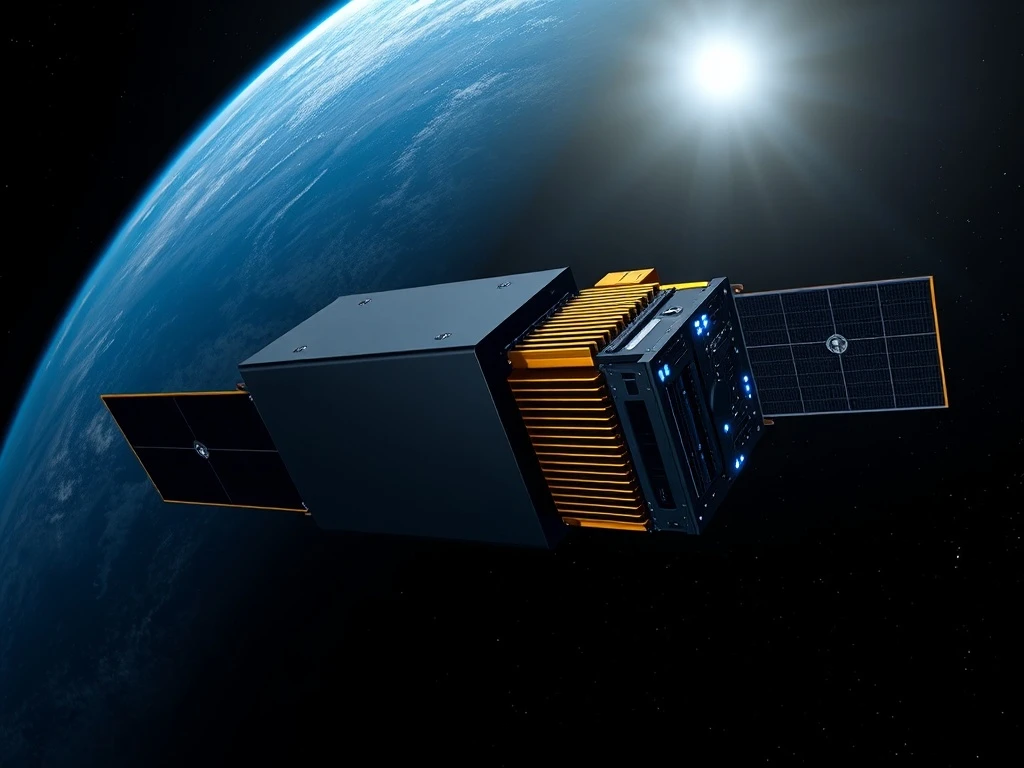
The company, Orbital Blockchain Systems (OBS), emerged from stealth mode this week with $50 million in Series A funding led by Nvidia’s venture arm. OBS CEO Dr. Aris Thorne, a former NASA thermal systems engineer, outlined the mission’s core rationale in an exclusive briefing. “Terrestrial mining faces two immutable physical limits: heat dissipation cost and grid dependency,” Thorne stated. “Space provides a near-infinite heat sink at 3 Kelvin and access to uninterrupted solar energy. Our initial calculations show a potential 40% reduction in operational cooling costs alone.” The first prototype, dubbed “Satoshi-1,” is scheduled for a rideshare launch aboard a SpaceX Falcon 9 in Q4 2026. It will carry a compact, radiation-hardened computing array powered by next-generation Nvidia GPUs specifically designed for the hashing algorithms used in Bitcoin mining.
Also read: Bitcoin Strategy Divide: GameStop's 4,710 BTC Hold Contrasts With Nation's Massive Sell-Off
This initiative follows years of conceptual discussions within aerospace and crypto circles. However, OBS represents the first entity to secure major industry backing and a clear launch manifest. The project timeline is aggressive. Following the Satoshi-1 technology demonstrator, OBS plans a constellation of twelve dedicated mining satellites by 2028. Each satellite would function autonomously, mining Bitcoin and transmitting only the successful block solutions and necessary validation data back to Earth via encrypted laser links, a process designed to minimize bandwidth use. The company has secured ground station partnerships in Alaska and Norway for data downlink.
Decoupling from Earth: Energy, Regulation, and Market Impact
The potential impacts of successful space-based mining are multifaceted, extending beyond simple operational cost savings. Analysts are primarily focused on three disruptive vectors: energy economics, regulatory arbitrage, and network security. First, the energy equation shifts dramatically. While solar power in space is abundant, the efficiency of photovoltaic cells and the power requirements for both computation and constant communication with Earth remain significant hurdles. A 2025 MIT study on space-based data centers noted that transmission energy loss could offset power generation gains unless laser communication technology advances substantially.
Also read: Bitcoin Volatility Dips Below Major Stocks as European Nation Sells Billions in Crypto Reserves
- Regulatory Gray Zone: National jurisdictions largely end at the Kármán line (100 km altitude). Operating in low Earth orbit could place mining hardware in a complex legal void, potentially circumventing local energy taxes, carbon credit schemes, or outright mining bans enacted by countries like China and parts of the EU.
- Network Decentralization vs. Centralization: While adding nodes in a novel location could technically increase the geographic decentralization of the Bitcoin network, the colossal capital barrier for space access risks creating a new, ultra-exclusive tier of miners. This could paradoxically lead to a centralization of hash power among a few space-capable entities.
- Security and Latency: The 550–600 millisecond latency for a round-trip signal to low Earth orbit is negligible for block validation, which occurs on a 10-minute scale. However, security experts like Dr. Lena Kovač of the Blockchain Security Alliance warn that the physical inaccessibility of the hardware presents a unique risk. “A software bug or firmware vulnerability could strand millions of dollars of equipment with no possibility of a manual reset or hardware fix. Redundancy and remote recovery protocols must be flawless.”
Expert Skepticism and Technical Hurdles
The financial community has reacted with cautious skepticism. “The capital expenditure for space infrastructure is orders of magnitude higher than building a warehouse in Texas,” noted Michael Vasquez, lead cryptocurrency analyst at NYDIG, in a research note published just hours after the OBS announcement. “While the operational cost thesis is intriguing, the upfront launch costs, insurance, and hardware redundancy needed for a space environment mean the break-even point is likely many years out, assuming zero launch failures.” Vasquez’s analysis underscores a critical point: the venture is a high-risk, long-term bet on the future price of Bitcoin and the declining cost of space access, rather than a near-term profit driver.
Engineering challenges are equally daunting. Space radiation can cause bit flips in computer memory, corrupting calculations. OBS claims its custom Nvidia chips include error-correcting code memory and triple modular redundancy for critical systems. Furthermore, the waste heat from intense computation, while easier to radiate into space, must be managed precisely to avoid creating thermal gradients that could warp the satellite’s structure or interfere with its sensitive orientation sensors. Dr. Thorne confirmed that Satoshi-1 will use a novel liquid-to-radiator cooling system that has only been tested in vacuum chambers on Earth.
Beyond Bitcoin: The Broader Race for Orbital Infrastructure
OBS’s plan is not occurring in a vacuum. It reflects a broader trend of moving high-intensity computing off-planet. In 2024, the European Space Agency funded a feasibility study for orbital data centers for climate modeling. Several private companies are exploring space-based rendering for visual effects. The OBS model, if successful, could provide a proven template for these applications. The following table compares key metrics of terrestrial and proposed orbital mining:
| Metric | Terrestrial Mining Farm | OBS Orbital Proposal (Projected) |
|---|---|---|
| Primary Energy Source | Grid (Fossil/Renewable Mix) | Solar Panels |
| Cooling Cost (% of OpEx) | 30-40% | 5-10% (Est.) |
| Regulatory Environment | National/Local Jurisdiction | International Treaty (Outer Space Treaty) |
| Hardware Access | Direct (for repairs) | None (Remote only) |
| Upfront Capex per TH/s | $X | $5X – $10X (Est. incl. launch) |
The Road to Launch: What Happens Next?
The immediate next steps for OBS are terrestrial. The company must complete rigorous vibration, thermal vacuum, and radiation testing on its flight hardware throughout 2026. Simultaneously, it must navigate the international licensing process for spectrum use with the International Telecommunication Union (ITU) and launch approval from the U.S. Federal Aviation Administration’s Office of Commercial Space Transportation. Industry observers will closely watch the integration of the mining payload with the satellite bus, a process often fraught with unforeseen compatibility issues. Success or failure of the Satoshi-1 mission will likely determine whether space-based mining remains a niche concept or sparks a genuine gold rush to orbit.
Market Reactions and Philosophical Divides
Within the cryptocurrency community, reaction is split. Proponents hail it as a visionary step that aligns Bitcoin’s expansion with humanity’s multi-planetary future. Critics deride it as a costly publicity stunt that ignores more pressing issues of blockchain scalability and real-world utility. The price of Bitcoin showed minimal direct movement on the news, suggesting traders are adopting a “wait-and-see” approach. However, shares of several aerospace logistics companies saw modest gains. The venture ultimately tests a core hypothesis: can the drive for efficient, globally-permissionless computation justify the extreme expense and risk of spaceflight? The answer will begin to take shape in late 2026.
Conclusion
The plan to mine Bitcoin in space represents a convergence of two of the 21st century’s most capital-intensive and speculative frontiers: cryptocurrency and private spaceflight. While the engineering and economic hurdles are substantial, the backing by a titan like Nvidia lends the project significant credibility. If successful, OBS could not only create a new paradigm for cryptocurrency mining but also pioneer the infrastructure for all future off-planet heavy computing. The Satoshi-1 launch in late 2026 will be a landmark event, watched closely by the finance, technology, and aerospace sectors. It will test whether the final frontier for blockchain is truly among the stars, or if gravity—both physical and economic—will keep its operations firmly grounded on Earth.
Frequently Asked Questions
Q1: How can a satellite in space mine Bitcoin without a constant internet connection?
The satellite will maintain an intermittent but scheduled connection via laser link to ground stations. It downloads the current block header and transaction mempool, then works independently on solving the cryptographic puzzle. Only the successful “nonce” (proof of work) and block solution need to be transmitted back, a tiny amount of data.
Q2: Who owns the Bitcoin mined by these satellites?
Orbital Blockchain Systems (OBS) will own the physical satellites and the mining rewards. The company plans to operate like a traditional mining pool, selling hash power or distributing rewards to investors. The Bitcoin would be stored in digital wallets controlled from Earth.
Q3: Isn’t launching things into space terrible for the environment? How is this “green”?
This is a major point of critique. Rocket launches produce significant carbon emissions and other pollutants. OBS argues that over the multi-year lifespan of a satellite, the offset from free solar power and zero cooling emissions outweighs the launch impact. This lifecycle analysis is hotly debated by environmental scientists.
Q4: Could other cryptocurrencies be mined in space?
Absolutely. The OBS hardware is being designed for flexibility. While Bitcoin is the first target, the same principles could apply to any proof-of-work cryptocurrency. The company has hinted that Ethereum Classic or Litecoin could be future targets if the business model proves viable.
Q5: What happens if the satellite is hacked or malfunctions?
This is a critical risk. The satellites will have multiple layers of software security and encrypted communication. For physical malfunctions, there is no repair option. OBS plans to include extensive hardware redundancy and the ability to completely reboot systems from the ground to mitigate this.
Q6: How does this affect the average Bitcoin investor or user?
In the short term, very little. If large-scale space mining becomes reality, it could increase the overall network hash rate, potentially making the network more secure. It could also slightly alter the geographic distribution of mining power. However, for someone buying or spending Bitcoin, the process would remain identical.

This article was produced with AI assistance and reviewed by our editorial team for accuracy and quality.