Bitcoin’s Devastating Defeat: Gold Dominates Debasement Trade as BTC Hits 2-Year Lows in 2026
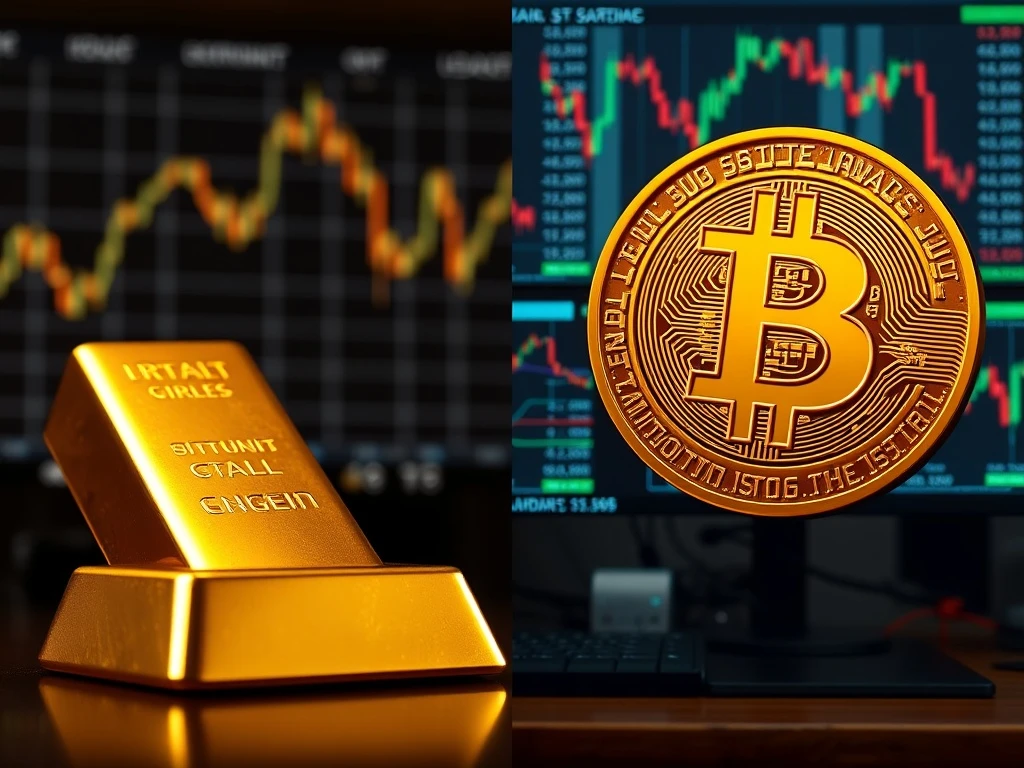
January 2026 marks a significant turning point in global financial markets as Bitcoin’s much-touted ‘digital gold’ narrative faces its most serious challenge yet, with the cryptocurrency trading at two-year lows against precious metals while gold and silver achieve repeated all-time highs. This dramatic divergence between traditional safe-haven assets and their digital counterpart represents more than just a temporary market fluctuation—it potentially signals a fundamental shift in how investors perceive inflation hedges during economic uncertainty.
Bitcoin’s Debasement Trade Narrative Collapses
For years, cryptocurrency proponents championed Bitcoin as the ultimate hedge against currency devaluation, positioning it as ‘digital gold’ for the modern era. However, recent market data presents a compelling counter-narrative. According to TradingView metrics, Bitcoin has slipped below 20 ounces in gold terms to begin 2026, circling lows not seen since early 2024. Meanwhile, gold achieved its seventh all-time high this month alone, with silver following closely behind in a synchronized precious metals rally.
Also read: Bitcoin's Liquidity Warning: Why the Heatmap Signals a Critical Juncture
Investment specialist Karel Mercx from Dutch advisory firm Beleggers Belangen delivered a particularly stark assessment this week. “The verdict is in: the debasement trade is Gold & Silver, not Bitcoin,” he declared to his substantial social media following. “A frontal attack on the FED sends metals to fresh ATHs while BTC sits 20% below its peak.” Mercx’s analysis challenges the core assumption that Bitcoin serves as an attractive destination for capital fleeing fiat currency dilution.
Historical Context and Market Mechanics
To understand this divergence, we must examine the historical relationship between these assets. Traditionally, investors have turned to gold during periods of monetary uncertainty, particularly when central bank policies threaten currency stability. The current environment features rare challenges, including ongoing debates about Federal Reserve independence and aggressive fiscal policies across major economies.
Also read: Leap Wallet Shutdown: Urgent Steps Cosmos Users Must Take Now
Bitcoin initially gained traction as an alternative store of value following the 2008 financial crisis, with its fixed supply and decentralized nature appealing to those skeptical of traditional financial systems. However, the 2025-2026 period reveals significant differences in how these assets respond to specific economic pressures:
- Institutional Adoption Patterns: While Bitcoin saw significant institutional investment between 2020-2024, recent quarters show gold ETFs attracting substantially more capital
- Regulatory Environment: Increasing cryptocurrency regulation in major economies has created uncertainty, while gold benefits from centuries of established legal frameworks
- Market Liquidity Dynamics: During periods of extreme volatility, gold markets demonstrate superior depth and stability compared to cryptocurrency exchanges
- Macroeconomic Sensitivity: Gold shows stronger correlation with traditional inflation indicators, while Bitcoin’s price drivers remain more complex and multifaceted
Expert Perspectives on the Shift
Market analysts offer varied interpretations of this developing situation. Crypto trader and entrepreneur Michaël van de Poppe acknowledged the concerning signals in a recent analysis. “Times are starting to get interesting for anyone involved in the crypto markets,” he observed. “Gold has made a new all-time high. Silver has made a new all-time high. My concern: it really needs to accelerate with this breakout, or we’ll start to tumble back down.”
Meanwhile, crypto market commentator Benjamin Cowen highlighted gold’s performance against the S&P 500 as particularly significant. “If SPX breaks down against Gold, the environment we have found ourselves in for the last decade will completely change,” he argued, pointing to monthly chart data that shows gold beginning to outperform major equity indices.
The Four-Year Cycle Question
Another vital element in this analysis involves Bitcoin’s historical price cycles. Since its early years, Bitcoin has demonstrated approximately four-year cycles tied to its halving events, where mining rewards decrease by 50%. However, Mercx declared this pattern “dead” in September 2025, noting that “$BTC priced in gold shows each cycle weaker than the last one, and now the first 4-year loss.”
This perspective gains support from comparative performance data:
| Time Period | Gold Performance | Bitcoin Performance | BTC/Gold Ratio |
|---|---|---|---|
| 2022-2024 | +18% | -35% | Declining |
| 2024-2026 | +42% | -12% | Sharp Decline |
| Since 2020 Peak | +67% | -58% | Historical Low |
The data reveals a clear trend: while both assets experienced volatility, gold has demonstrated stronger recovery and more consistent appreciation during periods of economic stress.
Structural Factors Influencing Current Trends
Several structural factors contribute to the current divergence between Bitcoin and precious metals. First, central bank gold purchases reached record levels in 2025, with emerging market economies particularly active in diversifying reserves away from traditional currencies. Second, geopolitical tensions have traditionally boosted gold demand, and current global conflicts continue this pattern. Third, the environmental debate surrounding Bitcoin mining has influenced some institutional investors, while gold benefits from improved sustainability practices in the mining sector.
Additionally, the regulatory space for cryptocurrencies remains uncertain in many jurisdictions. Recent legislative proposals in the United States and European Union have created compliance challenges for institutional crypto investors. Conversely, gold trading operates within well-established regulatory frameworks that provide greater certainty for large-scale investors.
Market Psychology and Narrative Shifts
The psychological dimension of this market shift warrants careful consideration. For over a decade, the “digital gold” narrative provided intellectual foundation for Bitcoin’s investment case. Mercx’s declaration that “the narrative is broken” represents more than just one analyst’s opinion—it reflects growing skepticism within broader financial circles.
“Investors are choosing the original hard money over the digital experiment,” Mercx concluded. “Book closed.” This sentiment, while controversial within crypto communities, aligns with observable capital flows showing consistent movement into precious metals ETFs and away from cryptocurrency investment products throughout late 2025 and early 2026.
Potential Implications for Portfolio Strategy
Financial advisors now face renewed questions about asset allocation in inflationary environments. The traditional 60/40 stock-bond portfolio has underperformed during recent inflationary periods, leading investors to seek alternative hedges. Gold’s recent outperformance reinforces its historical role in diversified portfolios, while Bitcoin’s correlation patterns remain less predictable.
Several portfolio managers report increasing client inquiries about precious metals allocations, with particular interest in:
- Physical gold versus paper derivatives – Growing preference for allocated physical holdings
- Mining equities versus bullion – Leveraged exposure through established mining companies
- Silver’s dual role – Both monetary metal and industrial commodity
- Geographic diversification – Storage across multiple sovereign jurisdictions
These trends suggest that, regardless of Bitcoin’s future trajectory, precious metals have reaffirmed their position in institutional and retail portfolios alike.
Conclusion
The dramatic underperformance of Bitcoin against gold in early 2026 represents more than a temporary market anomaly—it challenges fundamental assumptions about cryptocurrency’s role as a debasement hedge. While Bitcoin continues to demonstrate unique technological capabilities and maintains passionate support within specific communities, its failure to attract capital during a period ideally suited to its stated value proposition raises significant questions. The precious metals rally, particularly gold’s sustained breakout to repeated all-time highs, suggests that traditional safe-haven assets retain powerful appeal during monetary uncertainty. As markets continue reacting to evolving Federal Reserve policies and global economic conditions, the relative performance of these alternative stores of value will provide vital insights into investor psychology and portfolio construction in the coming years.
FAQs
Q1: What exactly is the “debasement trade” mentioned in the analysis?
The debasement trade refers to investment strategies designed to protect against currency devaluation, typically involving assets with limited supply that cannot be easily inflated by central banks. Historically, gold served this purpose, while Bitcoin proponents argued it could serve as a digital equivalent.
Q2: How significant is Bitcoin trading at two-year lows against gold?
This development is particularly significant because it challenges the core “digital gold” narrative during a period when gold itself is performing exceptionally well. The divergence suggests investors may be distinguishing between these assets rather than viewing them as substitutes.
Q3: Are analysts declaring Bitcoin’s four-year cycle completely over?
Some analysts, including Karel Mercx, have declared Bitcoin’s historical four-year price cycle “dead,” particularly when measured against gold. However, other market observers believe the cycle may simply be elongating or transforming rather than disappearing entirely.
Q4: What factors specifically drove gold to all-time highs in early 2026?
Multiple factors contributed, including record central bank purchases, ongoing geopolitical tensions, concerns about Federal Reserve independence, and broader inflationary pressures that traditionally boost precious metals demand.
Q5: Could Bitcoin still recover its role as a debasement hedge in the future?
Market dynamics remain fluid, and cryptocurrency adoption continues evolving. While current data favors gold, future regulatory clarity, technological developments, or shifts in institutional adoption could potentially restore Bitcoin’s appeal as an inflation hedge, though this would require demonstrated performance during monetary stress.

This article was produced with AI assistance and reviewed by our editorial team for accuracy and quality.