Bitcoin ETF Shakeup: Institutions Pivot as $90K Support Holds Amid Market Repricing
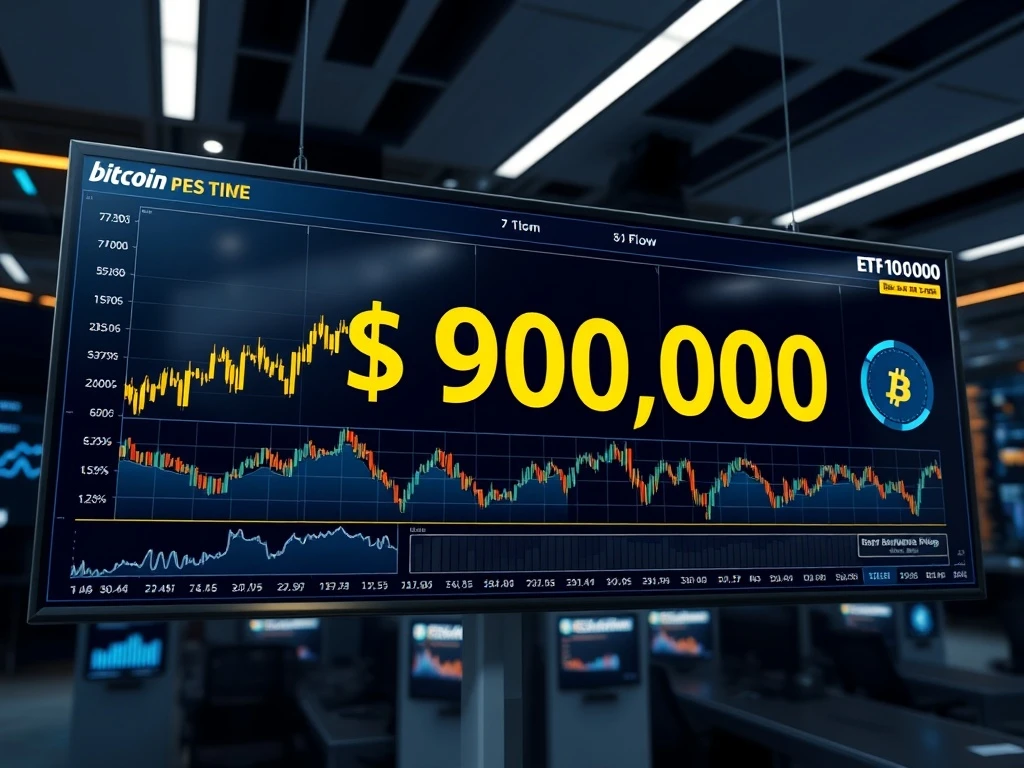
January 9, 2026 — Global cryptocurrency markets are experiencing a significant structural shift as Bitcoin maintains its $90,000 support level despite dramatic reversals in ETF flows and institutional capital repositioning. The digital asset arena is undergoing what analysts describe as a fundamental repricing, with traditional financial players increasingly influencing market dynamics while decentralized finance shows pockets of renewed activity.
Bitcoin ETF Flows Reverse After Strong Start
Bitcoin steadied near $90,000 this week despite a sharp reversal in US spot Bitcoin exchange-traded fund demand. After recording $1.1 billion in inflows during the first two trading days of 2026, the ETFs have since logged three consecutive days of outflows. According to Farside Investors data, Thursday alone saw cumulative outflows of $398 million.
Also read: Pi Network KYC Reward Milestone: First Distribution Pays 0.0504 Pi at 21x Rate
This reversal comes as Bitcoin reached a weekly high of $94,458 on Monday before declining to approximately $90,937 by Friday’s trading session. Market analysts note that investor liquidity has gradually returned following the holiday period, contributing to the limited recovery observed across cryptocurrency markets.

Also read: Ethereum's Sharp Drop Below $2,100: What Holders Must Understand About the Emerging Opportunity
Institutional Capital Drives Market Repricing
The broader cryptocurrency market experienced what analysts are calling a “repricing year” in 2025, particularly for assets beyond Bitcoin. According to blockchain data shared by Jamie Coutts, chief crypto analyst at Real Vision, decentralized finance tokens fell 67% last year while cryptocurrencies associated with smart contract blockchains delivered negative average returns of 66%.
Coutts described this performance as a fundamental repricing of leading crypto projects as institutional capital seeks greater exposure. “Repricing the highest quality protocols and layer-1 networks is occurring just as the multi-year onboarding of institutional capital commences,” he wrote in a Wednesday social media post.
Analysts Identify Quality Differentiation
This repricing reflects maturing investor behavior, with digital asset participants increasingly seeking exposure to tokens powering protocols with organic usage and revenue generation rather than general altcoins. According to crypto intelligence platform Nansen, Solana led blockchain networks by fees in 2025 with $585 million generated, followed closely by Tron with $576 million in revenue.
Nicolai Sondergaard, research analyst at Nansen, observed that institutional and large investors tend to gravitate toward the five leading cryptocurrencies. “Solana ETFs are still seeing inflows, but the same can’t fully be said onchain,” Sondergaard told Crypto News Insights. “Ethereum, on the other hand, has seen some players rotate from Bitcoin.”
Zcash Governance Dispute Highlights Protocol Challenges
Concerns emerged this week regarding privacy-preserving token Zcash after the Electric Coin Company, the main development team behind the protocol, decided to separate from Bootstrap, the nonprofit supporting its development. The separation follows governance disputes that led to the departure of key board members.
Bootstrap stated that the disagreement stemmed from legal limits nonprofits face when seeking outside investment. According to board member Zaki Manian, discussions involved “external investment and alternative structures to privatize” Zashi, the self-custodial crypto wallet built for private Zcash transactions.
The nonprofit emphasized that any proposed deal must comply with U.S. nonprofit law while remaining consistent with Zcash’s long-term mission. Bootstrap warned that improper transactions could bring “new vulnerabilities for politically-motivated attacks on Zcash” and potentially jeopardize the entire ecosystem.
Security Threats Target Crypto Investors
Blockchain security firm SlowMist identified a new phishing campaign targeting cryptocurrency investors through impersonated MetaMask security checks. The attackers utilize fake two-factor authentication verification flows that redirect users to fraudulent domains through fabricated security warnings.
These warnings request users’ seed phrases under the guise of completing security setup. According to SlowMist’s chief security officer, sharing wallet recovery phrases enables attackers to steal funds from compromised wallets. This campaign serves as a critical reminder that legitimate decentralized wallet protocols never ask users for their secret recovery phrases.
DeFi Evolution and Protocol Expansion
Aave founder and CEO Stani Kulechov outlined an expanded strategic vision for the protocol following a contentious governance vote. The proposal to transfer control of Aave’s brand assets and intellectual property to its decentralized autonomous organization was rejected, prompting renewed debate about the protocol’s direction.
Kulechov argued that Aave must evolve beyond core decentralized finance lending to pursue opportunities in:
- Real-world assets (estimated $500 trillion opportunity)
- Institutional lending products
- Consumer-facing financial applications
Significantly, Aave Labs plans to distribute non-protocol revenue to AAVE tokenholders, potentially expanding how the token captures value beyond governance participation.
Onchain Derivatives Experience Explosive Growth
Perpetuals decentralized exchanges closed 2025 with cumulative trading volume reaching $12.09 trillion, representing nearly triple the $4.1 trillion recorded at the year’s start. According to DefiLlama data, approximately $7.9 trillion of this lifetime total volume was generated in 2025 alone.
This concentration highlights how rapidly onchain derivatives scaled during the past year, with 65% of all perpetual DEX trading volume occurring in a single calendar year. December alone saw perpetuals trading volume reach $1 trillion, continuing momentum that began in October when monthly volumes first reached that threshold.
Market Performance and Sector Movements
According to data from Crypto News Insights Markets Pro and TradingView, most of the 100 largest cryptocurrencies by market capitalization ended the week positively. The Render token rose 56% as the biggest weekly gainer, followed by JasmyCoin with over 52% growth during the same period.
Total value locked in decentralized finance protocols showed stabilization signs after previous declines, indicating potential renewed interest in DeFi applications despite broader market repricing.
Conclusion
The cryptocurrency market is undergoing a fundamental transformation as institutional capital repositions and Bitcoin ETF flows demonstrate increased volatility. The $90,000 support level for Bitcoin represents a critical psychological and technical threshold amid shifting investment patterns. Market participants are increasingly differentiating between protocols with genuine utility and those lacking sustainable fundamentals. This repricing phase, while challenging for many altcoins, may establish a stronger foundation for long-term institutional participation in digital assets. The evolving environment suggests that quality differentiation, security awareness, and protocol sustainability will become increasingly important metrics for investors managing 2026’s cryptocurrency markets.
FAQs
Q1: Why are Bitcoin ETF flows reversing after strong initial 2026 inflows?
ETF flows typically experience volatility as institutional investors rebalance portfolios and respond to market conditions. The initial January inflows represented pent-up demand following holiday periods, while recent outflows reflect profit-taking and portfolio adjustments amid Bitcoin’s price consolidation near $90,000.
Q2: What does “market repricing” mean for cryptocurrency investors?
Market repricing refers to the process where assets are revalued based on changing fundamentals, investor preferences, or market structure. In cryptocurrency markets, this involves institutional capital flowing toward protocols with demonstrated utility, revenue generation, and sustainable ecosystems rather than speculative altcoins without clear use cases.
Q3: How significant is the growth in perpetual DEX trading volume?
The growth is substantial, with 65% of all perpetual DEX lifetime volume occurring in 2025 alone. This represents a nearly 200% increase from 2024 levels and indicates accelerating adoption of onchain derivatives as traders seek decentralized alternatives to traditional leveraged trading platforms.
Q4: What are the main security concerns for cryptocurrency investors currently?
Phishing campaigns remain a primary threat, particularly those impersonating popular wallet interfaces like MetaMask. Investors should never share recovery phrases, enable two-factor authentication through official channels only, and verify website URLs before entering sensitive information.
Q5: How are decentralized finance protocols evolving beyond basic lending?
Leading DeFi protocols like Aave are expanding into real-world assets, institutional products, and consumer-facing applications. This evolution reflects maturing DeFi ecosystems seeking broader adoption and sustainable revenue models beyond speculative trading and yield farming activities.

This article was produced with AI assistance and reviewed by our editorial team for accuracy and quality.