Bitcoin’s Critical $68K Trendline Offers Potential Lifeline as Traders Watch Key Support Levels
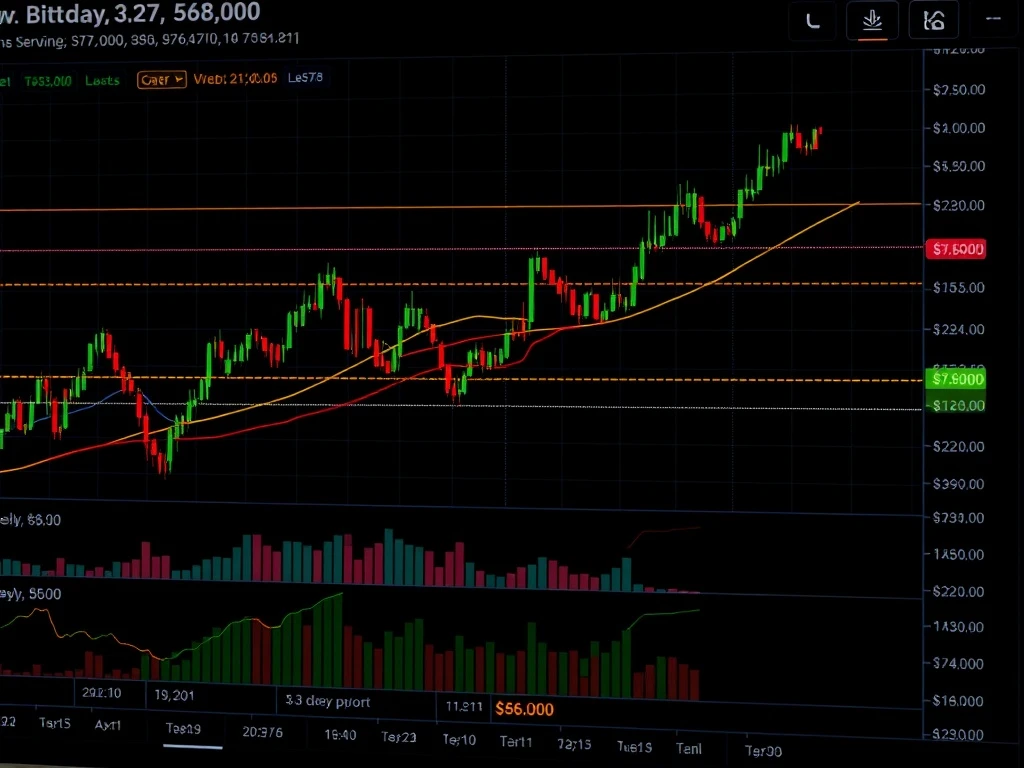
As Bitcoin faces significant downward pressure in early 2026, cryptocurrency traders are closely monitoring a key technical indicator that could determine the digital asset’s near-term trajectory. The 200-week moving average, currently positioned around $68,400, represents a historically significant support level that market analysts believe might prevent further substantial declines. This development follows four consecutive months of negative price movement, with BTC recently testing lows not seen since late 2024.
Bitcoin’s Technical Foundation at Critical Juncture
Technical analysts emphasize the importance of Bitcoin’s long-term moving averages during market corrections. The 200-week exponential moving average (EMA) and simple moving average (SMA) create a substantial support band approximately $10,000 wide. Market participants view this zone as potentially decisive for Bitcoin’s medium-term direction. Historically, these long-term trendlines have marked significant turning points during previous market cycles.
Nic Puckrin, CEO of educational platform Coin Bureau, recently highlighted the significance of these levels in social media analysis. “We’re currently trading at Strategy’s cost basis and are close to the April lows at $74.4k,” Puckrin noted. “If we break below, the next key level is $70k which is just above the previous all-time high of $69k.” His analysis suggests that breaking below these levels could lead to a bear market low target between $55.7k and $58.2k.
Market Dynamics and Trader Perspectives
Despite the challenging market conditions, several factors indicate underlying resilience within the Bitcoin ecosystem. The current drawdown of approximately 40% from recent highs has tested investor conviction, yet key metrics suggest the market hasn’t entered full capitulation. Derivatives traders have maintained relatively strong positions, while institutional products have demonstrated stability despite recent outflows.
Also read: SUI Price Tests Critical $1.05 Level as Pepeto's Stunning 300x Surge Captures Market Attention
Institutional Participation and Market Structure
U.S. spot Bitcoin exchange-traded funds (ETFs) have experienced net outflows totaling $3.2 billion since mid-January 2026. However, this represents only about 3% of their total assets under management, indicating that institutional exposure remains substantial. Market analysts interpret this relatively modest outflow as a sign that long-term institutional holders are maintaining their positions despite short-term volatility.
Matt Hougan, Chief Investment Officer at Bitwise Asset Management, recently offered perspective on the current market phase. “Retail crypto has been in a brutal winter since January 2025,” Hougan observed. “Institutions just papered over that truth for certain assets for a while.” His analysis notes that average “crypto winter” periods historically last approximately 14 months, providing context for the current market environment.
Historical Context and Technical Analysis
Bitcoin’s relationship with its 200-week moving average has proven significant throughout its history. Each time the cryptocurrency has lost its 100-week EMA support, it has subsequently retested the 200-week EMA level. This pattern has repeated across multiple market cycles, creating what technical analysts describe as a “safety net” for long-term price structure.
Trader Altcoin Sherpa recently commented on this dynamic, stating that it “makes sense” for Bitcoin to test the 200-week EMA. “On one hand it makes sense for BTC to tap the 200W EMA, an indicator that hasn’t been touched since 2023,” Sherpa noted. “This would be around 68k. On the other, this is still an interesting level as the 2025 low.”
Market analysts have identified several key technical levels worth monitoring:
- $74,400: April 2025 lows representing immediate support
- $70,000: Psychological level just above previous all-time high
- $68,400: 200-week exponential moving average
- $58,200-$55,700: Potential bear market low target range
Market Psychology and Investor Behavior
The current market environment reveals interesting patterns in investor psychology. Despite significant price declines, Bitcoin holders have demonstrated notable resilience. On-chain metrics indicate that long-term holders continue to maintain positions, while short-term traders have adjusted their strategies to account for increased volatility.
BitBull, another prominent market analyst, emphasized the accumulation opportunity that might emerge from current conditions. “Every time Bitcoin has lost 100W EMA, it has retested the 200W EMA,” BitBull explained. “Right now, 200W EMA is at $68,000 and this will most likely be retested. Once the retest happens, you could start accumulating for the long-term.”
Comparative Market Analysis
When examining Bitcoin’s current position relative to previous market cycles, several patterns emerge. The table below compares key metrics across recent significant market corrections:
| Correction Period | Maximum Drawdown | Weeks to Recovery | 200W EMA Test |
|---|---|---|---|
| 2021-2022 | 54% | 48 weeks | Yes |
| 2023 | 20% | 12 weeks | No |
| 2025-2026 | 40% (ongoing) | TBD | Potential |
Conclusion
Bitcoin stands at a critical technical juncture as it approaches its 200-week moving average around $68,400. This trendline represents a historically significant support level that could determine the cryptocurrency’s trajectory in the coming months. While market conditions remain challenging with four consecutive months of declines, technical indicators and market structure suggest potential stabilization around these key levels. Traders and analysts continue to monitor these developments closely, recognizing that Bitcoin’s relationship with its long-term moving averages has frequently signaled important market transitions throughout its history.
FAQs
Q1: What is the 200-week moving average and why is it important for Bitcoin?
The 200-week moving average is a technical indicator that calculates Bitcoin’s average price over the past 200 weeks. It’s considered significant because it has historically acted as strong support during market downturns, often marking potential reversal points.
Q2: How does the current Bitcoin price decline compare to previous market corrections?
The current approximately 40% drawdown from recent highs is substantial but not historic. Previous corrections have ranged from 20% to over 50%, with the 2021-2022 period seeing a 54% decline before recovery.
Q3: What are the key support levels traders are watching below $68,000?
Below the 200-week moving average, analysts are monitoring the range between $55,700 and $58,200, which represents the intersection of average realized price and historical support levels from previous cycles.
Q4: How have Bitcoin ETFs performed during the current market decline?
U.S. spot Bitcoin ETFs have experienced approximately $3.2 billion in net outflows since mid-January 2026, representing about 3% of total assets under management, suggesting relatively stable institutional participation despite market volatility.
Q5: What timeframe do analysts consider for potential market recovery?
Historical patterns suggest cryptocurrency market “winters” typically last around 14 months. The current phase began in January 2025, suggesting potential stabilization could occur within the coming months based on historical cycles.

This article was produced with AI assistance and reviewed by our editorial team for accuracy and quality.