Tokenized Stocks: Binance and OKX Pivot to Disruptive Global Equity Access
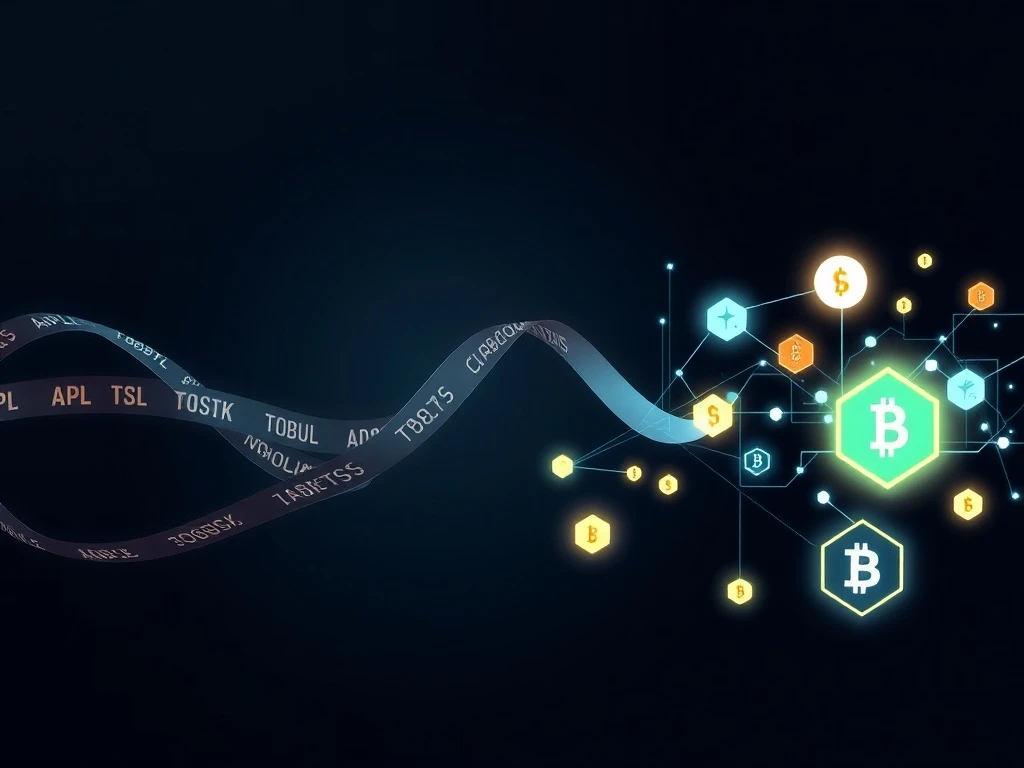
Major cryptocurrency exchanges Binance and OKX are reportedly exploring a significant expansion into traditional finance, with plans to launch tokenized stocks that could grant global users unprecedented exposure to U.S. equity markets. According to a recent report from The Information, this strategic move signals a pivotal convergence between digital asset platforms and conventional investment vehicles, potentially reshaping how international investors interact with American companies. The development follows the established groundwork laid by current providers like Ondo Finance (ONDO) and Kraken’s xStocks, highlighting a growing trend toward asset tokenization within the financial sector.
Tokenized Stocks Represent a Major Market Evolution
The reported consideration by Binance and OKX underscores a broader industry shift. Tokenized stocks are digital representations of traditional equities, built on blockchain technology. Each token typically mirrors the price movement of a single share of a publicly traded company, such as Apple or Tesla. Consequently, these tokens allow holders to gain financial exposure to the stock’s performance without directly owning the underlying security. This model leverages the inherent advantages of blockchain, including 24/7 trading, fractional ownership, and reduced intermediary friction.
Currently, the market for such products remains niche but is growing. Ondo Finance, through its ONDO token, and Kraken’s xStocks service are recognized as leading providers. Their operations demonstrate a proven demand, particularly from investors in regions with limited or expensive access to U.S. brokerage accounts. The potential entry of giants like Binance and OKX, with their massive global user bases, could catalyze mainstream adoption. Therefore, this move is not merely an addition of a new product line but a strategic bridge connecting two vast financial ecosystems.
The Driving Forces Behind the Strategic Pivot
Several key factors are driving cryptocurrency exchanges toward tokenized traditional assets. Firstly, regulatory pressures in multiple jurisdictions have increased scrutiny on pure-play crypto trading. Offering regulated or semi-regulated products like tokenized stocks can diversify revenue streams and improve compliance postures. Secondly, there is clear user demand for a unified financial interface. Many crypto investors also seek exposure to blue-chip equities but wish to avoid the complexity of managing separate, traditional accounts.
Furthermore, the technological infrastructure for tokenizing real-world assets (RWAs) has matured significantly. Secure custody solutions, reliable oracle networks for price feeds, and compliant onboarding processes are now more robust. This technical evolution makes the launch of such products more feasible from an operational risk perspective. Finally, the success of early movers provides a tangible business case, proving that a market exists and can operate effectively within certain regulatory frameworks.
Regulatory Landscape Presents the Primary Hurdle
The most significant challenge for Binance, OKX, and any exchange offering tokenized stocks is navigating the complex global regulatory environment. In the United States, the Securities and Exchange Commission (SEC) has consistently maintained that most tokenized securities fall under its purview. The critical distinction lies in whether the token constitutes a security, which would require registration or an applicable exemption. Exchanges must ensure proper licensing, either as a broker-dealer or through partnerships with licensed entities, to offer these products legally to U.S. persons.
Internationally, the regulatory stance varies dramatically by country. Some jurisdictions in Europe and Asia have more progressive frameworks for digital assets, while others explicitly prohibit derivatives linked to foreign equities. For global platforms, this creates a compliance mosaic where the product offering must be tailored, and access geoblocked, on a country-by-country basis. The report from The Information did not specify how Binance and OKX plan to address these hurdles, but their approach will likely involve:
- Strategic Partnerships: Collaborating with licensed broker-dealers or financial institutions to handle the underlying security custody and compliance.
- Geographic Rollout: Launching initially in jurisdictions with clearer regulations before expanding to more complex markets.
- Product Structure: Designing the tokens as debt instruments or other structured products that track the stock’s price, rather than direct equity claims.
Success in this arena will depend less on technology and more on legal and regulatory strategy. The exchanges that can build trust with regulators will gain a substantial first-mover advantage in this emerging asset class.
Comparative Analysis of Current Market Providers
To understand the potential impact of Binance and OKX’s entry, examining the existing competitive landscape is essential. The following table outlines key players and their models:
| Provider | Model / Product | Key Features | Target Audience |
|---|---|---|---|
| Ondo Finance (ONDO) | Tokenized U.S. Treasuries & Equities | Focus on institutional-grade, yield-generating RWAs; operates through a licensed entity. | Institutional and sophisticated investors. |
| Kraken (xStocks) | Tokenized Stock Trading | Offers direct exposure to stocks via tokenized certificates; available to non-U.S. clients. | Global retail crypto traders on the Kraken exchange. |
| Potential: Binance/OKX | Reported Tokenized Stock Plans | Would leverage massive global liquidity and user base; specifics on structure TBD. | Mass global retail market, potentially tens of millions of users. |
As shown, Ondo Finance takes a more institutional, yield-focused approach, while Kraken targets the retail crypto trader abroad. The entry of Binance and OKX would represent a scale shift, bringing the concept to a vastly larger audience. However, their model would need to address the regulatory complexities that Kraken already navigates for its non-U.S. clientele. The competition could accelerate innovation, lower costs for end-users, and force existing providers to enhance their offerings.
Expert Perspectives on Market Impact and Risks
Financial technology analysts highlight both the transformative potential and inherent risks of this development. “The tokenization of stocks is a logical next step in the democratization of finance,” notes a fintech researcher from a major university, whose work focuses on blockchain adoption. “It can reduce barriers for international investors, but it also creates new layers of counterparty and regulatory risk that users must understand.” The primary risk involves the custody chain; investors own a token representing a claim on a stock held by a third-party custodian, not the stock itself.
Market impact analysts also point to liquidity effects. If successful, these products could funnel significant new capital into tracking the movements of major U.S. stocks, albeit indirectly. This could potentially increase volatility during off-hours for the underlying equities. Conversely, they also create a new channel for global capital to enter U.S. markets, which could have a stabilizing effect by diversifying the investor base. The long-term success hinges on building systems that are as resilient and trustworthy as the traditional settlement systems they aim to complement.
Conclusion
The reported exploration of tokenized stocks by Binance and OKX marks a critical inflection point for both the cryptocurrency and traditional finance industries. This move toward tokenized stocks represents more than a new product; it is a fundamental step toward an integrated, global digital asset marketplace. While formidable regulatory challenges remain, the combined force of user demand, technological readiness, and the pursuit of diversified, compliant revenue streams makes this direction inevitable for major exchanges. The coming months will reveal how these platforms navigate the complex compliance landscape to potentially unlock a new era of borderless investment in leading U.S. equities.
FAQs
Q1: What exactly are tokenized stocks?
Tokenized stocks are digital tokens on a blockchain that represent ownership in a traditional company’s stock. Each token is designed to track the price of a single share, allowing investors to gain exposure to the stock’s performance without directly holding the equity certificate.
Q2: Why would Binance and OKX want to offer tokenized stocks?
Exchanges aim to diversify their product offerings, attract users seeking traditional market exposure, and create a “one-stop shop” for digital assets. It also represents a strategic move into more regulated financial products, which can improve long-term sustainability amid tightening crypto regulations.
Q3: Can U.S. investors use these services if launched?
It is highly unlikely in the near term. Offering tokenized stocks to U.S. residents would require the exchanges to comply with stringent SEC and FINRA regulations as broker-dealers. Initial launches would almost certainly be restricted to non-U.S. jurisdictions with more permissive frameworks.
Q4: How do tokenized stocks differ from simply buying stock through a broker?
Key differences include potential 24/7 trading, the ability to trade fractional amounts seamlessly, and settlement on a blockchain network which can be faster. However, token holders typically do not have direct shareholder voting rights or receive traditional dividends (they may receive a cash-equivalent distribution).
Q5: What are the main risks of investing in tokenized stocks?
Primary risks include regulatory uncertainty, counterparty risk (relying on the issuer and custodian to hold the underlying asset), potential liquidity issues on the crypto exchange, and the technological risk associated with the smart contracts and blockchain platform hosting the tokens.
This article was produced with AI assistance and reviewed by our editorial team for accuracy and quality.