Altcoins to Buy During Crypto Dip: Analyzing XRP, Cardano, and DeepSnitch AI ($DSNT) for Strategic Growth Potential
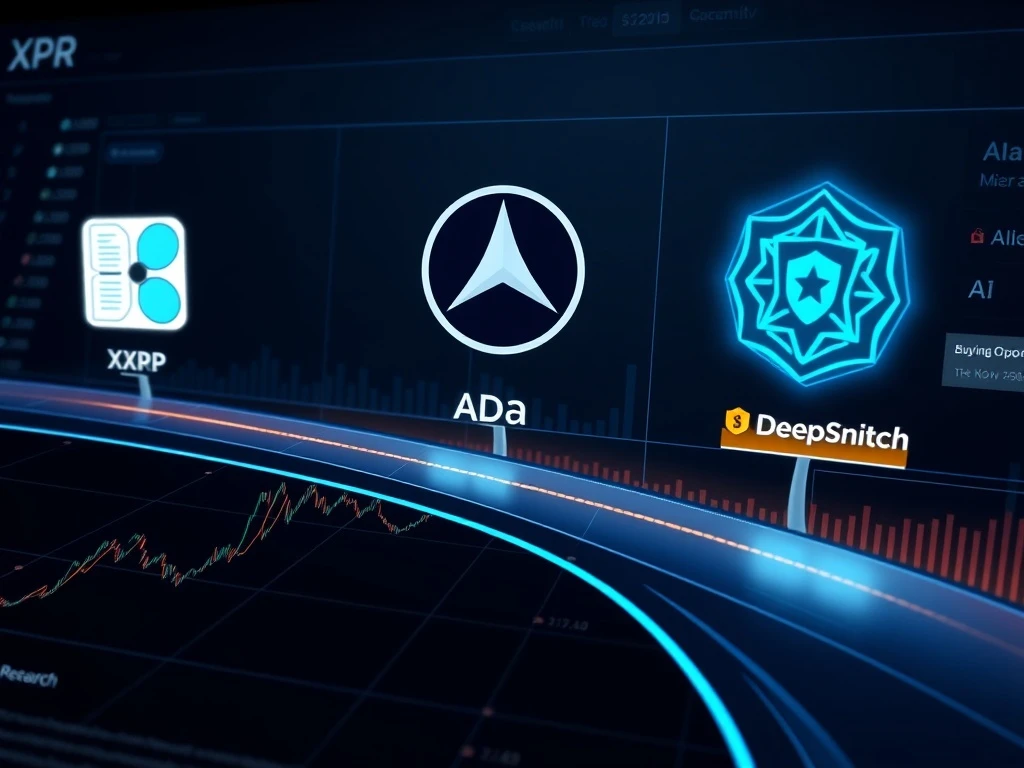
Market corrections in the cryptocurrency sector frequently present strategic entry points for informed investors. Consequently, three distinct altcoins—XRP, Cardano, and DeepSnitch AI ($DSNT)—have garnered significant analytical attention during recent volatility. This examination explores their respective technological foundations, market positions, and potential trajectories, providing a framework for understanding their roles in a diversified portfolio.
Market Context: Understanding Cryptocurrency Corrections
Cryptocurrency markets exhibit inherent cyclicality, with periods of expansion often followed by consolidation or correction. Historically, these phases have allowed investors to accumulate assets at potentially favorable valuations. The current market environment, characterized by shifting regulatory landscapes and macroeconomic pressures, underscores the importance of fundamental analysis. Therefore, distinguishing between short-term price movements and long-term value propositions becomes paramount for strategic positioning.
Also read: ONDO Price Under Scrutiny as Sustained Token Flows to Binance and Coinbase Signal Investor Caution
The Role of Fundamental Analysis in Volatile Markets
During downturns, project fundamentals often come into sharper focus. Key metrics include development activity, network utility, partnership ecosystems, and regulatory clarity. For instance, the total value locked (TVL) in decentralized applications, daily active addresses, and protocol revenue provide tangible indicators of health beyond speculative trading. Analysts from firms like Messari and CoinMetrics consistently emphasize these data points in their quarterly reports, which serve as critical resources for evaluating sustained growth potential amidst volatility.
XRP: Addressing Regulatory Crossroads and Payment Utility
XRP, the native digital asset of the Ripple network, primarily facilitates cross-border payments and currency exchange. Its value proposition centers on settlement speed and cost efficiency compared to traditional systems like SWIFT. However, its trajectory remains uniquely intertwined with ongoing regulatory developments.
Also read: Stablecoin Volume Projected for Staggering $719 Trillion by 2035, Chainalysis Finds
Key Differentiators and Current Status:
- Use Case: Designed for institutional payment flows and liquidity provision.
- Technology: Utilizes the XRP Ledger Consensus Protocol, which does not rely on proof-of-work mining.
- Regulatory Sector: The conclusion of the SEC vs. Ripple lawsuit in 2023 provided partial clarity, classifying XRP as not a security in programmatic sales. This ruling impacted exchange relistings and institutional adoption pathways.
- Growth Catalysts: Expansion of RippleNet’s partnerships with financial institutions and potential for central bank digital currency (CBDC) infrastructure.
Market analysts note that while regulatory overhang has decreased, XRP’s price performance remains sensitive to broader market sentiment and adoption milestones rather than pure technological upgrades.
Cardano: A Research-Driven Approach to Blockchain Evolution
Cardano (ADA) positions itself as a third-generation blockchain, emphasizing peer-reviewed research, formal verification, and a methodical development philosophy. The network operates on a proof-of-stake consensus mechanism called Ouroboros.
Core Development Pillars:
- Academic Rigor: Development follows academic papers and formal methods, aiming for high-assurance systems.
- Scalability Roadmap: The Basho phase focuses on scaling solutions like sidechains and layer-2 protocols.
- Governance: The upcoming Voltaire era intends to introduce a decentralized treasury and voting system for community-led funding.
- Ecosystem Growth: Measured expansion of decentralized finance (DeFi) applications and non-fungible token (NFT) projects on the network.
Critics sometimes highlight the deliberate, slower pace of development, while proponents argue it builds a more solid and sustainable foundation. Network activity metrics, such as smart contract deployments and staking participation rates, are closely monitored as indicators of organic growth.
Comparative Technical Framework
| Metric | XRP | Cardano (ADA) | DeepSnitch AI ($DSNT) |
|---|---|---|---|
| Primary Function | Cross-border payments | Smart contract platform | AI-driven blockchain security |
| Consensus | XRP Ledger Consensus | Ouroboros Proof-of-Stake | Hybrid (AI-validated) |
| Current Focus | Regulatory clarity & adoption | Scaling & governance | Protocol launch & audit integration |
| Ecosystem Stage | Mature, institutional | Expanding, developer-focused | Early, niche application |
DeepSnitch AI ($DSNT): A Niche Convergence of AI and Blockchain Security
DeepSnitch AI represents an emerging segment within crypto: projects employing artificial intelligence to address specific blockchain challenges. The $DSNT token powers a protocol designed to enhance smart contract security and audit processes through machine learning algorithms.
Reported Value Proposition:
- Automated Security Audits: Aims to use AI to identify vulnerabilities in smart contract code proactively.
- Pre-Trade Analysis: Proposes tools for screening token contracts for common risks before user interaction.
- Token Utility: $DSNT is described as necessary for accessing premium audit services and governing the protocol’s development.
It is critical to contextualize such projects within the high-risk, high-potential segment of the market. While the convergence of AI and blockchain is a recognized trend with substantial venture capital interest, as noted in reports from firms like Outlier Ventures, the success of any individual token depends on successful product deployment, market adoption, and sustainable tokenomics. Early-stage projects like DeepSnitch AI typically face significant challenges in transitioning from concept to widely used protocol.
Evaluating Risk and Reward in Emerging Altcoins
Financial analysts, including those cited in JP Morgan’s 2024 blockchain report, categorize crypto assets across a spectrum from “established infrastructure” to “experimental applications.” Assets like $DSNT fall into the latter category, where the potential for outsized returns is counterbalanced by higher risks, including technological execution risk, competitive pressures, and market fit. Disciplined investment in this segment often involves smaller portfolio allocations and rigorous due diligence on the development team’s track record and technical milestones.
Strategic Considerations for Portfolio Allocation During Dips
Building a position during market downturns requires a strategy aligned with risk tolerance and investment horizon. A balanced approach might involve core holdings in established assets with clear utility, complemented by satellite positions in innovative, higher-risk projects.
Diversification Principles:
- Core Holdings (Lower Risk): Assets like XRP and Cardano, with multi-year track records, extensive ecosystems, and clearer regulatory profiles.
- Satellite Holdings (Higher Risk): Allocations to emerging sectors like AI-blockchain convergence, represented by projects such as DeepSnitch AI, where thorough research into the team, whitepaper, and initial technical delivery is essential.
- Timing and Dollar-Cost Averaging: Spreading purchases over time to mitigate the impact of short-term volatility, rather than attempting to time the absolute market bottom.
Ultimately, the “best” altcoin during a dip is not a universal answer but a function of individual portfolio goals, research depth, and conviction in the underlying technology’s long-term viability.
Conclusion
Analyzing altcoins like XRP, Cardano, and DeepSnitch AI during a crypto dip reveals a spectrum of opportunities grounded in different theses. XRP offers exposure to the evolution of cross-border payments post-regulation. Cardano presents a research-centric approach to building a scalable smart contract platform. DeepSnitch AI ($DSNT) explores a nascent but growing intersection of artificial intelligence and blockchain security. Informed investment decisions stem from understanding these distinct value propositions, associated risks, and how each asset aligns with broader market trends and personal investment strategy. Consequently, periods of market correction can provide a valuable opportunity to conduct this analysis and build strategic positions based on fundamentals rather than sentiment.
FAQs
Q1: What defines a ‘crypto dip’ or market correction?
A crypto dip refers to a period of declining prices across a significant portion of the digital asset market. It is often driven by macroeconomic factors, regulatory news, or sector-specific events and is considered a normal part of market cycles by analysts.
Q2: How does Cardano’s development approach differ from other smart contract platforms?
Cardano’s development is notably methodical and peer-reviewed, prioritizing formal verification and academic research to aim for high security and correctness before implementing new features, which can result in a slower but potentially more solid rollout.
Q3: Why is regulatory clarity important for assets like XRP?
Regulatory clarity removes a significant layer of uncertainty for institutions, exchanges, and developers. For XRP, the SEC lawsuit’s resolution impacted its availability on U.S. trading platforms and influenced how financial entities can legally integrate and utilize the asset.
Q4: What are the key risks associated with investing in newer altcoins like DeepSnitch AI?
Primary risks include technological failure to deliver the promised product, intense competition within the AI and security niche, potential lack of market adoption, illiquidity, and the inherent volatility of early-stage, low-market-capitalization tokens.
Q5: Should investors focus only on price during a market dip?
No. Analysts emphasize that dips are optimal times to assess fundamental health indicators like developer activity, network usage, partnership announcements, and protocol upgrades—metrics that often provide better signals of long-term value than price action alone.

This article was produced with AI assistance and reviewed by our editorial team for accuracy and quality.