Altcoin Season Index Surges to 27, Sparking Crucial Market Sentiment Shift
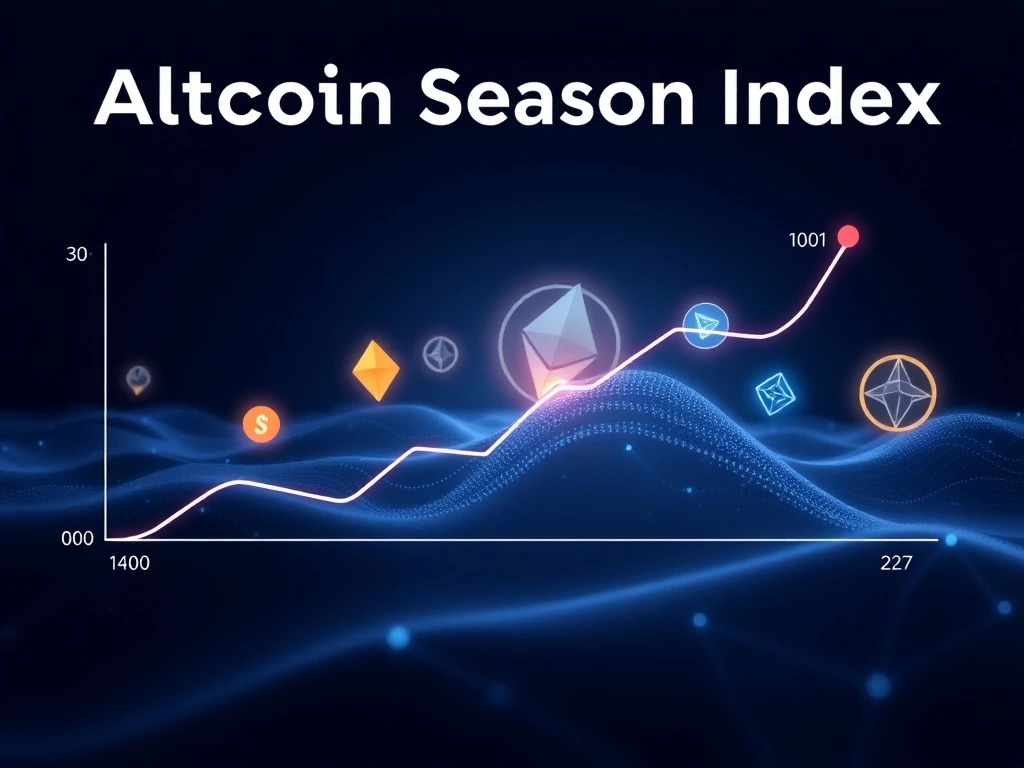
Global cryptocurrency markets are witnessing a subtle yet significant shift, as the widely monitored Altcoin Season Index has climbed to 27, marking a one-point increase from the previous day and fueling discussions about a potential change in market leadership. This metric, published by the authoritative data aggregator CoinMarketCap, serves as a critical barometer for investor sentiment and capital rotation between Bitcoin and alternative cryptocurrencies. Consequently, this recent movement provides a vital data point for traders and analysts navigating the complex 2025 digital asset landscape.
Understanding the Altcoin Season Index and Its Rise to 27
The Altcoin Season Index functions as a quantitative gauge for market cycles. Specifically, it measures whether 75% of the top 100 cryptocurrencies, excluding stablecoins and wrapped tokens, have outperformed Bitcoin over a rolling 90-day period. A score approaching 100 strongly suggests an ‘altcoin season,’ where capital flows aggressively into smaller-cap assets. Conversely, a low score indicates a ‘Bitcoin season,’ where the pioneer cryptocurrency dominates market returns. The index’s recent ascent to 27, while still far from the altcoin season threshold, represents a meaningful move from its recent lows. This incremental gain often precedes more substantial market rotations, according to historical data patterns analyzed by blockchain analytics firms.
Market analysts immediately scrutinized the underlying data driving this change. For instance, the index calculation excludes assets like Tether (USDT) and Wrapped Bitcoin (WBTC) to prevent skewing results. Therefore, the rise to 27 directly reflects improved relative performance of genuine alternative crypto assets against Bitcoin over the past quarter. Several sector-specific rallies, particularly in decentralized finance (DeFi) and layer-1 blockchain tokens, have contributed to this gradual uptick. Furthermore, this movement coincides with a slight decrease in Bitcoin’s market dominance percentage, a related metric tracked by platforms like TradingView.
Historical Context and Market Cycle Analysis
To fully grasp the implication of an index reading of 27, one must examine historical precedents. Previous crypto market cycles show that sustained moves above the 50-75 range typically confirm a full-blown altcoin season. For example, during the 2021 bull market, the index spent months above 75, coinciding with explosive growth for Ethereum, Binance Coin, and numerous other altcoins. Currently, the market remains in a transitional phase. The index’s slow climb suggests cautious optimism rather than euphoric speculation. This pattern often indicates that savvy institutional and retail investors are beginning to diversify their portfolios beyond Bitcoin, seeking higher beta opportunities in select altcoin projects with strong fundamentals.
Also read: Bitcoin Treasury Companies Face New Pressure as US-Iran Tensions Shift
Data from on-chain analytics providers supports this observation. Metrics such as exchange net flows and supply held by long-term holders for major altcoins like Ethereum (ETH) and Solana (SOL) have shown stabilizing or positive trends. Meanwhile, Bitcoin’s network activity, while robust, has not overwhelmingly outpaced the growth seen in competing smart contract platforms. This creates a fertile environment for the Altcoin Season Index to continue its gradual ascent, provided broader macroeconomic conditions remain supportive. The Federal Reserve’s interest rate policy and institutional adoption trends, as reported by entities like Fidelity and BlackRock, will heavily influence this trajectory.
Expert Interpretation and Strategic Implications
Leading cryptocurrency strategists emphasize the index’s role as a sentiment tool, not a timing signal. ‘A reading of 27 tells us that the conditions for an altcoin season are slowly brewing, but the catalyst for a full breakout is not yet present,’ notes a market analyst from a major digital asset fund, referencing public commentary from industry conferences. The strategic implication for investors is nuanced. Historically, accumulating high-quality altcoins during early index recoveries has proven profitable, but it requires rigorous risk management. Diversification across different crypto sectors—such as DeFi, gaming, and infrastructure—becomes paramount when the index trends upward.
The current financial landscape adds layers of complexity. Traditional equity market performance, regulatory developments from bodies like the U.S. Securities and Exchange Commission, and technological upgrades like Ethereum’s ongoing protocol improvements all interact with the Altcoin Season Index. Consequently, a holistic analysis that incorporates these factors is essential. The index’s rise is a single, albeit important, piece of a much larger puzzle. It confirms that the crypto market is dynamic and that capital is actively seeking opportunities, a fundamentally healthy sign for the ecosystem’s maturation.
Conclusion
The Altcoin Season Index’s increase to 27 provides a clear, data-driven signal of shifting momentum within the cryptocurrency markets. While far from indicating a full altcoin season, this movement highlights growing investor interest in assets beyond Bitcoin. Market participants should monitor this index alongside on-chain data, regulatory news, and macroeconomic indicators. Ultimately, the index serves as a crucial compass, and its current trajectory suggests a market slowly preparing for a broader phase of altcoin appreciation, making informed analysis more valuable than ever.
FAQs
Q1: What does an Altcoin Season Index of 27 mean?
An index reading of 27 means that less than 75% of top altcoins have outperformed Bitcoin recently. It indicates a market still dominated by Bitcoin but showing early signs of potential rotation towards altcoins.
Q2: How is the Altcoin Season Index calculated?
CoinMarketCap calculates it by determining the percentage of the top 100 cryptocurrencies (excluding stablecoins and wrapped tokens) that have outperformed Bitcoin’s price over the previous 90 days. That percentage becomes the index score.
Q3: What is considered a true ‘Altcoin Season’?
A true altcoin season is typically declared when the index sustains a reading above 75 for a significant period, indicating that the vast majority of major altcoins are outperforming Bitcoin consistently.
Q4: Does a rising index guarantee altcoin profits?
No. The index measures past relative performance, not future returns. It is a sentiment and cycle indicator. Profits depend on individual asset selection, market timing, and overall market conditions.
Q5: Should I sell Bitcoin when the Altcoin Season Index rises?
Not necessarily. Many investment strategies advocate for holding a core Bitcoin position while using the index as a guide for allocating a separate portion of a portfolio to altcoins for diversification and growth potential.

This article was produced with AI assistance and reviewed by our editorial team for accuracy and quality.