Altcoin Season Index Plummets to 29, Signaling a Critical Shift in Crypto Market Sentiment
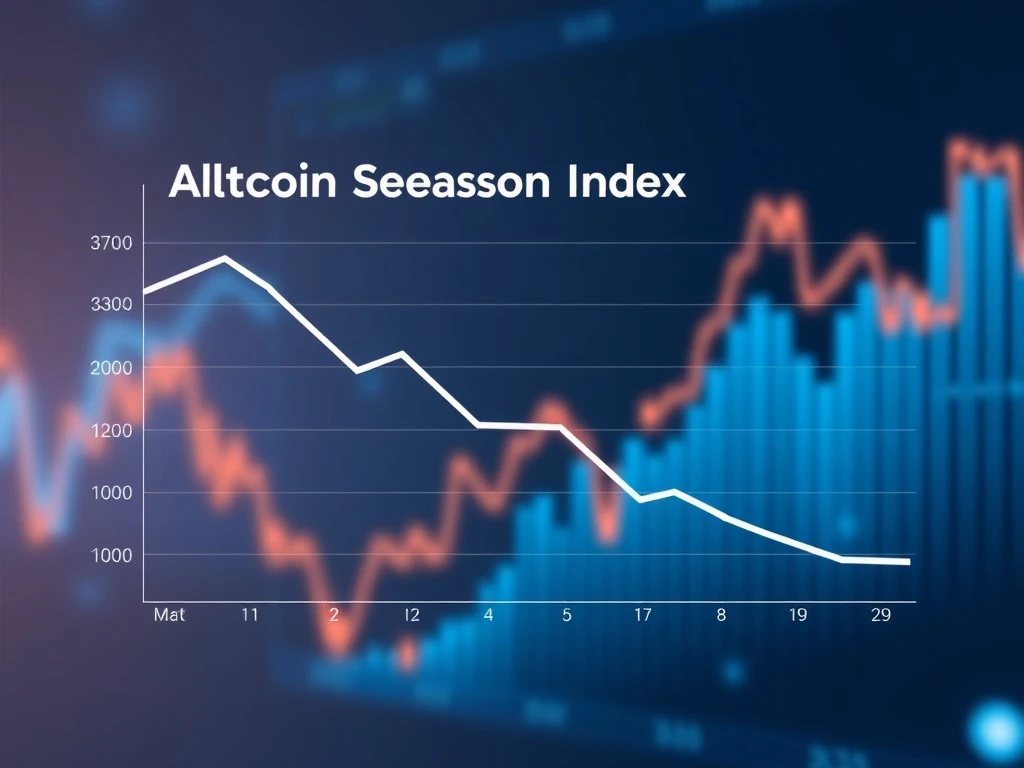
Global cryptocurrency markets witnessed a significant shift in sentiment this week as CoinMarketCap’s closely watched Altcoin Season Index fell to a reading of 29. This one-point decline from the previous day’s level reinforces a growing trend of Bitcoin outperforming the broader altcoin market, a dynamic with profound implications for investor strategy and capital allocation in 2025. Market analysts are now scrutinizing on-chain data and macroeconomic indicators to determine if this marks the beginning of a sustained Bitcoin season.
Decoding the Altcoin Season Index Drop to 29
CoinMarketCap’s Altcoin Season Index serves as a important quantitative barometer for market cycles. The index, now at 29, operates on a straightforward yet powerful premise. It systematically compares the 90-day performance of the top 100 cryptocurrencies, deliberately excluding stablecoins and wrapped assets, against Bitcoin’s performance over the same period. Consequently, a score approaching 100 signals that a majority of these assets are outperforming Bitcoin, heralding an altcoin season. Conversely, a low score like 29 strongly indicates that Bitcoin is the dominant market force. This metric provides investors with an objective, data-driven snapshot beyond mere price speculation.
Historically, readings below 35 have often preceded extended periods of Bitcoin dominance. For instance, during the market consolidation in late 2023, a similar low index reading persisted for several weeks before a notable rotation occurred. The current decline to 29 is not an isolated data point but part of a broader trend observed over the past month. This trend suggests a potential capital rotation from higher-risk altcoins into the perceived relative safety and established narrative of Bitcoin, especially with ongoing institutional adoption news.
Understanding the Mechanics of Market Cycles
The rhythm between Bitcoin and altcoin seasons forms the fundamental heartbeat of cryptocurrency markets. These cycles are typically driven by liquidity flows, investor risk appetite, and overarching macroeconomic narratives. In a Bitcoin season, capital tends to consolidate around the flagship cryptocurrency, often fueled by institutional interest, ETF inflows, or macro hedging narratives. Subsequently, altcoin seasons emerge when this capital, seeking higher returns, rotates into smaller-cap projects, catalyzed by technological breakthroughs, new protocol launches, or sector-specific narratives like DeFi or gaming.
Also read: Bitcoin Treasury Companies Face New Pressure as US-Iran Tensions Shift
The 90-day measurement window of the Altcoin Season Index is strategically chosen. It effectively filters out short-term volatility and noise, capturing sustained trends rather than fleeting price spikes. This methodology ensures the index reflects genuine market structure shifts. A prolonged period with the index below 50, as we are now observing, can significantly impact project funding, exchange listing priorities, and miner revenue strategies, as attention and liquidity concentrate elsewhere.
Expert Analysis on the Current Market Structure
Leading blockchain data firms provide essential context for the index’s movement. Analysis from entities like Glassnode and CryptoQuant reveals that Bitcoin’s exchange reserves are declining, suggesting accumulation, while many altcoins are seeing increased exchange supply, indicating potential distribution. Furthermore, funding rates for Bitcoin perpetual swaps have remained relatively neutral, whereas use in altcoin markets has slightly decreased, pointing to a cautious or receding speculative interest. This on-chain evidence corroborates the narrative of a shifting risk environment that the Altcoin Season Index quantifies.
Market veterans often reference the “halving cycle” theory, where periods of Bitcoin consolidation post-halving eventually give way to broad altcoin rallies. The 2024 halving event is a key backdrop for the current 2025 market phase. Experts suggest that while Bitcoin establishes a new post-halving price floor, altcoin markets frequently experience a lull before the next wave of innovation and speculation takes hold. The index at 29 may represent this very lull, a consolidation phase where foundational projects separate from mere speculation.
Historical Precedents and Future Implications
Examining past data provides a framework for potential outcomes. The following table compares key characteristics of different Altcoin Season Index thresholds:
| Index Range | Market Phase | Typical Investor Behavior | Volatility Profile |
|---|---|---|---|
| 75-100 | Altcoin Season | High risk-seeking, diversification into small caps | Extremely High |
| 50-74 | Transition / Neutral | Balanced portfolios, sector rotation | High |
| 25-49 | Bitcoin Season | Risk-off, capital preservation, BTC accumulation | Moderate (driven by BTC) |
| 0-24 | Strong Bitcoin Dominance | Extreme caution, flight to safety | Low to Moderate |
A reading of 29 places the market firmly in “Bitcoin Season” territory. Key implications for the near-term future include:
- Capital Concentration: Liquidity may continue to flow into Bitcoin and its related investment products (ETFs, trusts).
- Altcoin Scrutiny: Projects without strong fundamentals, clear use cases, or sustainable tokenomics may face increased selling pressure.
- Narrative Focus: Market narratives will likely center on Bitcoin’s store-of-value proposition, institutional adoption, and macro correlations.
- Opportunity Building: Historically, deep altcoin consolidations have laid the groundwork for the next cycle’s leading projects, making this a critical research period for investors.
Conclusion
The Altcoin Season Index’s decline to 29 provides a clear, data-centric signal of the current market structure favoring Bitcoin. This shift underscores the importance of cycle-aware investing and highlights the dynamic interplay between the flagship cryptocurrency and the broader altcoin ecosystem. While the index indicates a present period of Bitcoin strength, it also serves as a future indicator for when risk appetite may return to altcoins. For market participants in 2025, monitoring this index, alongside on-chain metrics and fundamental project analysis, remains an essential strategy for working through the changing cryptocurrency environment. The current low reading emphasizes a market in a cautious, discerning phase, potentially setting the stage for the next defined cycle.
FAQs
Q1: What does an Altcoin Season Index of 29 mean?
An index reading of 29 means that less than 30% of the top altcoins have outperformed Bitcoin over the past 90 days. This strongly suggests the market is in a “Bitcoin season,” where capital and positive sentiment are concentrated primarily in Bitcoin rather than alternative cryptocurrencies.
Q2: How is the Altcoin Season Index calculated?
CoinMarketCap calculates the index by comparing the 90-day price performance of the top 100 cryptocurrencies (excluding stablecoins and wrapped tokens) against Bitcoin’s performance over the same window. The percentage of these altcoins outperforming Bitcoin translates directly into the index score.
Q3: Is a low Altcoin Season Index bad for the crypto market?
Not necessarily. A low index indicates a specific market phase (Bitcoin dominance), not overall market health. These cycles are normal. Bitcoin seasons often involve institutional investment and can help establish a higher base price for the entire market, which can later support altcoin growth.
Q4: How long do Bitcoin or altcoin seasons typically last?
There is no fixed duration. Historical seasons have lasted anywhere from a few weeks to several months. The transition is often gradual, signaled by a sustained climb or fall in the index over time, rather than a single data point.
Q5: Should I sell my altcoins when the index is this low?
Investment decisions should not be based on a single metric. A low index is a context tool. It suggests conducting thorough fundamental research on your altcoin holdings. Strong projects with long-term viability may be undervalued during this phase, while weaker projects may struggle further.

This article was produced with AI assistance and reviewed by our editorial team for accuracy and quality.