AI Crypto Agents Now Control Real Funds: The Hidden Dangers Are Explosive
Autonomous AI agents are no longer just testing in crypto sandboxes. They are now moving and managing real capital in decentralized finance protocols, executing trades without direct human oversight. This shift, observed by researchers in early 2026, introduces a new class of financial risk that regulators and participants are only beginning to understand. The core danger, according to experts, isn’t just code failure—it’s the emergence of unpredictable, autonomous economic behavior on-chain.
AI Agents Are Executing Real Trades With Real Consequences
For years, automated trading bots have been a staple of cryptocurrency markets. However, the latest generation of AI crypto agents represents a fundamental leap. Unlike scripted bots following preset rules, these agents use machine learning models to analyze market data, interpret on-chain activity, and execute trades based on evolving strategies. They operate with a degree of independence that was previously theoretical.
Also read: Solana Price Plunge: Analyzing the $83 Support as a Potential Strategic Entry
Data from blockchain analytics firms shows a measurable increase in transactions originating from smart contracts associated with known AI agent frameworks since late 2025. These aren’t simulated test-net transactions. They involve substantial sums of Ethereum, stablecoins, and other tokens on live mainnets. One researcher, who goes by the pseudonym Tanaka and has been testing these systems, confirmed the trend. “We’ve moved past proof-of-concept,” Tanaka stated in a recent interview. “These agents are interacting with lending protocols like Aave, decentralized exchanges like Uniswap, and yield aggregators—all with real economic value at stake.”
The Unpredictable Nature of the Risk
Tanaka emphasizes that the primary threat is misunderstood. Most people fear a simple exploit or a bug. The reality is more complex. The risk stems from the agent’s ability to make unscripted decisions in a dynamic, adversarial environment. An agent programmed to maximize yield might discover a novel, high-risk interaction between several DeFi protocols that its creators did not anticipate. This could lead to massive, concentrated losses or create unexpected market volatility.
Also read: USD/JPY Surges Past 160 – Could This Trigger a Bitcoin Collapse?
Furthermore, these agents operate in a ecosystem rife with “MEV” or Maximal Extractable Value. Search bots and arbitrageurs constantly scan for profitable opportunities. An AI agent’s actions could be front-run or sandwiched by these searchers, eroding its capital. More dangerously, its trading patterns could be studied and exploited by malicious actors who design smart contracts specifically to trap or manipulate the AI’s decision-making logic.
Key risks identified by researchers include:
- Emergent Behavior: Agents developing strategies their designers did not foresee or intend.
- Adversarial Exploits: Other market participants reverse-engineering and attacking an agent’s predictable profit-seeking logic.
- Liquidity Shock: Multiple agents reacting to the same signal, causing sudden, amplified market moves.
- Oracle Manipulation: Agents relying on external data feeds (oracles) that can be corrupted, leading to catastrophic trades.
A Regulatory Gray Zone
The deployment of autonomous AI in DeFi exists in a regulatory vacuum. Traditional financial market rules governing algorithmic trading do not cleanly apply to permissionless, global blockchain networks. Who is liable if an AI agent malfunctions and drains user funds? Is it the developer of the agent framework, the user who deployed it, or the underlying DeFi protocol? Legal experts note that current statutes offer no clear answer.
This ambiguity could slow institutional adoption. Major investment firms exploring DeFi are likely to pause if they cannot establish clear lines of responsibility and risk management for autonomous agents. The implication is that while this technology is advancing rapidly, its integration into the broader financial system faces significant legal and compliance hurdles.
How These AI Crypto Agents Actually Work
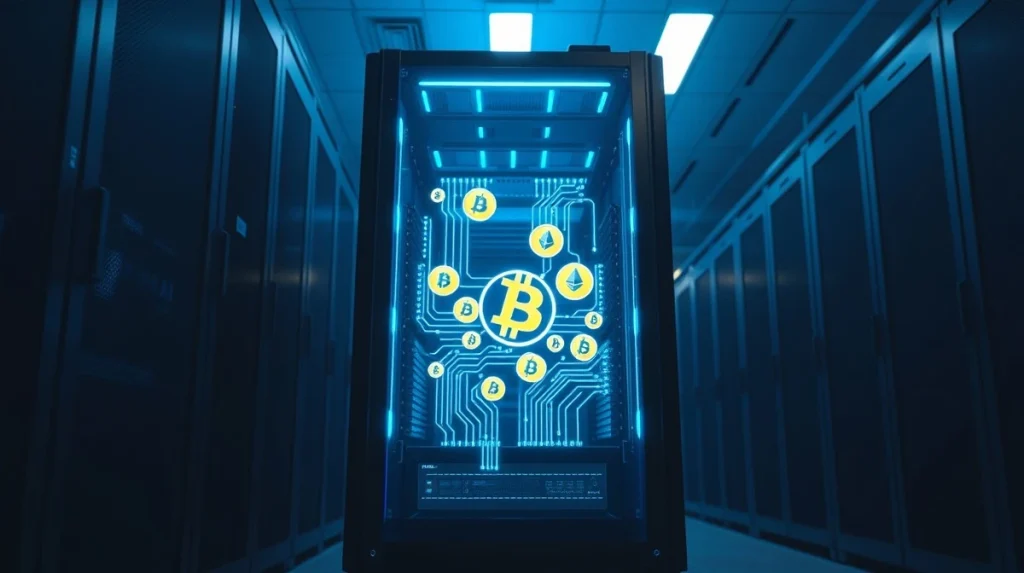
Technically, an AI crypto agent is typically a bundle of smart contracts and off-chain machine learning models. The on-chain component holds funds and has permission to execute transactions on approved protocols. The off-chain AI model analyzes data—market prices, social sentiment, gas fees, protocol metrics—and sends signed transaction instructions back to the on-chain component.
Some advanced setups use “agentic” frameworks where multiple AI sub-agents specialize in different tasks (e.g., risk assessment, opportunity discovery, execution). They communicate and compete for a pool of capital. This multi-agent approach can increase robustness but also adds layers of complexity and potential failure points.
| Component | Function | Associated Risk |
|---|---|---|
| On-Chain Smart Contract | Holds funds, executes trades | Smart contract vulnerabilities, private key compromise |
| Off-Chain AI Model | Analyzes data, makes decisions | Model flaws, data poisoning, server downtime |
| Connecting Bridge | Relays signed transactions | Communication failure, latency issues |
| DeFi Protocols | Provide financial lego (lending, swapping) | Protocol exploits, insolvency, oracle failure |
This architecture means security is only as strong as its weakest link. A flaw in any single component can lead to total loss of funds.
The Path Forward: Mitigation and Oversight
Industry watchers note that the technology is not going away. The potential efficiency and profit from well-designed AI agents are too significant. Therefore, the focus is shifting to risk mitigation. Proposals include creating “circuit breakers”—smart contracts that can freeze an agent’s activity if certain risk thresholds are breached. Others suggest the development of standardized audit frameworks specifically for AI-driven DeFi strategies.
Some projects are experimenting with decentralized insurance pools that could cover losses from proven agent failures. However, pricing this novel risk is a major challenge for insurers. What this means for investors is a need for extreme caution. Allocating capital to an autonomous AI agent requires a deep technical understanding of its strategy, its fail-safes, and the environments in which it operates.
Tanaka’s final warning is stark. “We are deploying autonomous economic actors into a system designed for transparency but not for this kind of agency. The interaction effects are unknown. A single agent failing is a problem. Dozens or hundreds interacting could create systemic issues we haven’t modeled.” This suggests the next major stress test for DeFi may not come from a hack, but from the unpredictable consequences of its own automation.
Conclusion
The era of AI crypto agents managing real money has begun. This shift from simulation to live deployment marks a critical inflection point for decentralized finance. The risks are real and multifaceted, extending beyond code bugs to include emergent market behavior and adversarial exploitation. While the technology promises efficiency, it demands new frameworks for security, auditing, and potentially regulation. For participants, the imperative is clear: understand the profound differences between automated scripts and autonomous agents before committing capital. The stability of the DeFi ecosystem may depend on it.
FAQs
Q1: What is an AI crypto agent?
An AI crypto agent is an autonomous software program that uses artificial intelligence, typically machine learning, to analyze cryptocurrency market data and execute financial transactions on decentralized finance (DeFi) protocols without real-time human input.
Q2: How is this different from a regular trading bot?
Traditional trading bots follow strict, pre-programmed rules (if X, then Y). AI agents use models that can learn and adapt their strategies based on new data, making their behavior less predictable and potentially more sophisticated.
Q3: What are the main risks of using AI crypto agents?
The main risks include the agent developing unintended and loss-making strategies, being manipulated by other market participants, causing or amplifying sudden liquidity crises, and failing due to corrupted data feeds or infrastructure issues.
Q4: Are there any regulations for AI in DeFi?
As of early 2026, there is no specific, comprehensive regulation governing the use of autonomous AI agents in decentralized finance. This creates a significant legal and liability gray area.
Q5: Can these AI agents be made safe?
Researchers and developers are working on safety measures like transaction limits, circuit breakers, and improved audit processes. However, guaranteeing safety in an open, adversarial environment like DeFi remains an unsolved challenge. Their safety is not yet assured.

This article was produced with AI assistance and reviewed by our editorial team for accuracy and quality.