Critical Divergence: Bitcoin Falling as Altcoins Rally? The 2026 Pattern Most Miss
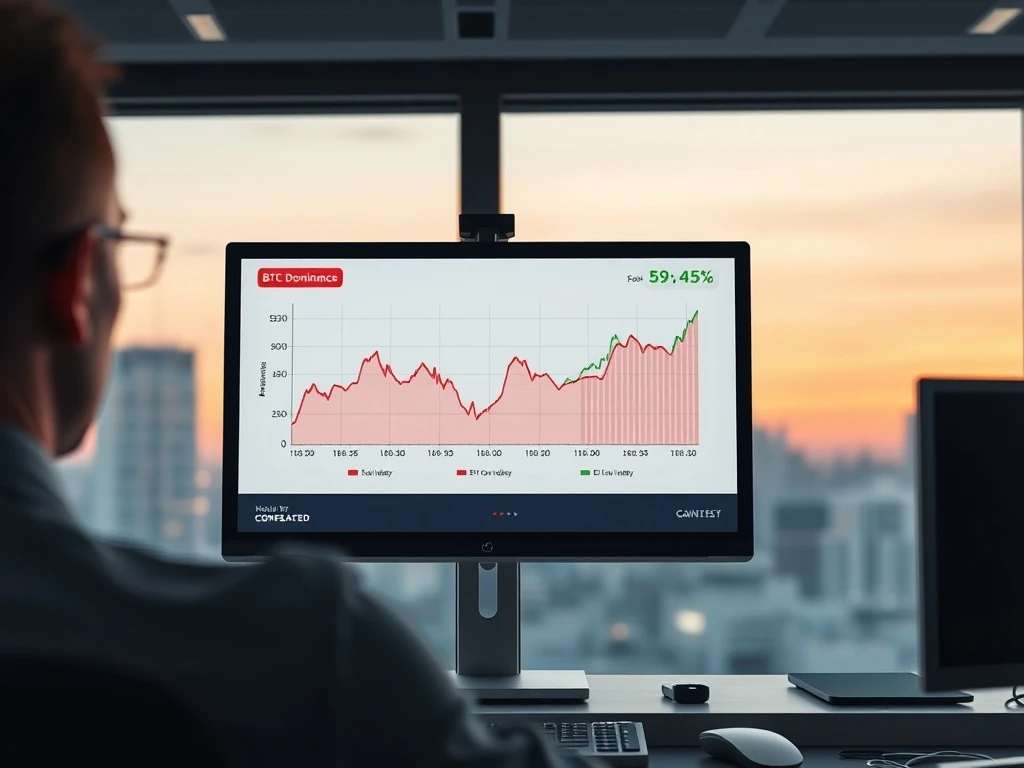
NEW YORK, March 15, 2026 — A significant and potentially misleading divergence is defining the cryptocurrency market this month. While Bitcoin’s price consolidates near the $66,000 level, underlying data reveals a stealth rally across major alternative cryptocurrencies, or altcoins. The key signal, according to market analysts, is the rising Altcoin Season Index, which climbed to 35 in March even as Bitcoin’s market dominance held firm at 59.4%. This pattern of Bitcoin falling while altcoins rally presents a complex picture that contradicts the simplistic ‘Fear & Greed’ gauge, which registered an ‘Extreme Fear’ reading of 14. The divergence suggests a nuanced capital rotation is underway, one that many investors focused solely on headline Bitcoin prices may completely miss.
Decoding the Altcoin Season Index Surge
The Altcoin Season Index is a specialized metric tracking the percentage of top altcoins outperforming Bitcoin over a rolling 90-day period. A reading above 75 typically signals a full ‘altcoin season,’ where capital floods out of Bitcoin into smaller assets. The current climb to 35, from a low of 22 in January, is a critical early signal. Crucially, more granular 60-day data shows that 40% of tracked altcoins have already outperformed Bitcoin. “The index is a leading indicator, not a lagging one,” explains Dr. Anya Sharma, Chief Data Officer at Blockchain Analytics Firm Chainalysis. “We saw similar creeping rises in the index weeks before the major altcoin rallies of late 2023 and early 2025. Investors watching only Bitcoin’s price action are seeing half the story.” This movement occurs against a backdrop of steady recovery in major altcoin projects. Ethereum (ETH), Solana (SOL), and Polkadot (DOT) have each posted consistent weekly gains, with their network activity and developer engagement metrics reaching multi-month highs, according to reports from GitHub and DappRadar.
The historical context is essential. The last time the Altcoin Season Index exhibited this specific pattern—rising while Bitcoin dominance remained elevated—was in Q4 2023. That period preceded a 210% aggregate gain for the top 50 altcoins over the following quarter, as recorded by CoinMarketCap. The current market structure, therefore, is not unprecedented but requires parsing layered signals rather than relying on a single metric.
Impact on Investor Portfolios and Strategy
This divergence creates distinct winners and losers and demands a strategic shift. Passive investors with heavy Bitcoin allocations may see relative underperformance. Conversely, active traders and funds rebalancing into select altcoins are positioned to capture alpha. The impact is already quantifiable. Data from crypto fund tracker CryptoFund Research shows that dedicated altcoin funds saw net inflows of $120 million in the first two weeks of March, while general market funds saw outflows. The primary consequence is a potential sector rotation within the crypto ecosystem. Capital isn’t fleeing crypto; it’s repositioning within it. This has several key implications:
- Volatility Transfer: Price volatility may shift from Bitcoin to large-cap altcoins, increasing trading opportunities but also risks in that segment.
- Narrative Shift: Market narratives could pivot from ‘store of value’ and ETF flows (Bitcoin-centric) to ‘utility’ and ‘protocol activity’ (altcoin-centric).
- On-Chain Pressure: Increased altcoin transactions could test the scalability and fee structures of their respective blockchains, a real-world stress test.
Expert Analysis: A Market in Transition
Market veterans are noting the unusual signals. “The ‘Extreme Fear’ reading from the traditional Crypto Fear & Greed Index is becoming less reliable as the market matures and fragments,” states Marcus Thielen, Head of Research at crypto analytics platform 10x Research. “It’s heavily weighted toward Bitcoin volatility and social sentiment. What we’re seeing now is sophisticated money moving quietly based on fundamentals, not retail sentiment.” Thielen points to institutional reports, like the recent one from Fidelity Digital Assets, which highlighted increasing client inquiry into Ethereum and Solana staking yields as a driver for this quiet accumulation. This fundamental demand contrasts sharply with the fearful sentiment captured by broader indexes. Furthermore, the stability of Bitcoin dominance near 59.4% is itself notable. It suggests that while altcoins are rallying, Bitcoin is not experiencing significant sell-off pressure—it’s merely stagnating as capital seeks growth elsewhere, a sign of a healthier, more diversified overall market.
Broader Context: A Maturing Crypto Landscape
This event must be viewed within the evolution of the cryptocurrency industry since the 2024-2025 cycle. The market is no longer a monolithic entity that rises and falls solely on Bitcoin’s momentum. The launch of multiple spot Bitcoin ETFs in 2024 cemented its role as a macro digital asset, often decoupling from the performance of utility-driven altcoins. The current divergence underscores this maturation. It reflects a market where different asset classes within crypto can have independent price drivers based on their specific use cases, regulatory developments, and technological milestones. For comparison, the table below contrasts key metrics from the peak of the last altcoin season (Q1 2025) with the current emerging pattern:
| Metric | Q1 2025 (Peak Altcoin Season) | March 2026 (Current Divergence) |
|---|---|---|
| Altcoin Season Index | 82 | 35 |
| Bitcoin Dominance | 48.1% | 59.4% |
| % of Top 100 Altcoins Outperforming BTC (60-day) | 68% | 40% |
| Primary Market Driver | Speculative retail frenzy, meme coins | Institutional rebalancing, protocol-specific developments |
What Happens Next: Scenarios and Catalysts
The forward path hinges on several identifiable catalysts. First, the sustainability of the altcoin rally depends on continued positive developments in their respective ecosystems, such as Ethereum’s upcoming “Prague” upgrade or Solana’s Firedancer client launch. Second, Bitcoin’s own trajectory remains a gravitational force. A sharp drop below $60,000 could trigger a broad risk-off move that halts the altcoin advance. Conversely, a Bitcoin breakout above $70,000 could initially suck capital back, but historically has later provided a rising tide that lifts all boats. Analysts at Galaxy Digital, in a note to clients this week, outlined a base case where the Altcoin Season Index continues its gradual climb, reaching the 50-60 range by mid-Q2 2026, setting the stage for a more pronounced rotation if Bitcoin enters a prolonged consolidation phase.
Industry and Community Reaction
The developer community within altcoin ecosystems views this as validation of building through the bear market. “The price action is finally catching up to the shipping we’ve been doing,” said a core developer for the Polkadot ecosystem, who asked not to be named as they are not an official spokesperson. On social platform X, crypto influencers are split. One camp warns this is a ‘dead cat bounce’ before a deeper correction, while another heralds it as the long-awaited start of ‘Altseason 2026.’ This polarization itself is typical of early-stage trend shifts. More measured voices, like those on crypto podcast Bankless, advise focusing on projects with clear revenue, user growth, and sustainable tokenomics rather than chasing momentum blindly.
Conclusion
The March 2026 cryptocurrency market is presenting a textbook case of divergence, where Bitcoin falling in relative momentum coincides with a stealthy altcoin rally. The critical signal for investors is the consistent rise in the Altcoin Season Index to 35, supported by 40% of altcoins outperforming Bitcoin over 60 days. This pattern, missed by those fixated on Bitcoin’s static price or the overarching ‘Extreme Fear’ sentiment, indicates a sophisticated capital rotation is in its early stages. The stability of Bitcoin dominance at 59.4% suggests this is not a flight from crypto, but a strategic repositioning within it. Investors should monitor the Altcoin Season Index for a sustained move above 50, watch for Bitcoin’s reaction around key support, and base decisions on fundamental protocol progress rather than fear or greed alone. The coming weeks will test whether this divergence is the precursor to a broader market revaluation.
Frequently Asked Questions
Q1: What exactly is the Altcoin Season Index and why is it important?
The Altcoin Season Index measures the percentage of top 50 cryptocurrencies by market cap that have outperformed Bitcoin over the previous 90 days. It’s important because it provides an early, quantitative signal of capital rotating from Bitcoin into alternative crypto assets, often preceding major altcoin bull runs.
Q2: If Bitcoin’s dominance is still high at 59.4%, how can there be an altcoin rally?
Bitcoin dominance measures Bitcoin’s share of the total crypto market cap. It can remain high if Bitcoin’s price is stable or falling slowly while the total market cap of all altcoins grows. A rally can occur within that stable dominance band if altcoins collectively grow without Bitcoin collapsing.
Q3: What are the immediate next steps analysts are watching for?
Analysts are monitoring two key levels: whether the Altcoin Season Index can break above 50, signaling strengthening momentum, and whether Bitcoin can hold support above $62,000. A break of either level would significantly alter the short-term trajectory.
Q4: Should the average crypto investor change their strategy based on this?
It’s a signal to review portfolio allocation, not panic. Investors might consider rebalancing a small portion to diversify into altcoins with strong fundamentals, but shifting an entire portfolio based on one early indicator is risky. Due diligence on individual projects remains paramount.
Q5: How does the current ‘Extreme Fear’ sentiment reading fit with altcoins rallying?
The Fear & Greed Index is largely driven by Bitcoin volatility and social media sentiment. It can become disconnected when institutional or sophisticated money moves quietly based on fundamentals, which appears to be happening now, creating a divergence between sentiment and price action.
Q6: How does this affect people who only invest through Bitcoin ETFs?
Investors solely in Bitcoin ETFs (like IBIT or FBTC) will not directly participate in any altcoin rally. Their performance is tied exclusively to Bitcoin’s price. This divergence highlights a potential limitation of a Bitcoin-only strategy during periods where other crypto assets outperform.