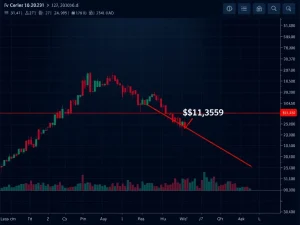
Bitcoin Price: The Critical $61,359 Threshold That’s Shaping the 2025 Market

In the volatile world of cryptocurrency, specific price levels often gain outsized importance, acting as magnets for market sentiment and technical trading. As of March 2025, the Bitcoin price of $61,359 has emerged as arguably the most significant level on the chart, a development underscored by recent commentary from prominent institutional investors. This threshold represents more than just a number; it encapsulates a confluence of historical resistance, on-chain data, and evolving macroeconomic narratives that could dictate the asset’s trajectory for the coming quarters.
The Technical Significance of the $61,359 Bitcoin Price
Market analysts immediately recognize the $61,359 Bitcoin price point as a major technical pivot. This level previously acted as a formidable zone of resistance throughout late 2024. Consequently, a sustained break above it would signal a robust bullish structure. Conversely, a failure to hold this level as support could indicate weakening momentum. The principle of “former resistance becoming new support” is a cornerstone of technical analysis. Therefore, the market’s behavior around this price is being scrutinized with intense focus.
On-chain data provides further context for this Bitcoin price significance. Analytics firms like Glassnode and CryptoQuant track the aggregate cost basis of investors. Significantly, the $61,000-$62,000 range represents the average acquisition price for a substantial cohort of addresses that accumulated during the previous cycle’s consolidation phase. When the spot price approaches the aggregate cost basis, it often triggers increased trading activity as investors decide to realize profits or losses.
Cathie Wood’s Endorsement and the Gold Comparison
The narrative surrounding this key Bitcoin price level gained a powerful institutional voice just hours ago. Cathie Wood, CEO of ARK Invest, stated unequivocally that “Bitcoin Is Flat Out Better Than Gold.” This declaration is not merely an opinion but a thesis backed by specific comparative frameworks that resonate with institutional allocators. Wood’s argument hinges on several verifiable characteristics where Bitcoin demonstrates superiority as a store of value and capital asset.
- Scarcity & Programmability: Bitcoin’s supply is algorithmically capped at 21 million coins, a verifiable and immutable rule. Gold’s supply, while finite, is subject to new discoveries and mining technology advances.
- Portability & Verifiability: Transferring billions in Bitcoin is a matter of minutes, with settlement on a public ledger. Physically moving equivalent value in gold is logistically complex and costly.
- Storage & Security: Digital storage in a decentralized network eliminates custodial and physical security risks associated with bullion vaults.
This endorsement matters because ARK Invest is a registered investment advisor with billions in assets under management. Their research influences pension funds, endowments, and other large institutions. When such entities begin evaluating a $61,359 Bitcoin price not as a speculative peak but as a potential base for a new monetary asset, the demand profile changes fundamentally.
Institutional Adoption as a Price Driver
The convergence of technical levels and high-profile advocacy points to a broader trend: accelerating institutional adoption. The approval of U.S. spot Bitcoin ETFs in early 2024 created a regulated on-ramp for traditional capital. These ETFs now hold hundreds of thousands of Bitcoin, creating a new, persistent source of buy-side pressure. The $61,359 level may represent a key valuation benchmark where these large-scale buyers become more or less aggressive. Their participation adds a layer of stability and volume that was absent in previous cycles, potentially turning old resistance into durable support.
Macroeconomic Backdrop and Historical Precedent
Understanding the importance of any Bitcoin price requires examining the external financial environment. In 2025, markets are navigating a landscape of moderating but persistent inflation, high sovereign debt levels, and geopolitical fragmentation. Historically, both Bitcoin and gold have been viewed as hedges against currency debasement and systemic risk. However, their performance and adoption curves are diverging.
The following table contrasts key attributes relevant to the current macro climate:
| Attribute | Gold | Bitcoin |
|---|---|---|
| Annual Supply Increase | ~1-2% (mining) | ~1.8% (current halving cycle) |
| Correlation to Real Yields | Historically Negative | Evolving, Currently Low |
| 90-Day Volatility (Avg.) | ~15% | ~60% |
| Primary Market Infrastructure | OTC, LBMA | Global 24/7 Exchanges |
While Bitcoin exhibits higher volatility, its transparency, global accessibility, and integration with digital finance appeal to a new generation of investors and institutions. The debate is no longer about one asset replacing the other entirely, but about portfolio allocation. A Bitcoin price holding above a major level like $61,359 strengthens the case for it occupying a larger share of the “alternative asset” or “store of value” bucket in institutional portfolios, directly competing with gold’s allocation.
On-Chain Metrics and Network Health
Beyond price, the fundamental health of the Bitcoin network supports the significance of this level. Hash rate, a measure of total computational power securing the network, continues to hit all-time highs, indicating robust miner investment and confidence. The number of active addresses and settlement volume denominated in USD also remains elevated compared to previous bear market periods. This underlying strength suggests that a $61,359 Bitcoin price is supported by organic network usage and security, not merely speculative trading.
Conclusion
The $61,359 Bitcoin price point has crystallized as a critical barometer for the market in 2025. It sits at the intersection of technical structure, on-chain investor psychology, and a powerful new institutional narrative championed by figures like Cathie Wood. This level’s importance stems from its role as a former resistance zone now being tested as support, coinciding with Bitcoin’s growing acceptance as a digital alternative to traditional stores of value. While volatility remains inherent, the battle around this specific Bitcoin price will likely reveal much about the asset’s maturity, the conviction of new institutional holders, and its evolving role in the global financial system. Market participants will watch this threshold closely, as its defense or breach will set the tone for the next major market phase.
FAQs
Q1: Why is $61,359 specifically important for Bitcoin?
This price level was a major resistance point in 2024. In technical analysis, such levels often flip to become crucial support. It also aligns with the average cost basis for a large group of investors, making it a sentiment and profitability pivot zone.
Q2: What did Cathie Wood actually say about Bitcoin vs. Gold?
Cathie Wood, CEO of ARK Invest, stated “Bitcoin Is Flat Out Better Than Gold.” She bases this on Bitcoin’s superior scarcity verification, portability, and security as a digital, programmable asset in the modern financial system.
Q3: How does institutional adoption affect Bitcoin’s price stability?
The influx of institutional capital through vehicles like ETFs creates consistent, long-term oriented buying pressure. This can reduce extreme volatility and help establish higher price floors, as these investors often use key technical and fundamental levels for entry.
Q4: Is Bitcoin meant to replace gold entirely?
Most analysts view them as complementary rather than mutually exclusive. Bitcoin is seen as a digital, natively internet-based store of value, while gold retains its historical role. Many portfolios may hold both, but Bitcoin is competing for a share of the allocation traditionally reserved for gold.
Q5: What happens if Bitcoin falls decisively below $61,359?
A sustained break below this key support level could trigger further selling as algorithmic traders and stop-losses are activated. It would shift the near-term technical bias to bearish, potentially leading to a test of lower support zones around $58,000 or $55,000, depending on market conditions.