Bitcoin Technical Shock: Unprecedented Weekly RSI Collapse Undercuts Every Major Crisis in Cryptocurrency History
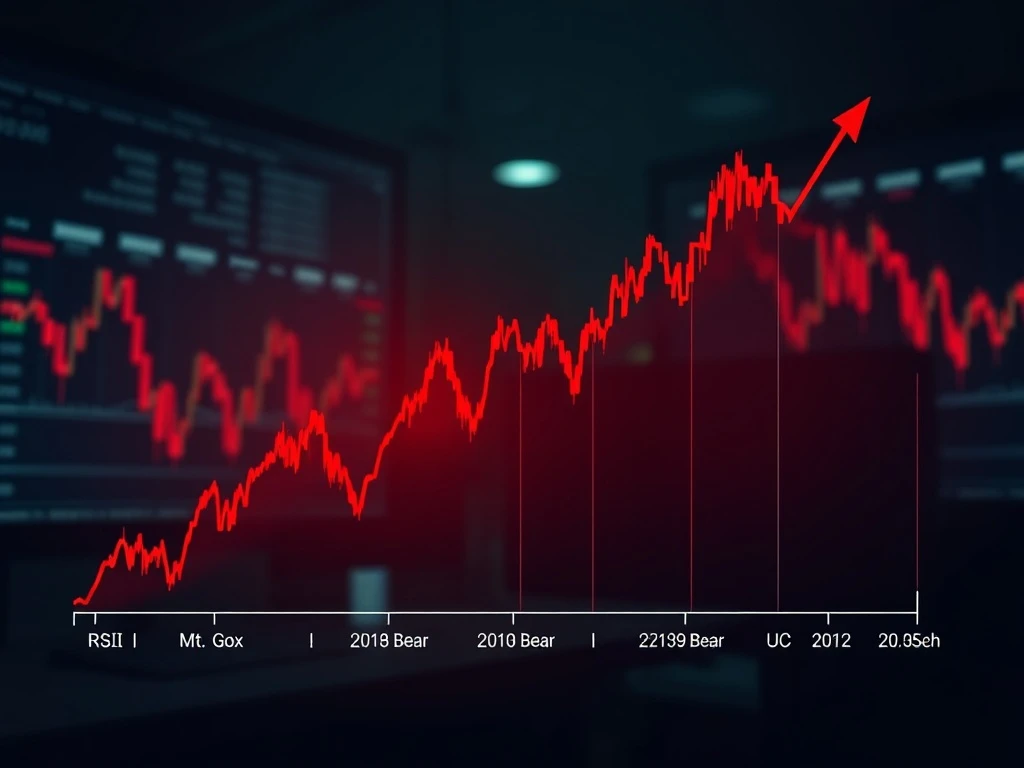
Global cryptocurrency markets witnessed a startling technical development this week as Bitcoin’s weekly Relative Strength Index plunged to levels never before recorded, falling below readings from the Mt. Gox collapse, the 2018 bear market, and the COVID-19 crash. This unprecedented momentum collapse signals deep market stress as institutional support weakens through consistent ETF outflows, creating what analysts describe as the most extreme technical reading in Bitcoin’s 16-year history.
Bitcoin Technical Analysis Reveals Historic Momentum Collapse
Technical analyst Ash Crypto first identified the extraordinary development on June 15, 2025. The weekly RSI, a momentum oscillator measuring the speed and change of price movements, registered below 22. This reading undercuts every prior macro panic event in Bitcoin’s history. Consequently, market participants face a completely novel technical landscape. The RSI typically ranges from 0 to 100, with readings below 30 indicating oversold conditions. However, this descent into uncharted territory suggests a market stress level exceeding even the most severe historical capitulations.
Simultaneously, aggregate open interest across major derivatives exchanges dropped by approximately 50% over the preceding fortnight. This sharp decline in leveraged positions indicates widespread deleveraging and risk reduction among traders. Furthermore, the combination of record-low momentum and collapsing open interest creates a rare confluence of bearish technical signals. Market structure now shows characteristics of both exhaustion and disengagement.
Comparative Analysis of Bitcoin Market Crises
To understand the severity of the current reading, a direct comparison with previous crises proves essential. The Mt. Gox exchange collapse in early 2014 saw Bitcoin’s price plummet from over $1,100 to below $200. During that event, the weekly RSI bottomed near 28. Similarly, the prolonged 2018 bear market, which drove prices from $20,000 to $3,200, recorded a weekly RSI low of approximately 26. The COVID-19 flash crash in March 2020 triggered a swift 50% drop, with the RSI briefly touching 24 before a rapid recovery.
The current technical setup differs fundamentally because it lacks a single, identifiable catalyst like an exchange failure or global pandemic. Instead, pressure appears multifaceted. Persistent outflows from U.S. spot Bitcoin ETFs have removed a key source of institutional buying pressure that supported prices throughout 2024. Additionally, macroeconomic uncertainty regarding interest rates and geopolitical tensions has suppressed risk appetite across all asset classes.
Institutional Support Weakens as ETF Flows Reverse
Data from fund issuers and blockchain analytics firms reveals a sustained exodus from spot Bitcoin exchange-traded funds. For eight consecutive weeks, these products have experienced net outflows, totaling over $3.2 billion. This trend marks a dramatic reversal from the consistent inflows seen during the product’s launch and initial adoption phase. The outflows directly reduce daily demand for Bitcoin on the open market, removing a structural price support mechanism.
Market makers and liquidity providers adjust their strategies in response to these flows. As a result, bid-side depth on major order books has noticeably thinned. This thinning increases volatility and exacerbates downward price movements. The linkage between ETF flows and technical indicators like RSI demonstrates how derivative and spot markets now interact in complex, amplified ways.
Interpreting the Record-Low RSI Reading
The Relative Strength Index measures the magnitude of recent price changes to evaluate overbought or oversold conditions. A weekly reading provides a longer-term, smoothed perspective than daily charts. Statistically, an RSI below 30 suggests an asset may be oversold and due for a corrective bounce. However, technical analysts emphasize that indicators can remain in extreme territory during strong trending markets. The key question is whether this signals a final capitulation before a reversal or indicates a breakdown in the indicator’s predictive utility.
Historical precedent offers limited guidance. While deeply oversold RSI readings have often preceded significant rallies, none have started from this extreme level. Some analysts propose that the market’s structure has evolved. The introduction of ETFs, institutional participation, and sophisticated derivatives may have altered the dynamics that historical RSI readings captured. Therefore, traditional interpretation frameworks require careful contextual adjustment.
On-Chain Data and Network Health Metrics
Beyond price-based technicals, on-chain analytics provide a complementary view of network stress. Key metrics show mixed signals. The MVRV Ratio, which compares market value to realized value, indicates the average holder is at a significant unrealized loss—a condition often associated with market bottoms. Meanwhile, exchange reserves continue a multi-year downtrend, suggesting long-term holders are not panic-selling to centralized platforms. Network fundamentals, including hash rate and active address count, remain robust, pointing to underlying protocol health despite price weakness.
This divergence between weak price momentum and strong network fundamentals presents a complex puzzle for analysts. Typically, such divergence resolves with price converging to network strength over extended periods. However, the timing and catalyst for this convergence remain uncertain in the current macro environment.
Market Structure and Liquidity Implications
The 50% drop in aggregate open interest carries significant implications for market functioning. Open interest represents the total number of outstanding derivative contracts. A sharp decline signals that traders are closing positions rather than opening new ones. This reduction in market participation decreases overall liquidity. Lower liquidity, in turn, leads to wider bid-ask spreads and increased slippage for large orders. Market quality deteriorates under these conditions.
Notably, the decline appears broad-based across both perpetual swaps and quarterly futures. This pattern suggests a withdrawal of both speculative and hedging activity. While reducing leverage can help purge excess risk from the system, it also diminishes the market’s depth and resilience. The current environment therefore presents a paradox: reduced leverage lowers systemic risk but also makes the market more vulnerable to large, discontinuous moves from relatively small order flows.
Historical Context and Potential Scenarios
Examining Bitcoin’s full history reveals that periods of extreme technical stress have consistently preceded major trend changes. The key distinction lies in whether the trend change is a reversal to the upside or a transition to a new, lower trading range. The 2014-2015 bear market featured multiple oversold RSI readings before a final capitulation and multi-year accumulation phase. The current technical picture shares some similarities with that period, particularly in the duration of negative momentum.
Analysts outline several potential forward paths. First, a technical bounce from deeply oversold conditions could occur, potentially catalyzed by a short squeeze or positive macro development. Second, the market could enter a prolonged consolidation phase with low volatility, allowing time for fundamentals to catch up to price. Third, continued weakness could test lower price levels until a stronger support zone emerges from long-term holder accumulation. Each scenario carries distinct implications for traders and investors.
Conclusion
Bitcoin’s descent to a record-low weekly RSI reading represents a significant technical event that undercuts every major crisis in its history. This development, coupled with a 50% drop in open interest and sustained ETF outflows, paints a picture of a market under profound stress. While historical comparisons to the Mt. Gox collapse, 2018 bear market, and COVID crash provide context, the current situation remains unique in its technical extremity and complex catalyst blend. Market participants must now navigate an uncharted technical landscape where traditional indicator interpretations may require recalibration. The coming weeks will prove crucial in determining whether this extreme Bitcoin RSI reading marks a final capitulation or the beginning of a new market paradigm.
FAQs
Q1: What does a low Bitcoin RSI reading actually mean?
The Relative Strength Index measures momentum. A weekly RSI below 30 typically indicates an oversold market where selling pressure may be exhausted. However, the current historically low reading suggests unprecedented momentum weakness that exceeds all prior bear markets.
Q2: How does the current situation compare to the Mt. Gox crash?
Technically, the current weekly RSI is lower than during the Mt. Gox collapse. Fundamentally, Mt. Gox was a single exchange failure, while current pressures stem from multiple sources including ETF outflows, macro conditions, and derivative market deleveraging.
Q3: Are Bitcoin ETFs making the market more volatile?
ETF flows create a new source of daily institutional demand or selling pressure. Their consistent outflows have removed a key support mechanism, potentially amplifying downward momentum and contributing to the extreme technical readings.
Q4: Can the RSI indicator be wrong or broken?
Technical indicators are mathematical representations of price action, not predictive crystal balls. In evolving markets with new participants like ETFs, historical indicator behavior may change. The indicator isn’t “broken,” but its interpretation requires context.
Q5: What typically happens after such extreme readings?
Historically, extreme oversold RSI readings have often marked intermediate-term bottoms, though the timing and magnitude of recoveries vary widely. The uniqueness of the current reading means there’s no direct historical precedent for what happens next.