Hyperliquid HYPE Whale’s Gritty $17M Defense Against Liquidation

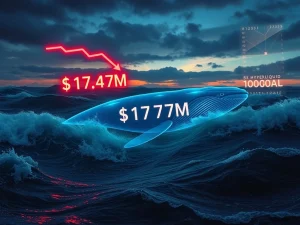
In a stark demonstration of the high-stakes volatility within decentralized finance, a major trader on the Hyperliquid derivatives exchange is mounting a costly defense against a multi-million dollar liquidation. The entity behind wallet address 0x082e, now famously dubbed the ‘HYPE whale,’ has reportedly incurred approximately $17.47 million in unrealized losses on a massive long position. Consequently, the trader has injected an additional $2.4 million in USDC collateral to stave off automatic liquidation, which is now triggered if the HYPE token price falls to $23.91. This event, unfolding against a backdrop of broader market turbulence, provides a critical case study in DeFi risk management and the immense pressures faced by large-scale participants.
Anatomy of the Hyperliquid HYPE Whale’s Position
The core of this financial drama centers on a highly leveraged bet placed on the HYPE token. According to on-chain data and exchange analytics, wallet 0x082e established a long position consisting of 1.38 million HYPE tokens. Initially, this position represented a bullish conviction on the asset’s price appreciation. However, recent market-wide corrections and asset-specific volatility have severely eroded its value. The trader’s decision to add $2.4 million in stablecoin collateral was a strategic move to increase the position’s health and push the liquidation price lower, from a more precarious level to the current $23.91 threshold. This action highlights a common yet risky strategy known as ‘averaging down’ or defending a margin position, where traders commit more capital to salvage an underwater bet.
Furthermore, this scenario underscores the automated and unforgiving nature of decentralized perpetual exchanges like Hyperliquid. Unlike traditional finance where margin calls might involve negotiation, DeFi protocols execute liquidations automatically when collateral ratios fall below specified levels. This process protects the system’s solvency but can lead to rapid, cascading sell-offs. The whale’s preemptive deposit is a direct response to this immutable protocol logic.
Contextualizing the HYPE Token and Market Volatility
The HYPE token itself is a speculative asset often associated with the Hyperliquid ecosystem’s native incentives and governance. Its price is notoriously susceptible to sharp swings based on platform activity, broader crypto market sentiment, and liquidity fluctuations. In recent weeks, the entire cryptocurrency market has experienced significant downward pressure, driven by macroeconomic concerns and shifting regulatory outlooks. This macro environment has amplified the volatility of smaller-cap tokens like HYPE, creating a perfect storm for over-leveraged positions. Analysts from firms like CoinMetrics and CryptoQuant routinely track such large wallet movements, noting that actions by single entities can disproportionately impact token liquidity and price discovery on decentralized venues.
Implications for DeFi and Risk Management Protocols
This event carries significant implications for the broader decentralized finance landscape. Firstly, it serves as a real-time stress test for Hyperliquid’s risk engine and liquidation mechanisms. The exchange’s ability to handle a potential $17M+ liquidation event without causing severe market disruption or insolvency is under scrutiny. Secondly, it acts as a powerful reminder to retail and institutional traders about the extreme risks of leverage in volatile markets. Risk management experts consistently advocate for conservative collateral ratios and stop-loss orders, principles starkly highlighted by this whale’s predicament.
- Protocol Resilience: The stability of the Hyperliquid exchange depends on its liquidation auctions functioning smoothly to cover the bad debt.
- Market Impact: A liquidation of this size could create a localized selling avalanche, negatively impacting all HYPE holders.
- Regulatory Attention: High-profile losses often draw scrutiny from financial regulators examining consumer protection in DeFi.
Moreover, data from previous crypto market cycles shows that forced liquidations often cluster around specific price levels, creating ‘liquidation zones’ that can exacerbate price movements. Traders and automated systems now closely monitor the $23.91 level for HYPE, as a break below could trigger not only this whale’s exit but also a wave of follow-on selling from other leveraged positions.
Historical Precedents and Expert Analysis
Similar events have punctuated crypto history, from the mass liquidations during the May 2021 and June 2022 market crashes to individual whale stories on platforms like BitMEX and dYdX. Experts like Arthur Hayes, co-founder of BitMEX, have long discussed the ‘volatility tax’ levied on over-leveraged traders. Blockchain analytics firms provide data showing that while whale movements are impactful, they are also a natural part of a maturing, albeit risky, market structure. The key learning, according to analysts, is that leverage multiplies both gains and losses, and sustainable trading strategies must account for black swan volatility events.
Conclusion
The Hyperliquid HYPE whale’s gritty defense against a $17 million liquidation is more than a sensational headline; it is a microcosm of the high-risk, high-reward environment defining decentralized finance. This event illustrates the intense pressure on large traders, the mechanical inevitability of DeFi liquidation protocols, and the interconnected risks present in leveraged crypto markets. As the market watches the $23.91 price level, the outcome will offer valuable lessons on position management, protocol design, and the perpetual dance between conviction and risk in the digital asset space. Ultimately, this saga reinforces the paramount importance of robust risk management for all market participants.
FAQs
Q1: What is a ‘whale’ in cryptocurrency?
A whale is a term for an individual or entity that holds a large enough amount of a specific cryptocurrency that their trading activity can significantly influence the market price.
Q2: How does liquidation work on Hyperliquid or similar DEXs?
On decentralized perpetual exchanges, positions are backed by collateral. If the value of the position moves against the trader and the collateral ratio falls below a maintenance threshold, the protocol automatically sells the position in a liquidation auction to repay the borrowed funds, protecting the system from insolvency.
Q3: What does ‘unrealized loss’ mean?
An unrealized loss is a decrease in the value of an open investment position that has not yet been sold or closed. The loss becomes ‘realized’ only when the position is liquidated or closed at the lower price.
Q4: Why would a trader add more money to a losing position?
By adding more collateral (like USDC), a trader increases the health of their margin position. This action lowers the liquidation price, giving the asset more room to fall before the position is automatically closed, in hopes that the market will reverse.
Q5: Can a large liquidation cause a price crash?
Yes, a very large liquidation can force the sale of a substantial amount of an asset on the open market. This sudden influx of sell orders can overwhelm buy-side liquidity, driving the price down rapidly and potentially triggering further liquidations in a cascade.