DEX Trading Volume Plummets 31.87%: Uniswap and PancakeSwap Defy Broader Market Slump
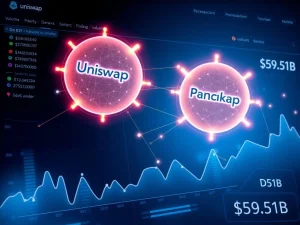
Global, March 2025 – The decentralized finance (DeFi) landscape presents a stark contradiction this week. According to the latest market snapshot from analytics firm Phoenix Group, the total weekly trading volume across all decentralized exchanges (DEXs) has slumped to $59.51 billion. This figure represents a significant 31.87% decline from the previous period, signaling a pronounced cooling in the sector. However, this aggregate drop masks the resilient, and even dominant, performance of industry leaders Uniswap and PancakeSwap, whose sustained strong activity raises critical questions about market concentration and user behavior.
Deciphering the DEX Trading Volume Decline
The reported $59.51 billion in weekly DEX trading volume marks a pivotal moment for the decentralized exchange ecosystem. This decline is not occurring in a vacuum. Consequently, analysts are scrutinizing several interconnected factors. Broader cryptocurrency market volatility often directly impacts DeFi activity. Additionally, shifting regulatory landscapes in key jurisdictions can influence trader sentiment. Meanwhile, the maturation of the sector may be leading to a consolidation of liquidity. Furthermore, competition from centralized exchanges (CEXs) offering improved services and lower fees for certain assets persists. This multifaceted environment creates a complex picture for DEX performance.
Historically, DEX volumes have shown strong correlation with overall crypto market capitalization. Periods of bullish price action typically see a surge in decentralized trading and yield farming. Conversely, bearish or sideways markets often trigger a retreat. The current slump suggests a cautious or risk-off approach among a significant portion of the DeFi user base. Data from previous cycles indicates that such contractions can precede periods of innovation, as developers focus on building the next generation of protocols.
Uniswap and PancakeSwap: Defying the Downtrend
Despite the overarching decline, a deep dive into the data reveals a tale of two titans. Uniswap, the Ethereum-based DEX behemoth, and PancakeSwap, the flagship exchange on the BNB Chain, continue to demonstrate formidable strength. Their sustained high activity levels are absorbing a larger share of the shrinking total volume. This trend highlights several key dynamics within the DeFi space.
- Liquidity Network Effects: Uniswap and PancakeSwap benefit from unparalleled liquidity depth. This attracts large traders who require minimal slippage, creating a virtuous cycle that reinforces their dominance.
- Multi-Chain Expansion: Both protocols have successfully deployed on multiple blockchains beyond their native networks. Uniswap v3 exists on Arbitrum, Optimism, and Polygon. Similarly, PancakeSwap has expanded to Aptos and Ethereum itself. This broadens their user base and insulates them from chain-specific downturns.
- Established Trust and Security: Years of reliable operation and massive total value locked (TVL) have built significant user trust. In a climate of caution, traders gravitate towards the most battle-tested platforms.
The concentration of activity on these two platforms underscores a growing divide between ‘blue-chip’ DeFi applications and the long tail of smaller DEXs. The latter group appears to be bearing the brunt of the volume decline.
Expert Analysis: A Market in Transition
Industry observers interpret this data as a sign of market maturation, not necessarily decay. “What we are witnessing is a natural consolidation phase,” explains a veteran DeFi analyst at Phoenix Group, whose data sparked this analysis. “The initial explosion of hundreds of DEXs has given way to a focus on quality, security, and sustainable tokenomics. The sharp decline in aggregate volume, juxtaposed with stable activity on top-tier DEXs, clearly indicates that liquidity and users are migrating to the most efficient and reliable venues.” This expert view suggests the slump may be a healthy correction, weeding out less competitive protocols and strengthening the foundational pillars of the DeFi ecosystem.
The Ripple Effects and Future Implications
The 31.87% slump in DEX trading volume carries immediate and long-term implications. For one, native governance tokens of smaller DEXs may face increased selling pressure as their fee generation declines. This could impact their treasury sustainability and development roadmaps. Secondly, liquidity providers (LPs) across lesser-used pools may experience higher impermanent loss risks and lower yields, potentially prompting a capital migration to the major platforms.
Looking ahead, this environment may accelerate several trends. First, we could see increased merger and acquisition activity or strategic partnerships among mid-tier DEXs. Second, innovation may focus on niche verticals like derivatives, options, or real-world asset (RWA) trading to capture specific demand. Finally, the pressure to improve user experience (UX) and reduce gas costs will intensify for all players, not just the leaders. The response from the broader DEX developer community to this volume challenge will likely define the next phase of DeFi evolution.
Conclusion
The latest Phoenix Group data revealing a 31.87% slump in overall DEX trading volume to $59.51 billion paints a picture of a sector at a crossroads. While the headline number signals a broad-based contraction, the enduring strength of Uniswap and PancakeSwap reveals a market consolidating around proven, liquid, and multi-chain platforms. This period of recalibration emphasizes the critical importance of sustainable models, deep liquidity, and relentless innovation in the decentralized exchange landscape. The evolving DEX trading volume narrative will continue to serve as a primary barometer for DeFi’s health and trajectory as it moves further into 2025.
FAQs
Q1: What does a 31.87% decline in DEX trading volume mean for DeFi?
It primarily indicates a market-wide contraction in decentralized trading activity, often linked to broader crypto market conditions. However, it also signals consolidation, where users and liquidity are concentrating on the largest, most established protocols like Uniswap and PancakeSwap.
Q2: Why are Uniswap and PancakeSwap still active if overall volume is down?
These platforms benefit from powerful network effects, including the deepest liquidity pools, multi-chain presence, and strong brand trust. During downturns, traders prioritize reliability and low slippage, which these blue-chip DEXs provide.
Q3: Could this volume slump be bad for cryptocurrency prices?
While correlated, DEX volume is a measure of DeFi-specific activity, not direct asset prices. Reduced trading can indicate lower speculation but doesn’t necessarily dictate price direction for major assets like Bitcoin or Ethereum.
Q4: What happens to smaller decentralized exchanges during this slump?
They face significant challenges, including reduced fee revenue, potential liquidity depletion, and increased competition. This may lead to closures, mergers, or a pivot to specialized niche markets to survive.
Q5: Is this a normal phase for the DEX industry?
Yes, similar consolidation phases have occurred in traditional finance and earlier in crypto. Periods of explosive growth are often followed by contractions where the strongest projects consolidate their position, which can lead to a healthier, more sustainable ecosystem long-term.