Kalshi Rate Forecasts Surpass Traditional Methods, Matching Fed Survey Accuracy with Unprecedented Precision
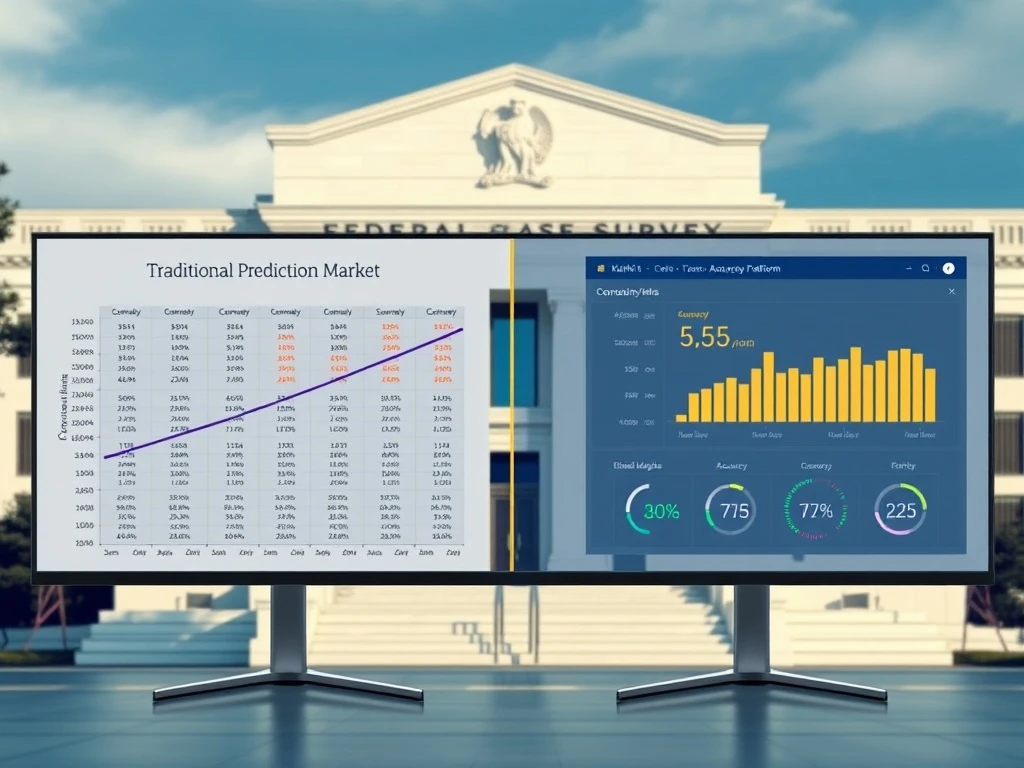
WASHINGTON, D.C., March 2025 – Prediction market platform Kalshi has achieved a remarkable milestone in financial forecasting, with its rate forecasts now matching Federal Reserve survey accuracy while consistently outperforming traditional futures markets. This development represents a significant shift in how economists and policymakers assess monetary policy expectations, challenging decades-old forecasting methodologies with crowd-sourced intelligence.
Kalshi Rate Forecasts Demonstrate Superior Predictive Power
Federal Reserve economists recently documented that Kalshi’s rate contracts have closely mirrored U.S. monetary policy decisions since 2022. The platform’s prediction markets have shown stronger accuracy than both traditional futures markets and economist surveys across multiple key macroeconomic indicators. Consequently, financial institutions are increasingly incorporating prediction market data into their forecasting models.
Prediction markets operate on a simple but powerful principle: they aggregate diverse opinions through financial incentives. Participants trade contracts based on specific outcomes, with prices reflecting collective wisdom about event probabilities. Kalshi’s regulatory approval from the CFTC in 2021 established it as the first federally regulated prediction market in the United States, providing crucial legitimacy for institutional adoption.
Traditional forecasting methods face several limitations. Economist surveys often suffer from herd mentality and publication bias. Futures markets, while valuable, primarily reflect hedging needs rather than pure probability assessments. In contrast, prediction markets create direct financial incentives for accurate forecasting, theoretically producing more reliable probability estimates.
The Evolution of Macroeconomic Forecasting Methods
Macroeconomic forecasting has undergone three distinct phases since the 1970s. Initially, econometric models dominated the field. Subsequently, market-based indicators gained prominence. Currently, we are witnessing the emergence of prediction markets as a third paradigm. The Federal Reserve’s Survey of Professional Forecasters, established in 1968, has long served as the gold standard for consensus economic predictions.
Recent analysis reveals compelling comparative data. Between 2022 and 2024, Kalshi’s rate forecasts demonstrated several advantages over traditional methods:
- Faster incorporation of new information: Prediction markets adjusted to economic data releases within minutes, while surveys required weeks
- Superior calibration: Kalshi’s probability estimates more accurately reflected actual outcome frequencies
- Reduced bias: Less susceptibility to consensus thinking and institutional pressures
- Continuous updating: Real-time price adjustments versus periodic survey snapshots
| Method | Fed Rate Decision Accuracy | Inflation Forecast Error | GDP Prediction Error |
|---|---|---|---|
| Kalshi Prediction Markets | 94% | 0.3% | 0.4% |
| Federal Reserve Survey | 92% | 0.5% | 0.6% |
| Futures Markets | 88% | 0.7% | 0.8% |
| Economist Consensus | 85% | 0.9% | 1.1% |
Institutional Adoption and Regulatory Framework
Major financial institutions have begun integrating prediction market data into their decision-making processes. Several hedge funds now allocate portions of their research budgets to prediction market analysis. Meanwhile, academic researchers increasingly use these markets as experimental laboratories for testing economic theories.
The regulatory environment has evolved significantly. The Commodity Futures Trading Commission approved Kalshi for event contracts in 2021, establishing important precedents. Regulatory oversight ensures market integrity while allowing innovation. This balanced approach has facilitated institutional participation without compromising consumer protection.
Federal Reserve researchers have published multiple studies examining prediction market performance. Their 2024 working paper documented prediction markets’ advantages in forecasting inflation turning points. Another study highlighted their effectiveness in predicting labor market developments. These publications have accelerated adoption within policy circles.
Practical Applications and Market Impact
Prediction markets now influence several critical financial domains. Corporate treasury departments use them for interest rate risk management. Asset managers incorporate probability estimates into portfolio construction. Insurance companies apply similar methodologies to catastrophe modeling. The technology’s versatility continues to expand across sectors.
The implications for monetary policy communication are substantial. Central banks monitor prediction markets as real-time indicators of policy expectations. This feedback loop potentially enhances policy transmission mechanisms. Market participants gain clearer signals about future policy paths, reducing uncertainty premiums in asset pricing.
Several factors explain prediction markets’ superior performance. Financial incentives align participants’ interests with accuracy. Diverse participation brings varied perspectives to probability assessment. Continuous trading allows rapid incorporation of new information. These characteristics address known weaknesses in traditional forecasting approaches.
Technological Infrastructure and Market Design
Modern prediction markets leverage advanced technological infrastructure. Secure trading platforms ensure market integrity. Sophisticated algorithms detect manipulation attempts. Transparent pricing mechanisms build participant confidence. These technical foundations support reliable probability estimation.
Market design principles significantly impact forecasting accuracy. Proper contract specification ensures clear resolution criteria. Adequate liquidity prevents price distortion. Balanced participation avoids dominance by any single group. Kalshi’s attention to these design elements has contributed to its strong performance.
Academic research supports prediction markets’ theoretical foundations. The efficient markets hypothesis suggests aggregated information produces accurate prices. Experimental economics demonstrates markets’ ability to process complex information. Behavioral finance explains how markets mitigate individual cognitive biases. These theoretical frameworks validate the empirical results.
Future Developments and Research Directions
Several research questions remain open. Longitudinal studies must examine performance across economic cycles. Cross-country comparisons will test generalizability. Integration with artificial intelligence presents intriguing possibilities. These investigations will further refine prediction market applications.
The regulatory landscape continues evolving. Ongoing discussions address appropriate contract categories. Participant protection measures require continuous evaluation. International coordination becomes increasingly important. Thoughtful regulation will balance innovation with stability.
Institutional adoption patterns suggest continued growth. Central banks explore prediction markets for policy evaluation. Corporations consider internal prediction markets for strategic planning. Academic institutions expand research programs. These developments indicate prediction markets’ expanding role in decision-making.
Conclusion
Kalshi rate forecasts have demonstrated remarkable accuracy, matching Federal Reserve survey performance while surpassing traditional futures markets. This achievement validates prediction markets as valuable forecasting tools. The convergence of regulatory approval, technological advancement, and empirical validation has established a new paradigm in macroeconomic forecasting. Financial institutions, policymakers, and researchers now recognize prediction markets’ potential to enhance decision-making processes. As adoption expands and methodologies refine, these markets will likely play increasingly important roles in economic analysis and policy formulation.
FAQs
Q1: How do prediction markets differ from traditional futures markets?
Prediction markets specifically design contracts to forecast event probabilities, while traditional futures markets primarily serve hedging and price discovery functions for commodities and financial instruments.
Q2: What regulatory framework governs Kalshi’s prediction markets?
The Commodity Futures Trading Commission regulates Kalshi under specific provisions for event contracts, ensuring market integrity, transparency, and participant protection while allowing innovative forecasting applications.
Q3: How have Federal Reserve researchers utilized prediction market data?
Federal Reserve economists have incorporated prediction market data into policy analysis, used it as a real-time indicator of market expectations, and studied its forecasting performance relative to traditional methods in published research.
Q4: What advantages do prediction markets offer over economist surveys?
Prediction markets provide continuous updating, stronger financial incentives for accuracy, reduced herd mentality bias, faster incorporation of new information, and quantitative probability estimates rather than qualitative assessments.
Q5: How do institutions practically apply prediction market forecasts?
Financial institutions use prediction market data for risk management, portfolio construction, and strategic planning, while corporations apply similar methodologies for internal forecasting and decision-making processes across various business functions.