Solana Price Analysis: The Critical $78 Support Test That Could Spark a Surprising Rally or a Deep Correction
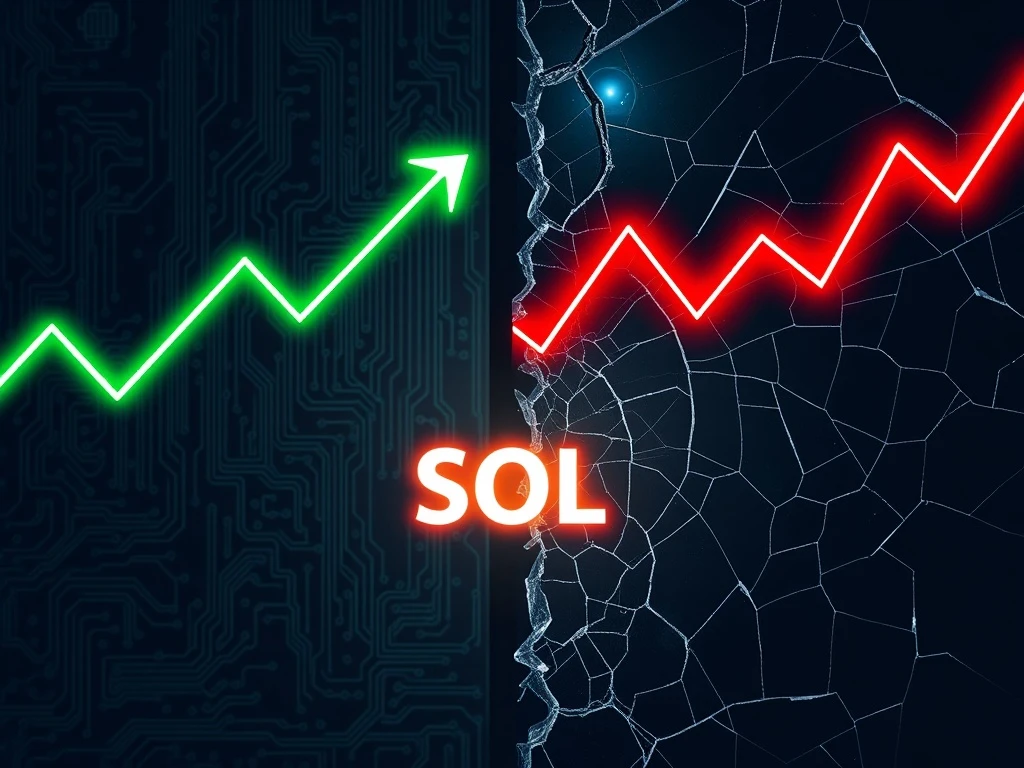
In the volatile landscape of the 2025 cryptocurrency market, Solana (SOL) has entered a decisive phase, testing a crucial support zone between $78 and $80. This technical juncture presents a stark fork in the road for the high-performance blockchain’s native asset. Consequently, market participants and analysts globally are scrutinizing whether this level will catalyze a significant rebound toward the $100 psychological barrier or trigger a deeper corrective phase. The outcome holds substantial implications for network sentiment, developer activity, and broader altcoin market dynamics.
Solana Price Analysis: Decoding the Critical Support Zone
Technical analysts identify the $78-$80 range as a major support confluence for Solana. This zone historically acted as resistance in early 2024 before transforming into support during the latter half of the year. A sustained hold above this level suggests underlying market strength and could provide a foundation for recovery. However, a decisive weekly close below $78 would invalidate this support, potentially accelerating selling pressure. Market data from major exchanges shows increased trading volume around this price, indicating heightened interest from both buyers and sellers.
Furthermore, the broader crypto market context significantly influences Solana’s trajectory. Bitcoin’s dominance and the performance of major indices often set the tone for altcoins like SOL. For instance, a stabilizing Bitcoin above key levels typically fosters risk-on behavior, benefiting high-beta assets. Conversely, macroeconomic factors such as interest rate decisions and regulatory developments continue to inject volatility into the digital asset space, impacting trader psychology.
The Analyst Perspective: Corrective Bounce vs. Trend Continuation
Prominent market analysts offer a nuanced view. Many caution that any price recovery from the $78 support should initially be viewed as a corrective move within a larger downtrend. They argue that without a sustained break above the $100 resistance level, the overall bearish structure remains intact. This perspective relies on classical technical analysis principles, where lower highs and lower lows define a downtrend. A rally that fails at $100 would confirm this pattern.
Conversely, some analysts point to Solana’s robust fundamental metrics. The network continues to demonstrate high throughput and low transaction costs, maintaining its competitive edge. Developer activity, measured by commits to core repositories and new project deployments, remains strong relative to other Layer 1 blockchains. This fundamental health could provide a divergence from purely technical price predictions, potentially leading to a stronger-than-expected rebound if market sentiment shifts.
Historical Fractals and Long-Term Price Scenarios
Some analytical models employ fractal analysis, comparing current chart patterns to past market cycles. These studies suggest a potential scenario where Solana experiences a deeper retracement toward the $30-$50 region before establishing a base for its next long-term bullish cycle. This pattern mirrors corrections observed in previous crypto market epochs, where assets retraced a significant portion of their prior gains to shake out weak hands and consolidate.
It is crucial to contextualize this possibility within Solana’s entire price history. The asset has experienced severe drawdowns before, notably during the network outages of 2022 and the broader crypto winter. Each time, recovery was predicated on both technical factors and fundamental improvements to network stability and adoption. Therefore, while a drop to $30-$50 seems severe, it represents a known risk within the asset’s volatile profile.
- Bullish Scenario: Hold above $78 support, followed by a volume-backed break above $100. This would target resistance levels at $120 and $150, potentially signaling a trend reversal.
- Bearish Scenario: Breakdown below $78 with sustained selling pressure. The next major support zones reside at $65, $50, and the $30-$40 historical accumulation area.
- Neutral/Range-Bound Scenario: Consolidation between $78 and $95 for an extended period, allowing the market to build energy for its next directional move.
Network Fundamentals and Ecosystem Health
Beyond the price chart, Solana’s ecosystem health provides critical context. The network’s performance metrics—including transactions per second (TPS), average fee cost, and uptime—are closely monitored. Significant improvements in network reliability since 2023 have reduced outage risks, a key factor for institutional and developer confidence. Additionally, the growth of decentralized finance (DeFi) total value locked (TVL), non-fungible token (NFT) volume, and consumer-facing applications on Solana contributes to its intrinsic value proposition.
Comparatively, Solana often trades in correlation with other major smart contract platforms like Ethereum, Avalanche, and Cardano, but with higher volatility. Its performance is also tethered to the success of major projects within its ecosystem, such as decentralized exchanges, lending protocols, and meme coin communities that drive retail engagement. A breakdown in price could test the resilience of these ecosystem projects, while a rally could fuel a new wave of innovation and capital inflow.
The Role of Market Structure and Liquidity
Modern market analysis also examines order book liquidity and derivatives data. Current data shows significant liquidity pools just below the $78 level, which can act as a magnet for price if support weakens. Conversely, a large volume of short-term call options are concentrated near the $100 strike price, creating a potential resistance wall. The resolution of these positions will influence short-term price action. Moreover, the funding rates in perpetual swap markets offer clues about trader sentiment—whether it is overly bullish or bearish—which can often act as a contrarian indicator at extremes.
Conclusion
Solana stands at a critical technical inflection point, with the $78-$80 support zone serving as the primary battleground between bullish and bearish forces. The forthcoming price action will likely be determined by a combination of technical breakdowns or breakouts, broader cryptocurrency market sentiment, and the underlying strength of the Solana network’s fundamentals. While analysts debate the potential for a corrective bounce to $100 or a deeper breakdown toward $30-$50, prudent market participants are advised to monitor volume, weekly closes, and key network metrics. This Solana price analysis underscores the high-stakes environment of digital asset markets, where decisive levels often dictate medium-term trends and investor outcomes.
FAQs
Q1: What does ‘critical support’ mean in Solana price analysis?
In technical analysis, ‘critical support’ refers to a specific price level where buying interest is historically strong enough to prevent further decline. For Solana, the $78-$80 zone is considered critical because it has previously reversed downtrends. A break below it on high volume suggests a significant shift in market structure.
Q2: Why is the $100 level important for SOL?
The $100 level is a major psychological and technical resistance barrier. A sustained break above it would invalidate the current pattern of lower highs, which is characteristic of a downtrend. Therefore, analysts view a move above $100 as necessary to signal a potential trend reversal from bearish to neutral or bullish.
Q3: What are ‘fractal studies’ in crypto trading?
Fractal studies involve comparing current price chart patterns to similar patterns from the asset’s past or from other market cycles. The theory suggests that markets exhibit repetitive behaviors. In Solana’s case, some models compare the current structure to past deep corrections, suggesting a potential path toward lower prices before a sustained recovery.
Q4: How do Solana’s network fundamentals affect its price?
Strong network fundamentals—like high transaction speed, low costs, reliable uptime, and growing developer activity—create long-term value and utility. While they may not prevent short-term price declines in a bearish macro environment, they provide a foundation for recovery and can attract institutional investment, ultimately supporting the price over the long term.
Q5: What should investors watch to gauge the next major move for SOL?
Investors should monitor: 1) Weekly closing prices relative to the $78 support, 2) Trading volume on rallies or declines (high volume confirms moves), 3) Broader Bitcoin and market sentiment, and 4) Key network health metrics like daily active addresses and DeFi TVL. The confluence of these signals provides a more complete picture than price alone.