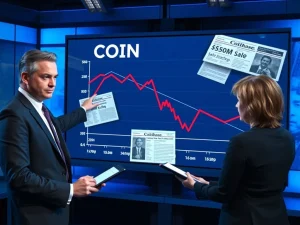
Coinbase CEO’s Staggering $550M Stock Sale Sparks Market Panic and Regulatory Scrutiny

In a move that sent shockwaves through the cryptocurrency and traditional finance sectors, regulatory filings in early 2026 revealed that Coinbase CEO Brian Armstrong executed a staggering $550 million sale of company stock over a nine-month period, a disclosure that immediately triggered a sharp sell-off in COIN shares and intensified debate about insider confidence in the digital asset market’s near-term future.
Analyzing the Coinbase CEO Stock Sale: A Timeline of Transactions
Securities and Exchange Commission Form 4 filings provide a detailed, transaction-by-transaction ledger of executive stock sales. Data shows Brian Armstrong began systematically selling Coinbase Global Inc. (COIN) shares in April 2025. Consequently, he continued these sales through January 2026. Ultimately, the CEO disposed of over 1.5 million shares. The total proceeds from these transactions reached approximately $550 million. Importantly, these sales occurred through pre-arranged trading plans known as 10b5-1 plans. These plans allow corporate insiders to sell predetermined amounts of stock at scheduled times. Therefore, they establish a legal defense against accusations of trading on material, non-public information. However, the sheer scale and timing of the sales inevitably draw intense market scrutiny.
For context, executive stock sales are a normal part of compensation and portfolio diversification. Notably, other tech CEOs like Mark Zuckerberg and Elon Musk have executed large sales. Nevertheless, the magnitude of Armstrong’s disposals relative to his remaining holdings becomes a critical focal point. Furthermore, the sales coincided with a period of significant volatility for Bitcoin and other core crypto assets. This context amplifies market sensitivity to the transactions.
Immediate Market Reaction and Broader Crypto Sector Impact
The market’s response to the disclosure was swift and severe. On the session the data became widely circulated, Coinbase’s stock (COIN) plummeted 13.3%, closing at $146.12. This decline significantly underperformed the broader technology indices. Simultaneously, other crypto-linked equities faced heavy selling pressure. For instance, Bullish, a competitor cryptocurrency exchange, saw its shares drop 8.5% to $24.90. This correlated sell-off suggests the news eroded confidence not just in Coinbase, but in the institutional crypto infrastructure sector more broadly.
The reaction extended beyond exchange stocks. Major cryptocurrency investment firms also adjusted their positions. Most prominently, Cathie Wood’s Ark Invest executed a substantial reduction in its Coinbase holdings. Ark’s funds sold 119,236 COIN shares, worth over $19 million. This selling occurred amid a broader downturn for Bitcoin, which slid toward the psychologically significant $60,000 support level. Analysts immediately debated the causality: Did Armstrong’s sales contribute to Bitcoin’s weakness, or did a softening Bitcoin price environment motivate the CEO’s decision to liquidate stock? The interplay between these events created a feedback loop of negative sentiment.
Expert Perspectives on Insider Selling and Market Signals
Financial analysts and governance experts quickly weighed in on the implications. “While 10b5-1 plans provide a legal framework, the market always reads mega-sales by a founder-CEO as a potent signal,” stated a veteran market strategist from a Wall Street research firm. “When the captain appears to be reducing exposure to the ship, passengers naturally question the vessel’s course, especially in a nascent and volatile industry like cryptocurrency.”
Other experts urged a more nuanced view. They highlighted that Armstrong’s sales could relate to personal financial planning, estate management, or funding new ventures. They also noted his remaining stake in Coinbase is still colossal, aligning his long-term interests with shareholders. However, critics countered that in the crypto space, where leadership vision and belief are paramount marketing tools, the optics of a half-billion-dollar exit are damaging. Historical precedent exists; large insider sales at other tech firms have often preceded periods of stock price stagnation or decline, though not universally.
The Regulatory and Governance Landscape in 2025-2026
This event unfolds within an evolving regulatory environment for both cryptocurrencies and insider trading rules. By 2025, the SEC had implemented stricter reforms to the 10b5-1 plan system. These reforms aimed to prevent abuse by mandating cooling-off periods between plan adoption and the first trade and limiting single-trade plans. Analysts will dissect Armstrong’s plans for compliance with these new, more rigorous standards. Any perceived loophole exploitation would attract severe regulatory and reputational consequences.
Moreover, the crypto industry faces ongoing scrutiny from lawmakers concerned about investor protection. A massive stock sale by its most prominent public-company CEO provides ammunition to skeptics who argue the industry prioritizes insider enrichment over building sustainable, compliant businesses. This narrative could influence pending legislation and regulatory approaches toward digital asset exchanges.
Comparative Analysis: Crypto vs. Traditional Tech Executive Sales
To fully grasp the significance, one must compare this activity to patterns in traditional technology sectors. The table below contrasts key metrics of large CEO sales.
| CEO / Company | Sale Period | Approx. Value Sold | Stock Performance After (6 Months) | Industry Context |
|---|---|---|---|---|
| Brian Armstrong (Coinbase) | Apr 2025 – Jan 2026 | $550 Million | To be determined | High-growth, volatile crypto market |
| Mark Zuckerberg (Meta, 2021) | Full Year 2021 | ~$4.5 Billion | -25% | Tech peak, pivot to Metaverse |
| Elon Musk (Tesla, 2021-2022) | Nov 2021 – Dec 2022 | ~$40 Billion | -40% (from first sale) | Twitter acquisition funding |
This comparison highlights that while Armstrong’s sale is enormous in absolute terms, it follows a pattern of tech founders liquidating holdings. However, the relative youth and regulatory uncertainty of Coinbase’s core business make the market’s reaction more pronounced. Key factors differentiating this sale include:
- Market Maturity: Coinbase operates in a sub-15-year-old asset class, unlike established tech.
- Regulatory Overhang: Constant SEC and CFTC scrutiny creates unique headwinds.
- Asset Correlation: COIN stock is highly correlated to Bitcoin’s price, unlike more diversified tech firms.
Long-Term Implications for Coinbase and Investor Confidence
The enduring impact hinges on several forthcoming factors. First, Coinbase’s next several quarterly earnings reports will be dissected for any signs of slowing growth, margin pressure, or competitive loss that might have been known to the CEO. Second, the company’s communication strategy regarding its leadership’s commitment will be critical. Third, the performance of Bitcoin and the broader crypto market will heavily influence whether this event is viewed as a wise personal trade or a loss of faith.
For investors, the episode serves as a stark reminder of the unique risks in crypto equities. These stocks often act as leveraged bets on underlying digital assets and are susceptible to sentiment shifts driven by insider actions. It underscores the importance of scrutinizing insider transaction filings, not just quarterly financials.
Conclusion
The disclosure of Coinbase CEO Brian Armstrong’s $550 million stock sale represents a pivotal moment for the publicly-traded cryptocurrency sector. While executed through compliant channels, the transaction’s scale during a market-sensitive period triggered a sharp de-valuation of COIN shares and raised fundamental questions about insider perspectives on future growth. The market’s violent reaction, coupled with parallel selling by Ark Invest and Bitcoin’s slump, illustrates the fragile interplay between leadership actions, institutional capital, and digital asset prices. Moving forward, investor confidence will depend on transparent communication from Coinbase, sustained business performance, and the evolving narrative around whether this Coinbase CEO stock sale was a routine portfolio rebalance or a more telling indicator of challenges ahead in the crypto exchange landscape.
FAQs
Q1: Did Brian Armstrong break any laws by selling $550M of Coinbase stock?
A1: Based on available data, the sales appear legal. They were likely conducted under SEC Rule 10b5-1, which allows insiders to set pre-planned trading schedules. The 2025 reforms to these rules aimed to prevent abuse, and compliance with those new standards is a key detail analysts are reviewing.
Q2: Why did COIN stock drop so sharply on this news?
A2: The stock fell 13.3% due to a combination of factors: perceived loss of insider confidence, algorithmic trading triggered by negative news, and broader risk-off sentiment in the crypto sector. Large insider sales are often interpreted by the market as a signal that executives believe the stock is fully valued or facing headwinds.
Q3: What is a 10b5-1 plan, and how does it work?
A3: A 10b5-1 plan is a binding contract or instruction an insider establishes with their broker to automatically execute trades (sales or purchases) at future dates or prices. Its primary purpose is to provide an affirmative defense against insider trading allegations by demonstrating the trades were planned before the insider possessed material non-public information.
Q4: How does this sale affect the average Coinbase user or crypto holder?
A4: For the average user, the direct effect is minimal on day-to-day trading. However, it can indirectly affect the ecosystem by influencing market sentiment and Bitcoin’s price. A sustained drop in COIN stock could also impact Coinbase’s resources for innovation, security, and compliance, though the company remains well-capitalized.
Q5: Has Brian Armstrong sold large amounts of stock before?
A5: Yes, Brian Armstrong has conducted previous stock sales since Coinbase went public in 2021. Executives often sell shares for wealth diversification, tax obligations, or personal financing. The unique aspect of this recent series is its concentrated $550 million value over a nine-month window during a period of market uncertainty.