BlockDAG Private Sale Offers Final Entry Before February 16 Listings as SHIB and SOL Face Critical Bearish Pressure
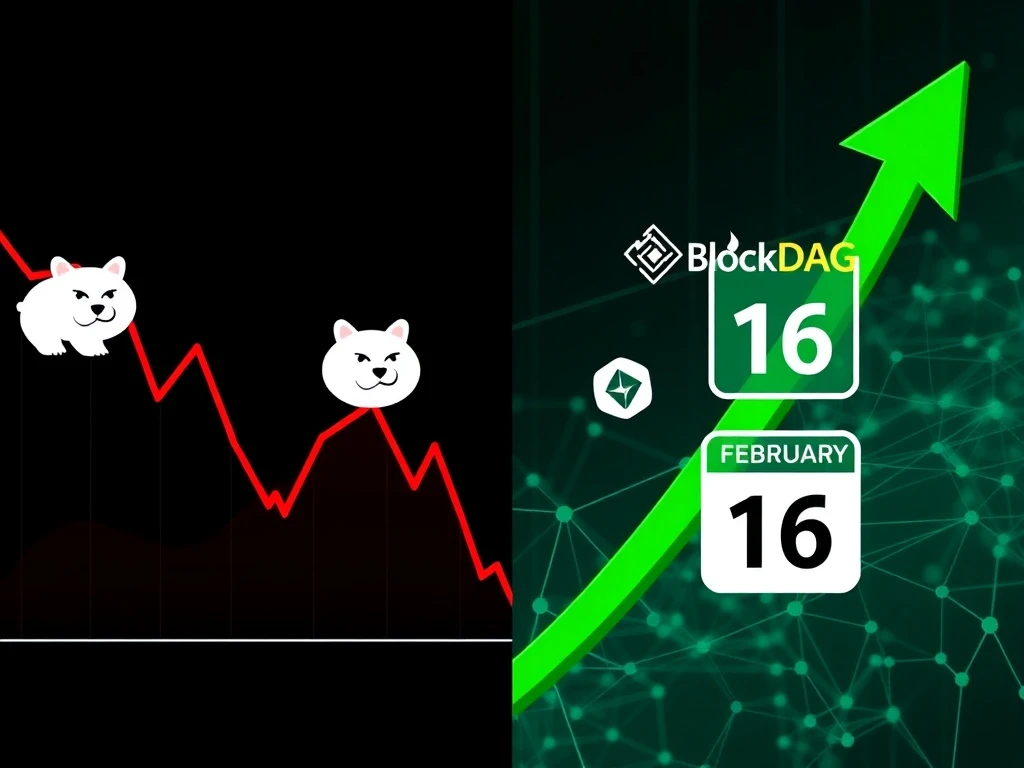
Global cryptocurrency markets are experiencing divergent movements as February 16 approaches, with BlockDAG’s private sale generating significant investor interest while established assets like Shiba Inu and Solana face mounting bearish pressure. This analysis examines the contrasting market dynamics and explores the factors driving these parallel developments in the digital asset space.
BlockDAG Private Sale: Final Opportunity Before Exchange Debut
The BlockDAG network is currently conducting its final private sale phase before scheduled exchange listings on February 16, 2025. This Layer-1 blockchain project utilizes a Directed Acyclic Graph architecture, which theoretically enables higher transaction throughput compared to traditional blockchain structures. According to the project’s technical documentation, BlockDAG aims to address scalability limitations that have challenged earlier blockchain implementations.
Private sale participants receive early access to BDAG tokens at predetermined pricing tiers. The project’s whitepaper outlines a token distribution model with specific allocation percentages for development, ecosystem growth, and community incentives. Market analysts note that similar blockchain projects have experienced significant price volatility following their initial exchange listings, though past performance never guarantees future results.
Understanding the 200× ROI Projection
Investment projections suggesting 200× returns originate from comparative analysis with historical blockchain project performances. However, financial regulators consistently emphasize that cryptocurrency investments carry substantial risk. The Securities and Exchange Commission has issued multiple advisories regarding the speculative nature of digital asset investments. Prospective investors should conduct thorough due diligence and consider consulting financial professionals before participating in any private sale.
Shiba Inu Price Analysis: Technical Indicators Signal Concern
Shiba Inu (SHIB) has entered a pronounced bearish phase according to multiple technical indicators. The meme cryptocurrency, which gained prominence during the 2021 bull market, has declined approximately 42% from its recent high. Trading volume data shows decreased activity across major exchanges, suggesting reduced retail investor interest. Market analysts attribute this trend to several factors including broader market sentiment and shifting investor preferences toward utility-focused blockchain projects.
Technical analysis reveals that SHIB has broken below several key support levels. The 50-day moving average crossed below the 200-day moving average in January 2025, forming what technical analysts describe as a “death cross” pattern. Additionally, the Relative Strength Index (RSI) has remained below 40 for consecutive weeks, indicating sustained selling pressure. These technical developments coincide with reduced social media engagement metrics for the Shiba Inu ecosystem.
| Metric | Value | Change (30-day) |
|---|---|---|
| Price | $0.00000872 | -42.3% |
| Market Cap | $5.14B | -41.8% |
| 24h Volume | $186M | -58.7% |
| RSI (14-day) | 36.2 | Bearish |
Solana Network Developments Amid Market Pressure
The Solana blockchain continues to demonstrate robust technical performance despite facing market headwinds. Network data shows Solana processed approximately 3,847 transactions per second throughout January 2025, maintaining its position among the fastest blockchain networks. However, SOL’s market price has declined approximately 28% from its December 2024 peak, reflecting broader cryptocurrency market trends.
Several developments within the Solana ecosystem warrant attention:
- Network Upgrades: The Solana Foundation implemented version 1.18.12 in January, addressing several performance optimizations
- Developer Activity: Monthly active developers increased by 18% year-over-year despite market conditions
- Institutional Interest: Several traditional finance institutions announced Solana integration pilots for settlement systems
- Regulatory Developments: The SEC’s ongoing classification discussions continue to create uncertainty for SOL and similar assets
Comparative Blockchain Architecture Analysis
Blockchain technology has evolved through multiple architectural generations. Traditional blockchains like Bitcoin and early Ethereum implementations utilize linear chain structures. Solana employs a proof-of-history consensus mechanism combined with proof-of-stake validation. BlockDAG represents a different approach entirely, utilizing a directed acyclic graph structure that allows parallel transaction processing. Each architecture presents distinct trade-offs regarding scalability, security, and decentralization—often described as the “blockchain trilemma” by researchers.
Market Context: Regulatory Environment and Investor Sentiment
The current cryptocurrency market operates within an increasingly defined regulatory framework. The Financial Action Task Force (FATF) implemented updated travel rule requirements in 2024, affecting cryptocurrency exchanges globally. Additionally, the European Union’s Markets in Crypto-Assets (MiCA) regulation entered its final implementation phase in December 2024. These developments have created both compliance challenges and legitimacy opportunities for blockchain projects.
Investor sentiment metrics show notable divergence between institutional and retail participants. The Crypto Fear & Greed Index registered 38 (Fear) as of February 2025, indicating cautious market psychology. However, blockchain analytics firm Chainalysis reported increased institutional allocation to digital assets, particularly through regulated financial products. This institutional interest appears concentrated in established projects with clear regulatory pathways and demonstrated utility.
Risk Assessment Framework for Cryptocurrency Investments
Financial analysts emphasize the importance of structured risk assessment when evaluating cryptocurrency opportunities. Key considerations include:
- Technical Fundamentals: Network security, decentralization metrics, and development activity
- Token Economics: Supply distribution, inflation schedules, and utility within the ecosystem
- Regulatory Compliance: Alignment with existing and proposed regulatory frameworks
- Market Position: Competitive advantages and network effects relative to similar projects
- Team and Governance: Development team experience and decision-making transparency
The cryptocurrency market’s volatility requires investors to maintain appropriate position sizing and risk management strategies. Financial advisors typically recommend limiting cryptocurrency exposure to a small percentage of overall investment portfolios, particularly for assets with limited trading history or unproven economic models.
Conclusion
The cryptocurrency market presents contrasting narratives as February 16 approaches. Established assets like Shiba Inu and Solana face technical and market challenges while emerging projects like BlockDAG generate anticipation ahead of exchange listings. Investors must navigate this complex landscape with careful analysis of both opportunities and risks. The BlockDAG private sale represents one of several developments in the evolving blockchain ecosystem, where technological innovation continues alongside market volatility and regulatory evolution. Market participants should prioritize fundamental research and risk management when considering any cryptocurrency investment.
FAQs
Q1: What is BlockDAG’s technological differentiation from traditional blockchains?
BlockDAG utilizes a Directed Acyclic Graph structure enabling parallel transaction processing, contrasting with linear blockchain architectures. This approach theoretically improves scalability but presents different security considerations that require extensive network testing.
Q2: Why are Shiba Inu and Solana experiencing price declines?
Multiple factors contribute including broader market sentiment, regulatory developments, technical indicator patterns, and shifting investor preferences toward projects with demonstrated utility rather than meme-based or purely speculative assets.
Q3: What risks should investors consider before participating in private sales?
Private sales typically involve illiquid assets, limited regulatory oversight, project failure risk, technological uncertainty, and potential dilution from future token releases. Investors may face extended lock-up periods before accessing their tokens.
Q4: How do exchange listings typically affect cryptocurrency prices?
Historical data shows significant volatility around initial exchange listings, often featuring rapid price appreciation followed by correction periods. However, each listing event has unique characteristics based on market conditions, token distribution, and project fundamentals.
Q5: What regulatory developments are affecting cryptocurrency markets in 2025?
Key developments include MiCA implementation in the EU, updated FATF guidance, SEC classification decisions in the United States, and coordinated international efforts to establish consistent digital asset frameworks across major economies.