Bitcoin Mining Difficulty Plummets 11% in Stunning Network Reset Echoing China Ban Aftermath
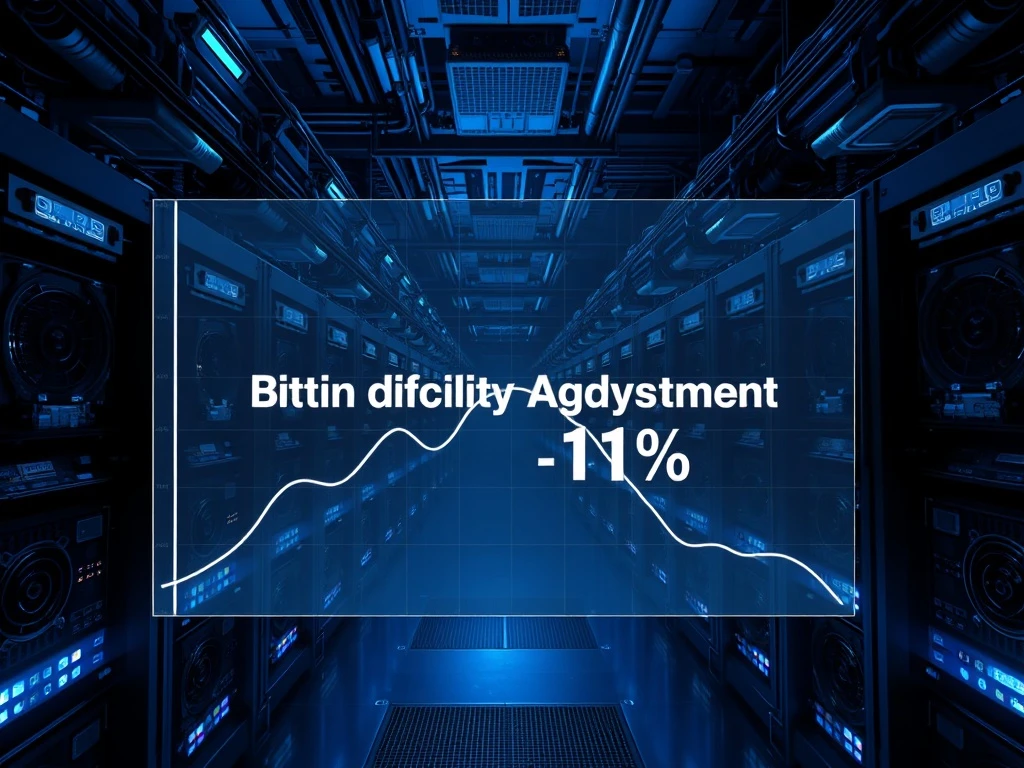
On Saturday, March 15, 2025, the Bitcoin network executed one of its most significant automatic protocol adjustments in nearly four years, with the mining difficulty plummeting by approximately 11%. This dramatic reset, the largest single downward shift since China’s sweeping ban on cryptocurrency mining in mid-2021, directly responded to a sustained and substantial drop in the global hash rate. Consequently, the event has sent ripples through the cryptocurrency industry, highlighting the delicate balance between network security, miner economics, and external real-world pressures.
Bitcoin Mining Difficulty Adjustment Explained
Bitcoin’s mining difficulty is a self-correcting mechanism fundamental to its decentralized design. Essentially, the protocol aims to produce a new block, and thus mint new bitcoin, approximately every ten minutes. The network automatically recalculates this difficulty metric every 2,016 blocks, or roughly every two weeks. If blocks were mined too quickly in the previous period, indicating more computational power (hash rate) had joined the network, the difficulty increases. Conversely, if mining slowed down, the difficulty decreases to make block discovery easier for the remaining miners.
This system ensures long-term stability regardless of how many miners participate. However, a drop of this magnitude signals a rapid and sizable exodus of hash power from the network. Historically, such large negative adjustments are rare and typically follow major geopolitical events or severe market downturns that render mining unprofitable for a significant portion of operators.
Analyzing the Causes of the Hash Rate Decline
The immediate catalyst for this adjustment was a multi-week decline in the total network hash rate. Analysts and mining pool operators point to a confluence of two primary, interconnected factors:
- Sustained Bitcoin Price Pressure: The price of Bitcoin remained below critical profitability thresholds for many miners operating with older, less efficient hardware or higher energy costs. When mining revenue, primarily from block rewards and transaction fees, falls below the operational costs of electricity and infrastructure, miners are forced to power down their machines. This economic pressure had been building for several weeks prior to the adjustment.
- Severe Weather-Related Outages: Unusually harsh winter storms and subsequent flooding in key mining regions across North America, particularly in Texas and the Pacific Northwest, caused widespread grid instability and forced temporary shutdowns. These regions host a significant concentration of the world’s Bitcoin hash rate following the migration from China. The outages were not merely local but substantial enough to impact global network metrics.
Furthermore, the approaching Bitcoin halving, scheduled for April 2024, has created a strategic environment where less efficient miners are exiting early. They are doing this to avoid the sudden 50% reduction in block subsidy that will immediately follow the event.
Expert Analysis and Historical Context
Industry experts quickly drew parallels to the 2021 China mining ban, which triggered a series of downward difficulty adjustments totaling over 28% over two months. “While the catalyst is different—economic and environmental versus geopolitical—the network effect is similar,” noted a report from crypto analytics firm Arcane Research. “The protocol is demonstrating its resilience by automatically rebalancing to maintain block times, but the speed of the hash rate decline is noteworthy.”
Data from Blockchain.com confirms the trend. The seven-day average hash rate fell from over 650 exahashes per second (EH/s) in early February to nearly 550 EH/s by mid-March, representing a drop of over 15%. The following table illustrates recent major downward difficulty adjustments:
| Date | Adjustment Size | Primary Catalyst |
|---|---|---|
| July 2021 | -27.94% | China Mining Ban Exodus |
| March 2025 | ~-11.0% | Price Pressure & Weather Outages |
| December 2022 | -7.3% | FTX Collapse & Market Winter |
Mining economists emphasize that this adjustment provides immediate relief to remaining miners. With lower difficulty, their machines solve blocks more frequently, increasing their share of revenue and potentially restoring profitability for some operations. This could, in turn, stabilize or gradually attract hash rate back to the network.
Immediate and Long-Term Network Impacts
The immediate impact of a lower mining difficulty is faster block production until the next adjustment. This can temporarily increase the rate of new bitcoin issuance and ease network congestion, potentially leading to lower transaction fees for users. However, the core concern revolves around network security.
Bitcoin’s security model is intrinsically linked to its high hash rate. A lower total computational power dedicated to mining theoretically makes the network more vulnerable to a 51% attack, where a malicious actor gains control of the majority of hash power. Nevertheless, security experts consider this risk largely theoretical at Bitcoin’s current scale, as the cost to acquire and run enough hardware to attack the network remains prohibitively high, even after an 11% drop.
The longer-term impact depends on market conditions. If Bitcoin’s price recovers, mining becomes profitable for a broader set of operators, and hash rate will likely rebound quickly, leading to a subsequent upward difficulty adjustment. If low prices persist, the network may see continued volatility in hash rate and further downward adjustments, consolidating mining power among the most efficient, best-capitalized industrial operators.
Conclusion
The 11% drop in Bitcoin mining difficulty serves as a stark reminder of the cryptocurrency’s deep connection to physical realities like energy markets and global climate events. While the protocol’s automated adjustment functioned precisely as designed to maintain block production, the event underscores the economic pressures facing miners in a volatile market. This network reset, the largest since the China ban era, highlights the ongoing geographic and industrial evolution of Bitcoin mining. It demonstrates both the resilience of the decentralized system and its sensitivity to the complex interplay of finance, technology, and the natural environment. The coming weeks will be critical in observing whether this adjustment marks a temporary rebalancing or the beginning of a more prolonged hash rate migration.
FAQs
Q1: What does Bitcoin mining difficulty mean?
Bitcoin mining difficulty is a measure of how hard it is to find a new block on the blockchain. The network adjusts it every 2,016 blocks to ensure a consistent block time of about ten minutes, regardless of changes in total mining power.
Q2: Why did the difficulty drop by 11%?
The difficulty dropped because the total computational power (hash rate) securing the network decreased significantly over the previous two weeks. This was primarily due to miners shutting off unprofitable machines amid low Bitcoin prices and forced outages from severe weather in major mining regions.
Q3: Is the Bitcoin network less secure after this adjustment?
While a lower total hash rate theoretically reduces the cost to attack the network, Bitcoin remains exceptionally secure. The cost and logistics of acquiring enough hardware to launch a 51% attack are still considered prohibitively high for any likely adversary.
Q4: How does this affect transaction fees and speed?
In the short term, with lower difficulty and potentially faster block times, transaction fees may decrease slightly, and confirmations could happen more quickly. This effect is temporary and will rebalance at the next difficulty adjustment.
Q5: What was the largest mining difficulty drop in history?
The largest single downward adjustment occurred in July 2021, falling by nearly 28%. This was a direct result of the Chinese government’s crackdown and ban on cryptocurrency mining, which caused a massive, sudden migration of hash power out of the country.